ETH Price Prediction: What Will Ethereum Be Worth in 2030?
Ethereum has come a long way from being just another altcoin. Today, it sits at the center of a much larger onchain economy, powering stablecoins, decentralized finance, tokenized real-world assets, Layer-2 networks, staking, and a growing range of institutional products. With billions of dollars moving through Ethereum-based applications every day, the network is increasingly being treated less like an experiment and more like financial infrastructure.
But price remains a different story. Ethereum has gone through another volatile cycle in 2026, falling sharply before staging a strong summer recovery. That raises the same big question for long-term investors: What will Ethereum be worth in 2030? Could ETH reach $10,000, $20,000, or even $40,000?
In this article, we look at where Ethereum stands in 2026, the latest long-term ETH price forecasts, and the major forces that could determine how high Ethereum can go by the end of the decade.
Ethereum Today: The 2026 Snapshot
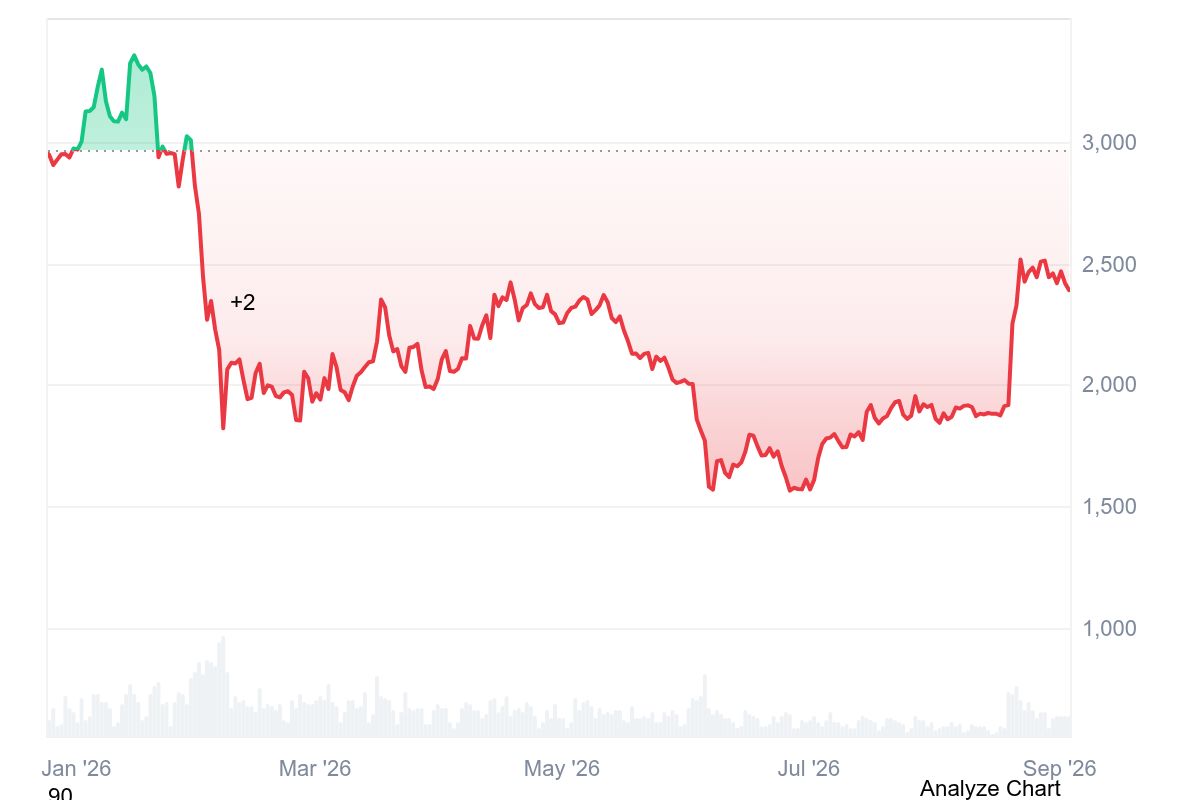
Ethereum (ETH) Price
Source: CoinMarketCap
By mid-to-late 2026, ETH is trading around $2,400, giving Ethereum a market capitalization of roughly $290 billion. The price picture has been volatile. ETH spent much of the first half of 2026 under pressure, but August delivered a sharp turnaround, with Ethereum gaining approximately 32.5% during the month as ETF demand and broader crypto sentiment improved.
Behind the price action, Ethereum itself has continued to evolve.
After the Merge shifted Ethereum to proof-of-stake in September 2022, Shapella enabled staking withdrawals in 2023, Dencun introduced blob transactions in March 2024, and Pectra arrived in May 2025 with major improvements to validator operations and account functionality.
The next major step came with Fusaka on December 3, 2025. Fusaka introduced PeerDAS, allowing validators to sample rather than download all Layer-2 data, while Ethereum's default gas limit was raised to around 60 million. Together, these changes expanded both Layer-1 capacity and the amount of data Ethereum can make available to rollups.
Now attention is shifting toward Glamsterdam, Ethereum's next major upgrade, currently targeted for Q4 2026. It is expected to introduce technologies such as enshrined proposer-builder separation and block-level access lists, laying the groundwork for higher execution capacity and greater parallelization.
Institutional participation has also moved to another level.
U.S. spot Ethereum ETFs have accumulated approximately $13 billion in cumulative net inflows since launch as of September 2, 2026. BlackRock's iShares Ethereum Trust alone held around $8.45 billion in net assets at the beginning of September . Staking-enabled Ethereum investment products have also emerged, bringing ETH staking exposure further into traditional financial markets.
At the protocol level, approximately 42.7 million ETH is now staked, close to 35% of the supply, compared with less than 29% in the original 2025 snapshot. More than 2 million additional ETH is waiting to enter staking, while the validator exit queue is almost empty.
Corporate accumulation has become another new part of the Ethereum story. BitMine reported holding approximately 5.90 million ETH as of August 30, 2026, equivalent to about 4.9% of the stated ETH supply, with more than 5 million ETH already staked.
In short, ETH's price remains volatile, but Ethereum's institutional, staking, and infrastructure footprint is significantly larger than it was a year ago.
How High Can Ethereum Go by 2030?
What will ETH be worth four years from now?
There is still no real consensus. In fact, the gap between conservative and bullish forecasts has widened as analysts debate whether Ethereum's growing use in stablecoins, tokenized assets, DeFi, and institutional finance will translate directly into greater value for ETH.
One of the most bullish institutional forecasts now comes from Standard Chartered. The bank introduced a $40,000 ETH target for the end of 2030, arguing that Ethereum could benefit from expanding onchain finance, stablecoins, tokenization, higher network throughput, and an eventual recovery in the ETH/BTC ratio. The bank reaffirmed that $40,000 long-term target in May 2026 even while reducing its shorter-term expectations for ETH.
VanEck offers a more moderate but still highly bullish scenario. Its updated Ethereum valuation model estimates a $22,000 base-case price by 2030, based on Ethereum becoming an important settlement platform for financial services, digital assets, and other blockchain-based economic activity.
A January 2026 Finder survey provides a more conservative reference point. Its panel of crypto industry specialists produced an average 2030 ETH forecast of $11,712.
That gives investors a remarkably wide spectrum:
-
More conservative expert outlook: around $10,000–$12,000
-
Strong adoption scenario: around $20,000–$25,000
-
Highly bullish institutional scenario: up to $40,000
-
Bearish scenario: ETH may remain far below these levels if Ethereum fails to convert ecosystem growth into greater ETH demand
Why are these forecasts so different?
Ethereum is unusually difficult to value. Unlike Bitcoin, ETH has no fixed maximum supply. Its economics depend on staking issuance, transaction-fee burning, network activity, Layer-2 settlement, application demand, institutional adoption, and ETH's role as collateral.
That means the real question is not simply how many Ethereum users there will be in 2030. It is how much economic value Ethereum can capture from the activity happening on and around its network.
6 Key Drivers That Could Push ETH to New Highs
Ethereum's price in 2030 will not depend on hype alone. It will be shaped by network adoption, technological progress, institutional demand, and whether ETH remains economically important inside the Ethereum ecosystem.
1. Network Adoption
Ethereum remains one of the largest blockchain economies in the world.
As of September 2026, Ethereum supports around $148 billion in stablecoins, nearly $15 billion in active real-world assets, and roughly $48 billion in DeFi TVL. The network is also processing around 2 million transactions per day.
These numbers matter because Ethereum increasingly serves as a settlement layer rather than simply a place for users to trade tokens.
If stablecoin payments, tokenized securities, DeFi markets, and institutional settlement continue growing, demand for Ethereum blockspace and ETH-based collateral could rise with them.
2. Staking and Supply Dynamics
Ethereum staking has reached record levels.
Approximately 42.7 million ETH, or nearly 35% of supply, is currently staked, while another roughly 2 million ETH is waiting to enter the validator set. That removes a substantial amount of ETH from immediately liquid markets.
However, one important part of the Ethereum investment thesis has changed.
ETH should no longer automatically be described as deflationary.
EIP-1559 continues to burn transaction base fees, but Ethereum's much lower fees mean the amount burned can sometimes fall below new staking issuance. Recent data have therefore shown periods of positive ETH supply growth.
The bullish argument in 2026 is less about permanent deflation and more about how much ETH becomes economically locked through staking, institutional products, DeFi collateral, and corporate treasuries.
3. Scalability and Upgrades
Ethereum's roadmap is becoming increasingly focused on scaling both Layer 1 and Layer 2.
Pectra improved wallet functionality and validator efficiency. Fusaka delivered PeerDAS and increased network capacity. Ethereum developers are now working toward Glamsterdam, followed by Hegotá in 2027.
Glamsterdam is particularly important because it aims to restructure block processing and prepare Ethereum for greater parallel execution. Ethereum Foundation researchers have also discussed pushing the gas limit toward and eventually beyond 100 million, with longer-term testing pointing toward much higher capacity.
If Ethereum can scale without sacrificing decentralization and security, the network may be able to support significantly more economic activity by 2030.
4. DeFi, Stablecoins and Tokenized Asset Growth
Ethereum's strongest long-term advantage may no longer be NFTs or even traditional DeFi.
It may be onchain finance itself.
Ethereum currently hosts about $147–148 billion in stablecoins, nearly half of the entire stablecoin market. It also supports almost $15 billion in active tokenized real-world assets according to DefiLlama.
If tokenized funds, stocks, bonds, credit products, commodities, and stablecoin payments grow into trillion-dollar markets by 2030, Ethereum could become one of the core settlement networks connecting traditional finance with blockchain infrastructure.
That is one of the central assumptions behind some of the most bullish long-term ETH forecasts.
5. Institutional Adoption
The institutional Ethereum story is much larger in 2026 than it was when U.S. spot ETH ETFs first launched.
Cumulative U.S. spot Ethereum ETF net inflows have reached about $13 billion, while staking-enabled Ethereum investment vehicles have introduced another potential source of long-term ETH demand.
Meanwhile, corporate Ethereum treasury strategies are becoming large enough to affect supply dynamics. BitMine alone reported owning approximately 5.9 million ETH, or close to 5% of the stated supply, at the end of August 2026.
If ETFs, treasury companies, asset managers, banks, and institutional staking products continue accumulating ETH, a growing portion of supply could move into longer-term holdings.
6. Macro Trends and New Use Cases
Ethereum still trades like a risk asset.
Interest rates, liquidity conditions, inflation, geopolitical risk, Bitcoin's market cycle, and institutional risk appetite can all overwhelm blockchain fundamentals in the short term.
At the same time, Ethereum is expanding into areas that barely existed during previous cycles.
Stablecoin payments, tokenized financial assets, decentralized identity, AI agents, prediction markets, institutional settlement, and machine-to-machine payments could all create new reasons to use Ethereum infrastructure.
Staking adds another dimension. Current Ethereum staking yields are around 2.6% annually, substantially below the 4–6% levels often quoted during earlier stages of proof-of-stake, but still giving ETH a native yield component that most non-staking crypto assets do not have.
If these use cases grow while ETH remains central to security and settlement, Ethereum's addressable market could look very different by 2030.
What Could Stop ETH From Reaching Its Full Potential?
Ethereum's long-term case is strong, but reaching $10,000, $20,000, or $40,000 is far from guaranteed.
Several risks could prevent those forecasts from becoming reality.
1. Fierce Competition
Ethereum no longer has the smart-contract market almost to itself.
High-throughput networks such as Solana and other emerging Layer-1 ecosystems compete aggressively for developers, users, liquidity, and new applications.
If developers increasingly choose competing networks for consumer apps, DeFi, trading, payments, or tokenization, Ethereum may lose some of the network effects built over the past decade.
2. Upgrade Delays or Technical Problems
Ethereum's roadmap is ambitious.
Glamsterdam, Hegotá, parallel execution, higher gas limits, account abstraction, interoperability improvements, and longer-term security upgrades all involve significant engineering complexity.
Ethereum's own development updates emphasize that upgrade timelines remain estimates and may change.
If important upgrades are delayed or introduce unexpected problems, growth could arrive more slowly than bullish valuation models assume.
3. Regulatory Uncertainty
Ethereum has gained significantly more access to regulated financial markets through ETFs and staking products, but global crypto regulation is still evolving.
Rules governing DeFi, stablecoins, staking, tokenized securities, wallets, and blockchain-based financial services could either accelerate institutional adoption or limit it.
Ethereum's long-term valuation therefore depends not only on technology, but also on whether regulators allow major parts of the onchain economy to scale.
4. Security Breaches
Ethereum's base protocol has proven resilient, but much of the value built around Ethereum exists inside smart contracts, bridges, Layer-2 networks, wallets, and decentralized applications.
A major exploit may not technically compromise Ethereum itself, yet billions of dollars in losses could still hurt confidence in the wider ecosystem.
As more financial assets move onchain, the consequences of security failures may also grow.
5. Market Volatility and Liquidity Shocks
Strong fundamentals do not protect ETH from crypto market cycles.
Ethereum has repeatedly experienced drawdowns of 50% or more, including another severe decline leading into 2026.
A global liquidity shock, higher interest rates, falling Bitcoin prices, ETF outflows, or forced deleveraging could send ETH sharply lower even if Ethereum adoption continues growing.
Any 2030 price forecast therefore needs to account for the possibility of several major bull and bear cycles before the decade ends.
6. Layer-2 Growth May Not Automatically Mean Higher ETH Prices
This may be Ethereum's most important valuation debate.
Layer-2 networks make Ethereum cheaper and more scalable, but they can also move transactions away from the main chain. Dencun dramatically reduced the cost of posting Layer-2 data to Ethereum, helping users while reducing some of the fees flowing to the base layer.
That trade-off has become increasingly visible as Ethereum fees and ETH burns have fallen.
In other words, Ethereum can become more useful without automatically becoming more profitable for ETH holders.
The long-term bull case therefore depends on Ethereum finding ways to capture value from a much larger Layer-2 ecosystem through settlement, blobs, staking, collateral demand, and other economic mechanisms.
Ethereum in 2030: Real-World Use Cases That Could Drive ETH Price
By 2030, Ethereum may look much less like a "crypto network" and much more like an invisible financial settlement layer.
Stablecoins are already giving a glimpse of that future. Ethereum currently hosts close to $148 billion in stablecoin value, while tokenized real-world assets on the network are approaching $15 billion.
If this trend continues, banks, asset managers, fintech companies, and payment providers could use Ethereum infrastructure to issue and settle tokenized stocks, bonds, money-market funds, private credit, commodities, and other financial instruments.
Ethereum could also become part of the infrastructure behind AI agents and automated payments. Software agents may eventually need blockchain-based wallets to pay for services, trade assets, purchase computing resources, or interact with other machines without relying on traditional bank accounts.
Digital identity could become another major category. Ethereum-based credentials could allow users to prove identity, qualifications, ownership, or eligibility without exposing unnecessary personal information.
Gaming and digital ownership may continue developing as well, although the industry may look very different from the NFT boom of 2021.
Even in a multi-chain world, Ethereum does not necessarily need to process every transaction directly. Its more valuable role could be serving as the security, settlement, and coordination layer that other networks ultimately connect back to.
If that vision becomes reality, Ethereum's 2030 valuation may depend less on how many people knowingly "use Ethereum" and more on how much economic activity quietly settles through it.
Conclusion: Is ETH a Buy-and-Hold Until 2030?
Ethereum has built a powerful foundation: it remains a major force in DeFi, supports a growing Layer-2 ecosystem, and continues to attract serious institutional capital. With around 35% of its supply staked and upgrades such as Pectra and Fusaka expanding what the network can do, Ethereum is moving beyond its image as simply another crypto asset. It is increasingly becoming infrastructure for stablecoins, tokenized assets, onchain finance, and the wider digital economy. Current forecasts put ETH anywhere from around $10,000 to $40,000 by 2030, depending on how quickly adoption, institutional demand, and network activity continue to grow.
The road to 2030 will not be smooth. Competition is getting stronger, regulation is still evolving, and Ethereum still needs to prove that growth across Layer 2s and onchain applications can translate into lasting value for ETH itself. But if Ethereum succeeds in becoming one of the main settlement layers of the digital economy, today’s price may eventually look very different in hindsight. The real question may not be whether ETH can reach a new all-time high, but just how big Ethereum can become before 2030 arrives.
Don’t just watch ETH move. Register on Bitget and take your place in the market.
Disclaimer: The opinions expressed in this article are for informational purposes only. This article does not constitute an endorsement of any of the products and services discussed or investment, financial, or trading advice. Qualified professionals should be consulted prior to making financial decisions.