Fund Manager: The Fed Has Become a Debt Instrument, Model Predicts Gold at $20,000

Huitong Finance, September 1—— Kevin Smith, founder of Crescat Capital, stated that despite a pullback from the historical high of $5600, the long-term bull market for gold remains strong. The ongoing global expansion of money supply and unsustainable debt will eventually push gold prices to $20,000 per ounce. He believes the Federal Reserve has been captured by fiscal imbalances and is powerless to control inflation, making monetary policy a tool for debt management. Both key macro models (global M2 versus above-ground gold supply, and the gold/S&P 500 ratio) support the $20,000 target. He also noted that exploration mining stocks offer the greatest alpha opportunities.
Although gold prices have seen a significant pullback from historic highs and volatility persists this year, a fund manager still asserts:
Kevin Smith, founder and CEO of Crescat Capital, said that although the rally to an all-time high of $5600 per ounce earlier this year did appear to be overbought, the months-long pullback has not weakened the fundamental monetary forces supporting precious metals. Instead, it has strengthened them.
Three Questions About the Pullback: Why Did It Fall? Is the Fed Effective?
Smith stated: "I think the gold market moved a bit too fast in January and February of this year." He added that a pullback after a strong rally is natural. In his view, two factors drove this pullback: First, the appointment of Federal Reserve Chairman Kevin Warsh, who entered the central bank with a reputation as a hawk; second, the Iran war, which heightened inflation concerns and drove the market to reprice interest rate expectations significantly.
However, Smith noted that the market is now beginning to question whether the Federal Reserve can actually implement the restrictive monetary policies implied by Warsh's statements. He said: "I don’t think the Fed is truly able to combat or control inflation, which is contrary to Warsh’s claims, because I believe, under fiscal imbalances and the need to maintain low rates, they are really trapped by this fiscal-dominant regime."
The Fiscal-Dominant Era: Monetary Policy Becomes a Tool for Debt Management
Crescat made a similar argument in its July report, stating that investors have now priced in an excessively hawkish monetary policy outlook. The company believes the continuously accumulating fiscal imbalance has pushed the US into a fiscal-dominant era, where monetary policy is increasingly used as a tool for debt management rather than a credible mechanism to control inflation. Smith noted that the problem is that the government’s debt burden and record-high deficits make significant interest rate hikes increasingly unsustainable.
He said: "The only way out of the debt-to-GDP ratio issue we’re facing is through growth, but this growth comes with nominal GDP expansion, which includes a large inflation component. I still believe this is a major macro headwind for inflation and a tailwind for gold."
Two Macro Models Support the $20,000 Target
Against this backdrop, Smith said Crescat believes gold prices will ultimately reach $20,000 per ounce. He stated: "Our view is that miner stocks offer the most alpha for gold. We’re in a bullish macro environment for gold, and our target is $20,000."
Crescat’s target is based on two independent macro models. The first model compares the global M2 money supply with the above-ground global gold stock.
Smith said this model assumes that as central banks continue to increase their gold holdings, gold will increasingly reestablish itself as the de facto underpinning of the global monetary system. Even if money creation does not accelerate, he said the current trend still supports the company’s target. He stated: "Just by extending the money supply growth at 7%—that is, with global money supply rising more than 7%, and we believe it will accelerate—you can reach $20,000 in four years."
Crescat’s second model examines gold’s performance relative to the S&P 500, assuming a 50% drop in the US stock market and subsequent sharp devaluation of the dollar. The company pointed out that during the 1930s and 1970s, similar crashes and currency devaluations triggered gold bull markets. Smith said that after a 50% stock market drop, the gold/S&P 500 ratio reaches 5.25, which also implies a gold price of about $20,000, still far below the peak of 7.58 in 1980. Smith stated that, given today’s monetary environment, he doesn’t think the $20,000 target is extreme. He said: "I don’t think our $20,000 price target is crazy."
The Central Bank Prisoner’s Dilemma: The US May Be Forced to Join
Smith added that central bank demand is becoming an increasingly important part of the bullish outlook.
Crescat noted that over the past four years, central banks have purchased around 1,000 tons of gold annually on average—twice the pace of the previous decade. Smith described this trend as a monetary-level prisoner’s dilemma:
He stated that the US may ultimately be drawn into this global gold competition. He said: "If central banks can simply print money to buy gold, that’s a prisoner’s dilemma. If the dollar is to maintain its status as the world’s reserve currency, the US must also join this game."
Genuine Alpha: Mining and Exploration Stocks
Despite Smith’s very bullish outlook on gold itself,
Crescat’s report argued that this year’s pullback in precious metals created an attractive entry point rather than undermined the long-term investment logic. The company stated that despite significant volatility, its valuation models remain intact, describing the pullback as an opportunity for investors to position themselves in the sector. Smith said that exploration companies could ultimately benefit from both rising metal prices and a recovery in M&A activity. Since the last commodity cycle, major producers have underinvested in exploration and mine development, making them increasingly reliant on junior companies to replenish reserves and build project pipelines. He said there are already signs of growing interest from major miners in exploration companies, even though M&A in this sector has yet to reach scale.
Conclusion
In summary, for Smith, the combination of rising global money supply, fiscal dominance, central banks accumulating gold, and years of underinvestment in new mine supply means that the volatility in 2026 has done little to change the long-term opportunity. He said: "There are periods when exploration stocks outperform, but we’ve just come through 17 years of underperformance. The math on their appreciation potential will shock you."
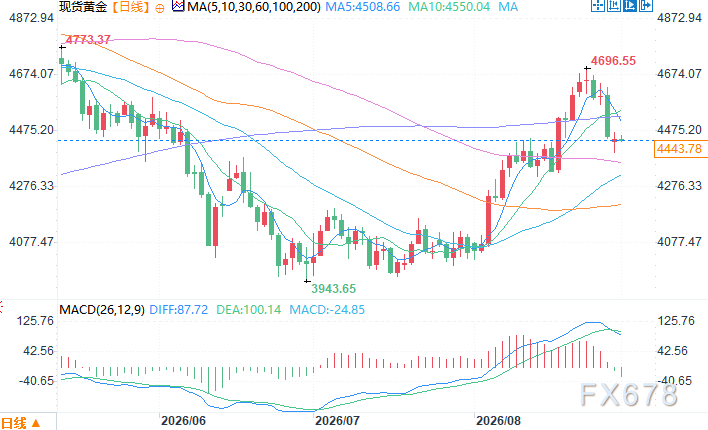
Spot gold daily chart Source: EasyHuitong
GMT+8 September 1, 10:27 (UTC+8) Spot gold is quoted at $4,442.78 per ounce
Disclaimer: The content of this article solely reflects the author's opinion and does not represent the platform in any capacity. This article is not intended to serve as a reference for making investment decisions.
You may also like
Oil prices surge combined with hawkish Fed expectations, gold falls below $4,400
Apple Stock Holds Bullish Trend at $316.85 as Tim Cook Hands Off CEO Role
Crypto sector saw 50 major hacks in August, losses fell 49% to $136 million
Tesla Stock Jumps to $367.95 Ahead of Cybercab Event, but 200-Day Resistance Looms