
Starbucks' New Story in China Is Hard to Tell | Juchao

Written by|Lao Yuer
Editor|Yang Xuran
Observing the latest financial results from Starbucks, there is a subtle sense of division:
On one hand, global same-store sales grew by 7.9%, marking the fourth consecutive quarter of positive growth, with net profit attributable to shareholders reaching about $1.045 billion, a year-on-year surge of 87.2%;
On the other hand, total revenue was about $9.32 billion, a slight decrease of 1.4% year-on-year, and international division revenue plunged by 34% year-on-year.
Behind this stark contrast, where profits soar despite falling revenue, is the key shift of China operations moving out of the consolidated financial statements.
In April 2026, the Starbucks joint venture with Boyu Capital was officially completed, and about 8,000 directly-operated stores in Mainland China were converted to franchising. The revenue recognition changed from full consolidation of directly-operated stores to recognizing only franchise fees and product supply income.
In some sense, this is more like a performance adjustment after "shedding baggage": after spinning off the China market, which accounts for nearly one-fifth of its global stores, from consolidated statements, Starbucks’ profit margin instantly rebounded sharply.
The financial statements look better at headquarters, but the competitive dilemma and operational pressure Starbucks China faces haven't vanished because of a change in equity structure. This American giant, once the very definition of coffee consumption in China, will have to fight harder than ever to survive under siege by local brands.
This is an in-depth value article from the content team at Juchao WAVE. We welcome your attention on multiple platforms.

Performance Contrast
The impact of China business being excluded from Starbucks' global financial statements is most apparent on the revenue side.
The financial report clearly shows that due to the retail business in China transitioning to a new joint venture franchising structure, Starbucks’ consolidated net revenue for the third fiscal quarter declined by 1% year-on-year to $9.3 billion, with the international division's revenue drop almost entirely attributable to the China business exclusion. Excluding this change, the operational data of core global markets is actually steadily improving.
In sharp contrast is the profit explosion. Net profit for the quarter increased by 87.2% year-on-year, and the non-GAAP operating margin improved by 430 basis points to 14.4%.
The simultaneous drop and rise reflect a reality: Starbucks China is no longer the growth engine it once was for the company, but rather a weak link dragging down overall profitability.
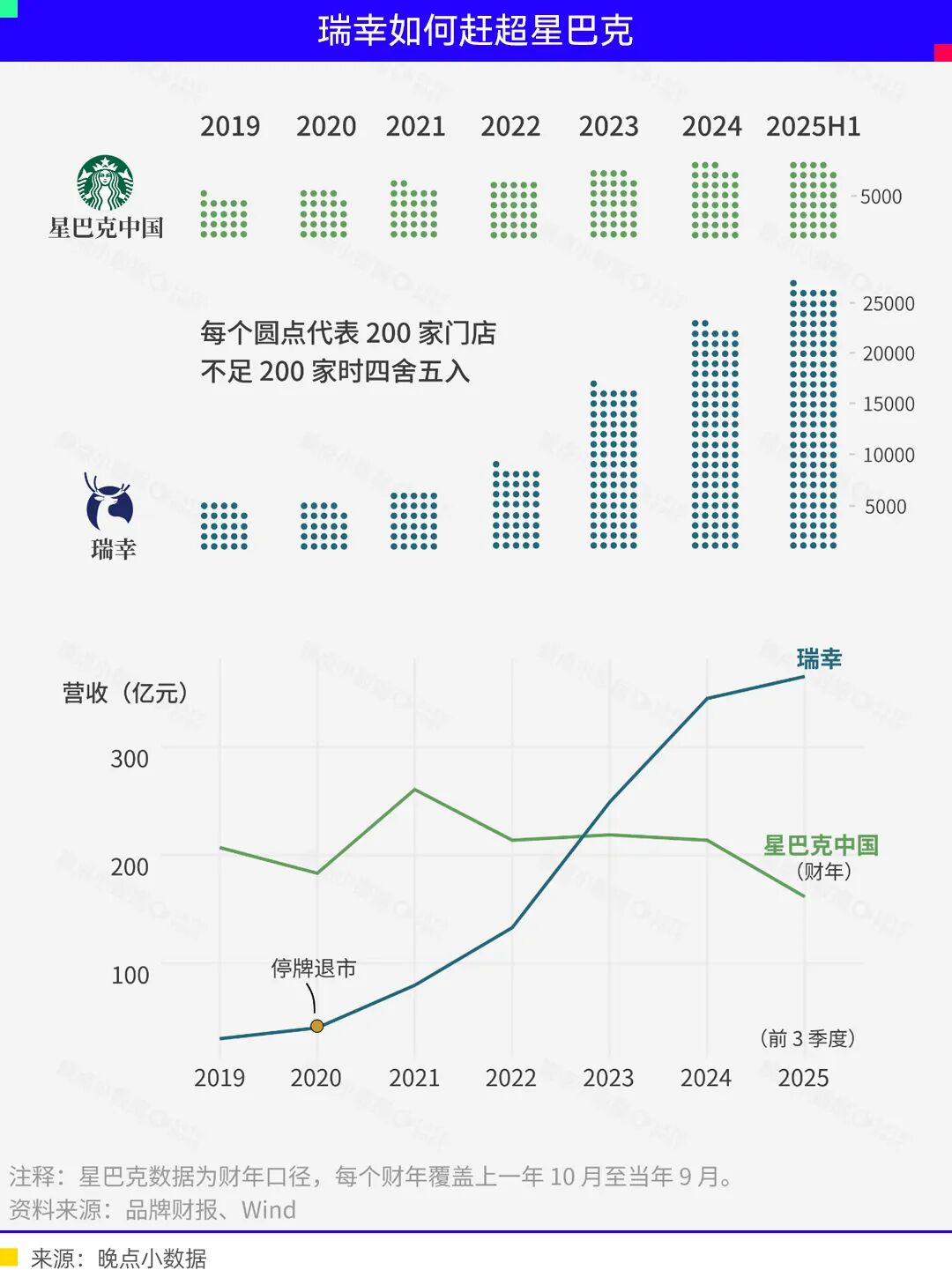
The drag of the China market on Starbucks’ performance (and its eventual decision to divest) had long been evident.
In 2021, Starbucks China reached a revenue peak of $3.7 billion, but since then has stagnated, dropping to about $2.958 billion in 2024 and recovering slightly to $3.105 billion in 2025. In three years, revenue has barely grown at all.
The serious mismatch between store numbers and revenue contribution illustrates the problem more clearly. By the end of the third fiscal quarter in 2026, Starbucks had 41,304 stores globally, including about 8,000 stores in China, accounting for nearly 20%. Yet these nearly one-fifth of stores contribute less than 10% of global revenue.
Market share loss is even more direct. According to Euromonitor, Starbucks’ market share in China’s coffee market dropped from a peak of 42% in 2017 to 14% in 2024. Over seven years, its share evaporated by two-thirds.
Yet during the same period, China's coffee market continued to expand.
According to the 2025 China Urban Coffee Development Report jointly published by the Shanghai Culture & Creative Industries Promotion Association and Hongqiao International Coffee Harbor, the overall size of China's coffee industry reached 313.3 billion RMB in 2024, up 18.1% from the previous year.
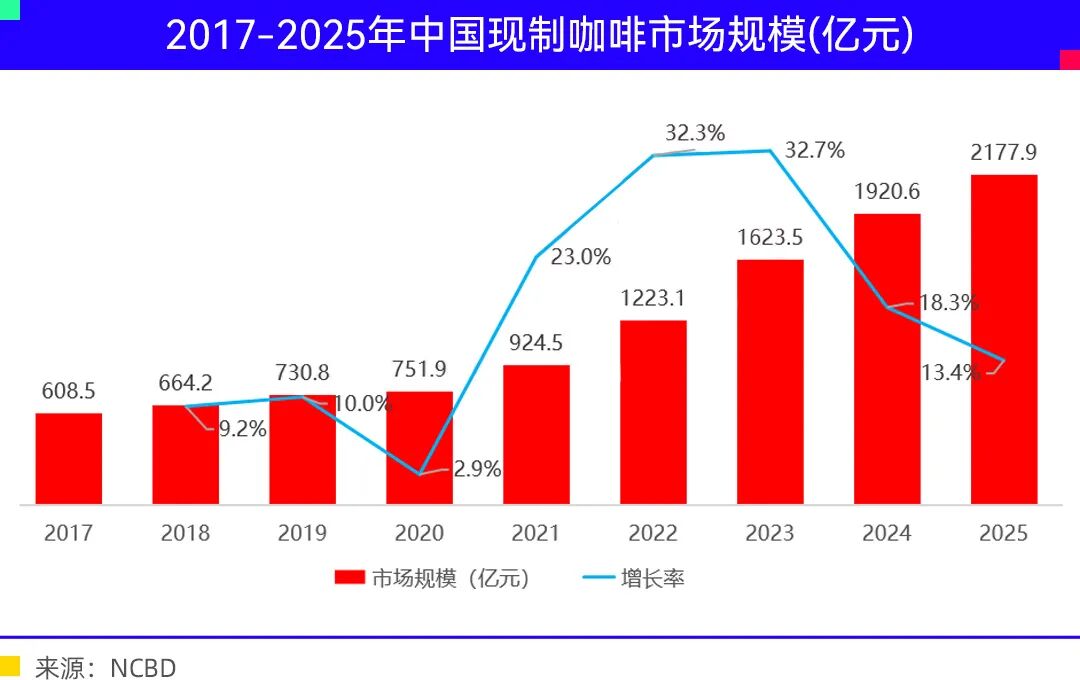
The growth in freshly-brewed coffee, Starbucks' direct competitor, is even clearer. Industry monitors like Canyanbaodian indicate that the market size in China for freshly-brewed coffee reached about 192.06 billion RMB in 2024 and is expected to grow to about 217.79 billion RMB in 2025, more than 13% expansion. The boom of the entire industry contrasts sharply with the revenue stagnation of Starbucks China.
Even more telling is the valuation gap: Market calculations indicate that each Starbucks China store is valued at about $500,000—only about a quarter of the global average store valuation.
The same green logo, the same standard store, but in China, store value is deeply discounted. This reflects the market’s pessimism about its growth potential and profitability.
From the once-highly-anticipated second largest global market to now needing to spin it off for nicer financials, Starbucks’ relationship with China has completely reversed in the span of just a few years.

The Dissolution of a Myth
The Starbucks story in China was once a perfect case of consumer product growth.
In January 1999, Starbucks opened its first mainland store at Beijing’s China World Trade Center. At the time, most Chinese people had little understanding of coffee, and the few who did thought only of Nestlé instant coffee.

Image: Starbucks China Chairperson Liu Wenjuan
To cultivate the market, Starbucks lost money in China for nearly a decade. Rather than rushing to sell coffee, it patiently developed the “third space” concept: home as the first space, office as the second, and Starbucks as a social and leisure spot in between.
This positioning precisely matched the identity anxiety of China’s white-collar workers amid urbanization.
In 2003, an article titled “It Took Me 18 Years of Struggle to Sit and Have Coffee With You” went viral. Its undertone of class made coffee, represented by Starbucks, an icon of elite, bourgeois living. Back then, ordering a coffee and posting a Starbucks window shot on social media was itself a form of social currency.
Starbucks was selling not just coffee, but a socially validated, respectable lifestyle that was a rare badge of identity in a specific era.
This approach brought Starbucks to its peak in 2017. That year, it spent $1.3 billion to buy back Uni-President Group’s equity in the East China region and gained full direct control over the China market. At the same time, its China chain coffee market share reached 42%—nearly half the market.
At that time, Starbucks was the undisputed industry king, defining the price point and consumption scenario of fresh-brewed coffee in China.
But that same year, a transition began quietly. Luckin Coffee was founded in 2017, and from then on, Chinese coffee brands started taking a very different approach: smaller stores, digital operations, and cost-effectiveness as the focus.

Image: Former Starbucks China Chairperson Wang Jingying
The real watershed came in 2023. Cotti Coffee launched a store-wide 9.9 yuan promotion; Luckin quickly followed with weekly 9.9 yuan specials. This full-scale price war engulfed every coffee and new-style tea brand.
When a cup of decent coffee can be had for less than 10 yuan, it’s hard for consumers to pay over 30 yuan at Starbucks. The brand’s former quality moat was quickly flattened by China’s local supply chains.
In 2023, Luckin surpassed Starbucks in annual sales for the first time, becoming China’s biggest coffee chain. The gap has widened since: by the end of 2025, Luckin had over 31,000 stores and annual revenue of 49.288 billion RMB, up 43% year-on-year. Other local brands like Luckin Beer and Nova Coffee have also joined the “10,000-store club.”
Starbucks China’s store count has continued hovering around 8,000, making further expansion difficult.
More importantly, coffee has shed its mystique as a high-end product: it is no longer a symbol of status, but simply a daily beverage.
As coffee has left the altar, Starbucks’ brand premium has lost its strongest foundation.

Model Dilemma
Behind changing market shares is essentially a competition between two business models.
For years, Starbucks insisted on a fully direct-operated model in China. Opening a standard direct-operated store costs 3 to 5 million RMB, and flagship stores in major cities cost even more. Everything from site selection and decor to staff training and daily operations is tightly controlled by headquarters.
This heavy-asset model has clear advantages: the brand’s tone is highly unified, services and quality are stable, and it best maintains a high-end brand image.
But the shortcomings are just as pronounced: slow expansion, high capital lock-in, and persistently high costs. This is why Starbucks struggles to respond to price wars.
With the franchising model, local brands expand much faster than Starbucks can hope to. Through an asset-light approach, they attract more partners and quickly penetrate lower-tier cities and underserved areas, placing stores wherever there is demand.
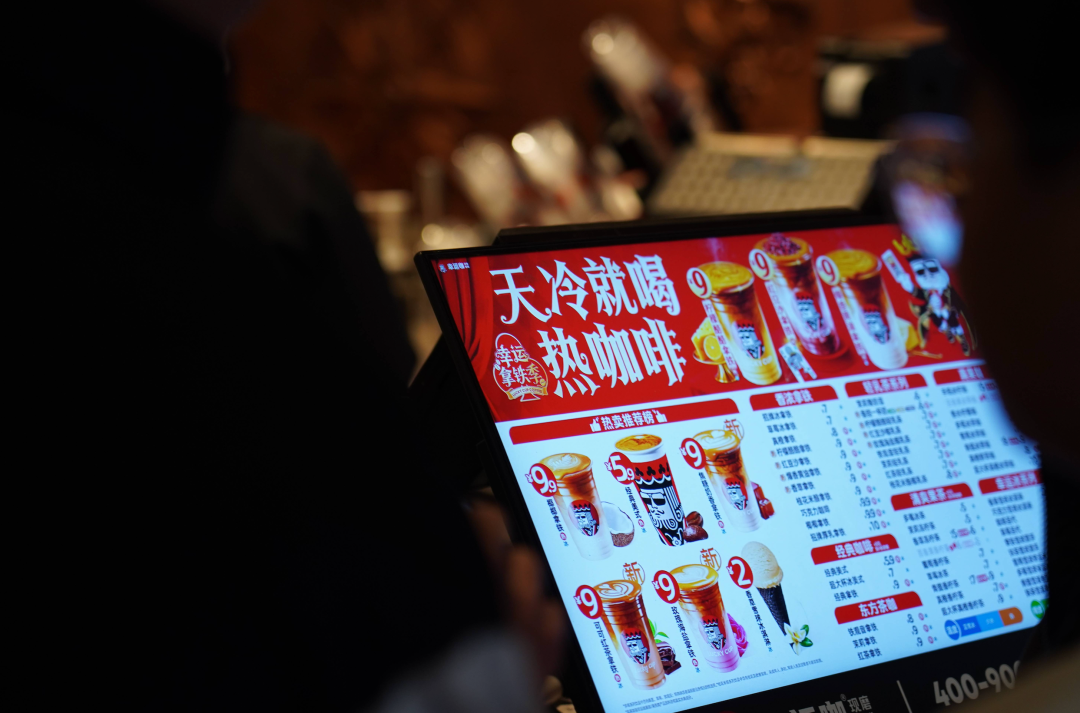
In contrast, after 27 years of direct-operation in China, Starbucks' store count has yet to break 10,000.
After setting up a joint venture with Boyu Capital, Starbucks China is nominally franchised, but in essence, it hasn’t left the direct-operation logic behind.
Currently, the joint venture still operates what used to be direct stores, and the management team and operating model have not fundamentally changed. Starbucks Chairman and CEO Laxman Narasimhan said in June 2026 that they aim to increase the number of China stores from 8,000 to 20,000 with their partner.
The core question is: if the average price remains above 30 RMB, can the spending power in lower-tier markets sustain 20,000 stores? If they lower prices to compete, will it harm the brand value accrued over decades?
Eventually, operational pressure cascades down to frontline employees. The most iconic change is the cancellation of "Bean Stock"—once Starbucks employees’ proudest benefit and core symbol of its “partner culture.”
But according to reports from TechStar, after the joint venture was established, employees with less than a year’s service as well as new hires would no longer be granted Bean Stock. Although vested Bean Stock can be held until the end of 2027, the disposition of unvested portions remains unclear.
Meanwhile, many stores are switching to hourly pay, replacing the previous monthly + 14th month salary system. Some employees say their take-home income has dropped under this system, with fewer full-time positions and a greater proportion of part-time and student workers.
Pressure is also visible in how sales targets are assigned. From Star Ice Rice Dumplings to mooncakes to merchandise and prepaid cards, store staff are continuously handed sales KPIs. Failing to meet these means being warned or having performance pay docked—something increasingly exposed on social media.
Right before the 2026 Dragon Boat Festival, a staff member came under unreasonable customer demands when pressured to sell Star Ice Rice Dumplings—an incident that was publicized.
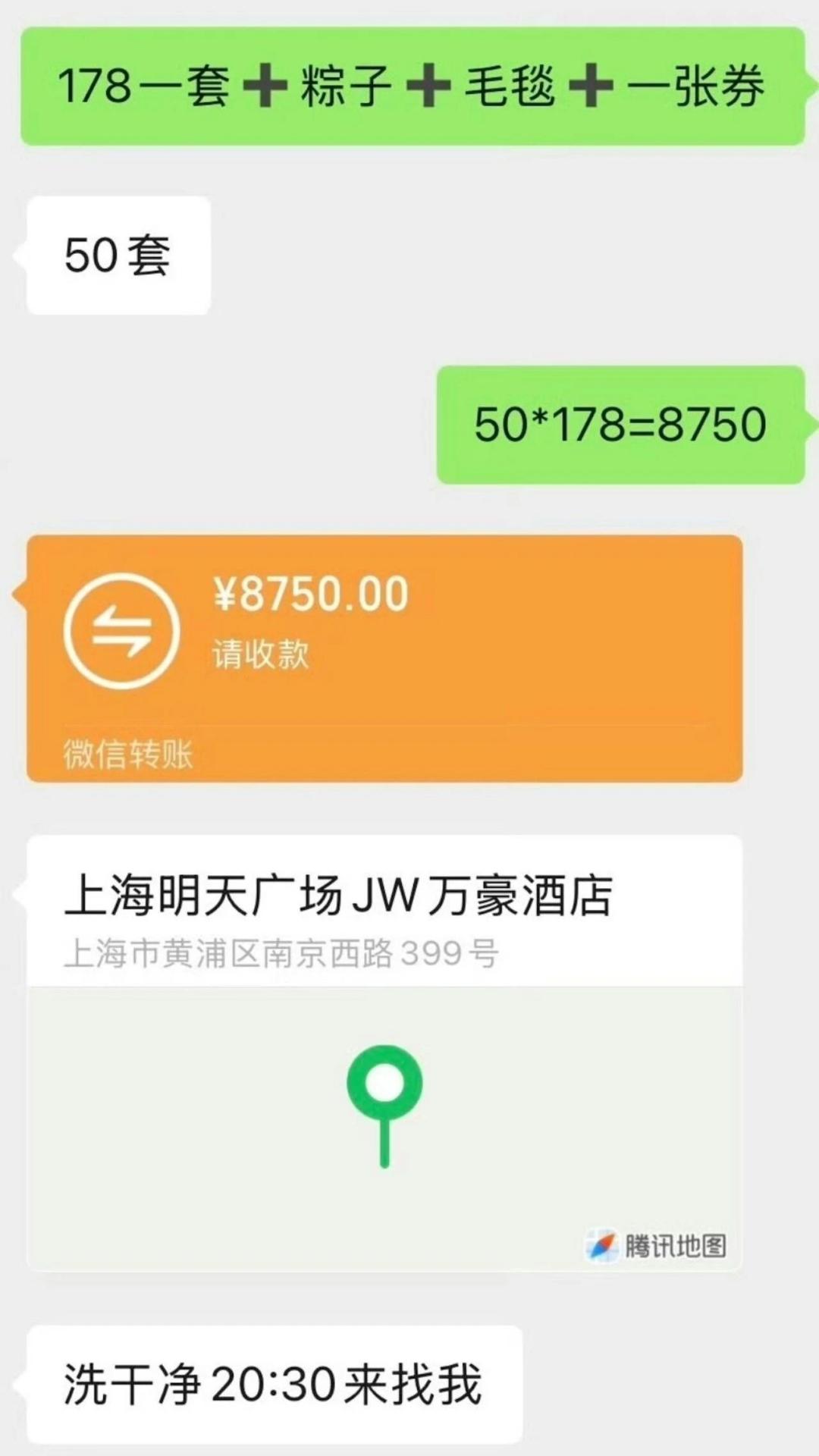
When a coffee company known for spatial experience, status symbol, and high-end image starts forcing frontline employees to sell just to hit performance, the operational pressure is self-evident.

In Conclusion
Removing the China business from consolidated statements does indeed make Starbucks’ global financials look significantly better.
But the problem is that this is more of a financial maneuver than a true strategic breakthrough.
Ultimately, China is not a place where financial engineering alone brings lasting results. Especially as countless Chinese coffee players have already found a more localized, more efficient, and lower-cost way of running the business—something that never occurred in Starbucks’ earlier years here.
The Starbucks China story is far from an easy one. In fact, compared to the China narratives of KFC or McDonald's, it's much, much harder to tell.





Disclaimer: The content of this article solely reflects the author's opinion and does not represent the platform in any capacity. This article is not intended to serve as a reference for making investment decisions.
You may also like
AI "Capital Game": When Major Companies Run Out of Operational Cash Flow
Morgan Stanley believes that the AI arms race among tech giants is triggering a financing crisis: Amazon and Google have negative free cash flow, with Meta about to enter negative territory. Major companies are forced to cut back on share buybacks, issue new shares, and undertake large-scale bond issuance, with on-balance-sheet debt soaring to $770 billion. More hidden are off-balance-sheet commitments totaling $3.1 trillion, which conceal risks. Accounting opacity masks the real burden; if AI returns cannot cover skyrocketing funding costs, this frenzy over computing power could face a collapse crisis.
Robinhood Chain Daily Fees and Revenue Both Clear $4 Million
The Rise of the "Renter Generation" in the US: Preferring Stocks Over Homeownership
XRP draws most questions from wealth managers, Bitwise says


