Apple’s departure from the home hardware market indicates a shift in expertise and investment towards the rising trajectory of Oura’s smart ring.
Smart Rings: The Next Wave in Wearable Technology
When a major tech company steps away from a product category, it often reflects slow market uptake along the technology adoption curve. Apple's recent withdrawal from its Home hardware line highlights a broader transformation in wearables, with innovation now shifting to finger-based devices. Smart rings are moving from a niche novelty to a significant upgrade in wearable infrastructure, with shipments expected to surge 49% in 2025, far outpacing the projected 6% growth for smartwatches.
This trend marks more than just steady progress—it signals a fundamental change in how biometric data is collected. Wearing a ring on the finger allows for more precise health monitoring, thanks to thinner skin and close proximity to major arteries. This enhanced accuracy is crucial for the next era of health and AI, where continuous, high-quality data drives predictive analytics and preventative healthcare.
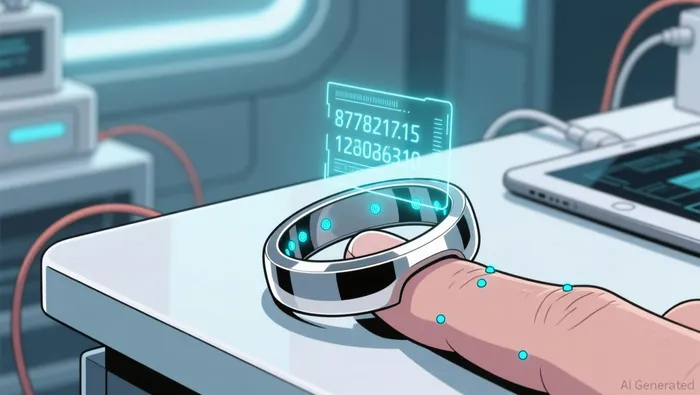
The commercial impact is now unmistakable. Oura, a leader in smart rings, has reached a valuation of $11 billion and is set to achieve $1 billion in sales this year. This revenue, spanning hardware and subscription services, demonstrates the sector's ability to capture substantial market share. Oura's rapid growth—from 5.5 million rings sold since 2015 to nearly three million in 2025 alone—shows adoption is expanding well beyond early enthusiasts.
For investors, the message is unmistakable: the wearable adoption curve is evolving. The wrist is becoming a secondary interface, while the finger is emerging as the primary, discreet sensor. Companies like Oura, which are developing core infrastructure such as AI-driven health advisors and bloodwork integrations, are positioning themselves for explosive growth. The smart ring is not just a new device—it is becoming the backbone of the health data ecosystem.
Talent Migration: Reflecting Competitive Shifts in Wearables
The move of a longtime Apple executive to a fast-growing startup is more than a personnel change; it signals a shift in strategic focus within the wearable technology landscape. Brian Lynch's transition to Oura as SVP of Hardware Engineering exemplifies the migration of talent from established, slower-growing segments to areas experiencing rapid expansion. At Oura, Lynch joins a company on track to generate over $1 billion in revenue this year, offering greater autonomy and impact compared to leading a smart home division that has struggled in the market.
This is not an isolated event. Oura has consistently recruited specialized wearable experts from Apple, including a chief medical officer and a design leader. This ongoing battle for talent underscores the fierce competition in the smart ring segment, where developing advanced health sensors demands deep, specialized engineering expertise. Oura's willingness to invest in top talent—and Apple's executives choosing to leave—reflects a significant shift of human resources toward the most dynamic part of the adoption curve.
For Apple, Lynch's departure adds to a series of recent leadership changes, including key figures in AI and environmental roles. While Apple has internal replacements, the cumulative effect is a loss of specialized knowledge at a critical moment, as the company pushes into smart home technology. Delays in launching its smart home hub, now postponed to September 2026 due to Siri development, highlight the resource challenges and internal friction that can accompany such strategic shifts. In contrast, Oura's successful fundraising—raising $875 million in its latest round—provides the capital needed to scale and retain the talent Apple is losing.
MACD Crossover Long-only Strategy: SPY Backtest Overview
- Entry Criteria: Buy when MACD(12,26,9) crosses above the signal line and the price closes above the 50-day SMA.
- Exit Criteria: Sell when MACD crosses below the signal line, after 20 trading days, or if a take-profit (+8%) or stop-loss (−4%) is triggered.
- Asset: SPY
- Risk Controls:
- Take-Profit: 8%
- Stop-Loss: 4%
- Maximum Hold: 20 days
Backtest Results
- Total Return: -5.73%
- Annualized Return: -2.83%
- Maximum Drawdown: 11.2%
- Profit-Loss Ratio: 1.14
Trade Statistics
- Total Trades: 20
- Winning Trades: 7
- Losing Trades: 13
- Win Rate: 35%
- Average Hold Days: 7.85
- Max Consecutive Losses: 7
- Profit-Loss Ratio: 1.14
- Average Win Return: 1.28%
- Average Loss Return: 1.13%
- Maximum Single Win: 2.31%
- Maximum Single Loss: 2.42%
Competing Adoption Curves: Apple vs. Oura
Ultimately, this is a contest between two different growth trajectories. Apple is attempting to establish a new product category—smart home devices—in a market where it is already lagging, diverting resources from its core strengths. Meanwhile, Oura is attracting the talent and capital necessary to accelerate its own exponential growth in smart rings. Lynch's move is a clear endorsement of Oura's future prospects.
Financial and Operational Divergence: Growth Acceleration vs. Investment Cycle
The strategic gap between Apple and Oura now centers on how each deploys capital and pursues growth. Oura is in the midst of a classic exponential funding phase, recently closing a $900 million Series E round that values the company at $11 billion. This substantial investment is not just financial—it is intended to "accelerate innovation, expand global reach, and set new standards for wearables," according to CEO Tom Hale. This funding enables rapid scaling, research, and market expansion at a pace that established companies struggle to match.
Apple, on the other hand, is funding its smart home delays from its considerable reserves. While it can afford to postpone its hub launch to September 2026 and develop new devices through 2027, it is investing in a market where it is not a leader. The real risk is not financial, but strategic—misallocating resources and talent to a late-entry product, potentially losing the critical first-mover advantage in a space where ecosystem integration is key. The ongoing talent exodus, highlighted by Lynch's departure, exacerbates this risk, shifting expertise from Apple to more nimble competitors.
The heart of this difference lies in the technology adoption curve. The smart ring offers a fundamental infrastructure leap, with its finger placement enabling more precise health monitoring. This accuracy is essential for the next wave of health data. Oura is building this foundation with $1.5 billion in total capital raised, while Apple is trying to establish a new platform on a slower curve. The priorities are clear: Oura is fueling its growth engine with fresh investment, while Apple is navigating an investment cycle in a crowded, mature market.
Key Drivers and Risks: What Will Shape the Wearable S-Curve
The strategic significance of Lynch's departure depends on upcoming milestones. For Oura, the main challenge is converting its large capital raise into sustained growth and technological leadership. The company has already doubled its revenue to $500 million in 2024 and is projected to surpass $1 billion in 2025. The critical metric will be its Q1 2026 shipment numbers, which will indicate whether the ring's adoption curve maintains its 49% growth rate. Additionally, Oura plans to use its new funding to advance AI capabilities in its products. Success in this area would solidify its role as the infrastructure layer for the next health paradigm, turning its $1.5 billion capital raise into a lasting competitive advantage.
For Apple, the pivotal factor is the execution of its delayed smart home strategy. The company has postponed its hub launch to September 2026, with other devices like a home security sensor and advanced robot scheduled for 2027. The performance of these products, especially the hub, will determine if the delays were a necessary investment in a more capable AI platform or a sign of strategic misdirection. If Apple's upgraded Siri and Intelligence can deliver a seamless, predictive home experience, it may still achieve the ecosystem lock-in that smart rings have already established.
In summary, the competition is a race between two adoption curves. Oura must demonstrate it can sustain exponential growth and rapidly develop AI features to secure its lead. Apple needs to prove that its delayed, AI-driven entry can overcome the first-mover advantage and talent loss. The next 12 to 18 months will reveal which company is advancing faster along the wearable technology curve.





