
Bitget:全球日交易量排名前4!
BTC 市场份额59.68%
当前ETH GAS:0.1-1 gwei
热门BTC ETF:IBIT
比特币彩虹图:考虑定投
比特币减半年份:2024年,2028年
BTC/USDT$79088.84 (+0.22%)恐惧与贪婪指数74(贪婪)
山寨季指数:0(比特币季)
比特币现货 ETF 总净流入流出量 +$336.2M(1日);+$2.17B(7日)。Bitget 新用户立享 6200 USDT 欢迎礼包!立即领取
到 Bitget App 随时随地轻松交易!立即下载
Bitget:全球日交易量排名前4!
BTC 市场份额59.68%
当前ETH GAS:0.1-1 gwei
热门BTC ETF:IBIT
比特币彩虹图:考虑定投
比特币减半年份:2024年,2028年
BTC/USDT$79088.84 (+0.22%)恐惧与贪婪指数74(贪婪)
山寨季指数:0(比特币季)
比特币现货 ETF 总净流入流出量 +$336.2M(1日);+$2.17B(7日)。Bitget 新用户立享 6200 USDT 欢迎礼包!立即领取
到 Bitget App 随时随地轻松交易!立即下载
Bitget:全球日交易量排名前4!
BTC 市场份额59.68%
当前ETH GAS:0.1-1 gwei
热门BTC ETF:IBIT
比特币彩虹图:考虑定投
比特币减半年份:2024年,2028年
BTC/USDT$79088.84 (+0.22%)恐惧与贪婪指数74(贪婪)
山寨季指数:0(比特币季)
比特币现货 ETF 总净流入流出量 +$336.2M(1日);+$2.17B(7日)。Bitget 新用户立享 6200 USDT 欢迎礼包!立即领取
到 Bitget App 随时随地轻松交易!立即下载

山寨季指数
在哪里购买交易量最大的加密货币?在 Bitget 上追踪流动性和交易量最大的山寨币。
Bitget 山寨季指数页面提供有关加密货币市场是否处于山寨季的实时分析。查看详细图表和指标,追踪市场动态和山寨币的主导趋势。
当前的山寨季指数:
非山寨季 - 31
过去90天,市值前100的加密货币中,只有31个币种的价格表现超过了比特币,表明加密货币市场目前不处于山寨币主导的阶段。 立即交易
31
比特币季山寨季
历史数据
昨天非山寨季 - 31
7天前非山寨季 - 44
30天前非山寨季 - 55
年度最高值/最低值
年度最高值非山寨季 - 72
2025-09-19
年度最低值比特币季 - 19
2025-12-18
最近更新时间
市值排名前100的山寨币近90天内的价格表现
查看所有币种价格详情
























![BitTorrent [New]](https://img.bgstatic.com/multiLang/coinPriceLogo/c87b5c29752b2123cca40f4dd2c6b6501710522527061.png)


![Sun [New]](https://img.bgstatic.com/multiLang/coinPriceLogo/sun-new.png)







关于山寨季指数
什么是山寨季指数?
山寨季指数是一种工具,用于衡量山寨币(即比特币以外的加密货币)与比特币的相对表现。该工具通过分析历史价格数据和市场趋势,判断市场重心是否转向山寨币,或依然集中在比特币上。
如何识别山寨季?
通常情况下,当特定时间段内(如90天)表现最好的加密货币中绝大多数是山寨币而非比特币时,就被认为出现了山寨季。山寨季指数汇总了这些数据,当山寨币超过比特币表现时,指数分数较高;而当比特币更具主导性时,指数分数则较低。
如何使用山寨季指数?
山寨季指数以各种方式帮助交易者和投资者:
- 识别市场情绪向山寨币转变的信号。
- 根据山寨币的表现调整市场进出时机。
- 根据市场变化调整投资组合。
什么是山寨币市场?
山寨币市场包括所有除比特币之外的加密货币,涵盖如以太坊等成熟代币、去中心化金融(DeFi)中的流行代币以及新兴项目。“山寨币市场”这一术语通常指投资者对这些替代加密货币的兴趣和交易活动。
哪些山寨币值得关注?
以太坊是最具代表性的山寨币之一,因其智能合约功能和强大的开发者社区而受到关注。其他重要的山寨币包括币安币(BNB)、Solana(SOL)和 Cardano(ADA),其各自拥有庞大的用户基础和独特应用。
该指数包含哪些山寨币?以太坊(Ethereum)是否被视为山寨币?
山寨季指数通常包括基于市值和交易量的领先山寨币,如以太坊(Ethereum)、XRP、Litecoin 和 Cardano。是的,以太坊被视为山寨币,因为它不是比特币;它是独立开发的且拥有其区块链,并专注于智能合约。
指数背后的计算方法是什么?
山寨季指数的计算方法通常包括:
- 根据市值和交易量选择一组山寨币。
- 将这些山寨币与比特币在指定时间段(通常为90天)内的表现进行对比。
- 将这些数据编制成一个单一指数值,用以指示当前市场环境是更倾向于“比特币季”还是“山寨季”。
山寨季指数相关文章
DGrid AI (DGAI) Price Prediction 2026, 2027–2030: Can the Rally Continue?
DGrid AI (DGAI) has entered the crypto market with a strong first impression. Shortly after trading began on August 24, 2026, DGAI surged sharply as traders turned their attention to the project's combination of decentralized AI, inference infrastructure, and AI agents. At around $0.70–$0.73 at the time of writing, the token is now trying to establish its first stable market range after an unusually active launch.
Behind the price action is DGrid AI, a decentralized AI smart network designed to give developers and users access to AI models and agents through an open infrastructure layer. Its AI Gateway currently supports 200+ AI models through a unified API, while DGAI acts as the native utility token connecting payments, network incentives, staking, and other parts of the ecosystem.
The early rally has naturally raised a bigger question: can DGAI continue rising after the launch excitement fades? This DGrid AI price prediction looks at possible bearish, neutral, and bullish scenarios for 2026 through 2030 based on the current DGAI price, token supply, ecosystem development, and the broader decentralized AI market.
DGrid AI Price Surges After Launch
DGAI officially opened for spot trading on Bitget on August 24, 2026 at 08:00 UTC, with the DGAI/USDT pair available in the DePIN zone. The token quickly became one of the notable new-market movers following its launch.
DGrid AI (DGAI) Price
Source: CoinMarketCap
Within its first day of broad trading, DGAI climbed about 93% over 24 hours, reaching approximately $0.73 while its market capitalization approached $110 million. Trading activity was also unusually high for a newly launched token, with 24-hour volume exceeding $165 million during the rally. DGAI briefly traded around $0.85, establishing an early price high before pulling back toward the $0.70 area.
Part of the attention comes from timing. AI remains an important crypto narrative, while DGrid combines several themes within that sector, including decentralized inference, AI agents, distributed nodes, and an AI model marketplace. The project's launch therefore arrived in a market already familiar with the idea of bringing blockchain incentives into AI infrastructure.
There were also early signs of interest beyond token trading. DGrid reported selling more than 140 DClaw Boxes within several hours, at 1,580 USDT each. DClaw is designed as a deployment layer for personal AI agents, connecting users with DGrid's broader model and inference ecosystem.
What Is DGrid AI (DGAI)?
DGrid AI describes itself as a decentralized AI smart network built to make AI services more open, transparent, and community-driven. Instead of forcing developers to integrate different AI services separately, DGrid provides a unified infrastructure for accessing models and AI agents.
One of its main products is AI Gateway, which provides access to more than 200 AI models through a single API. DGrid says its infrastructure uses intelligent routing to direct requests between providers based on factors such as performance and cost. The network is designed to combine this access layer with decentralized infrastructure rather than relying entirely on a single centralized provider.
Another important part of the architecture is Proof of Quality (PoQ). The mechanism is designed to evaluate inference results across factors such as accuracy, consistency, and format compliance. This helps DGrid verify the quality of outputs produced by participating nodes before settling network activity.
The wider ecosystem includes AI Gateway, AI Arena, Dori, DClaw, and a marketplace for models and AI agents. AI Arena, for example, uses blind comparisons between AI model responses to collect human preference data, which can then contribute to better model evaluation and routing.
DGAI is the native utility token of this ecosystem. Its planned functions include:
Paying for AI inference tasks and agent services
Staking by network node operators
Rewarding participants that provide resources to the network
Supporting economic incentives across the DGrid ecosystem
Participating in selected protocol governance functions
DGAI has a fixed maximum supply of 1 billion tokens. The token allocation assigns 50% to node incentives, while additional allocations go toward community rewards, the team, investors, airdrops, and liquidity. Node tokens follow a long-term release structure, while several other allocations vest over shorter periods.
Learn more: What Is DGrid AI (DGAI)? The Decentralized AI Smart Network Connecting Models, Nodes, and Users
DGrid AI (DGAI) Price Prediction for 2026
DGAI trades at roughly $0.70–$0.73 at the time of writing, giving us a useful starting point for the forecast. Since the token only began broad trading in August 2026, the remainder of this year will likely be defined by price discovery.
The first challenge is simple: can DGAI hold a meaningful portion of its launch rally once the initial wave of attention settles?
Bearish Scenario: $0.35 – $0.55
If early holders take profits and launch-driven demand cools quickly, DGAI could retrace toward $0.35–$0.55. A weaker overall crypto market or declining interest in AI tokens could increase the downside pressure.
Such a correction would not necessarily mean the DGrid project had failed. New tokens frequently experience large swings while the market searches for a sustainable valuation.
Neutral Scenario: $0.60 – $0.85
Under more balanced conditions, DGAI could spend much of the remainder of 2026 between $0.60 and $0.85. This scenario assumes that the initial rally cools without completely reversing and that interest in DGrid's ecosystem remains relatively stable.
The upper end of this range would also bring DGAI back toward its early trading high around $0.85, making that level an important first benchmark.
Bullish Scenario: $0.90 – $1.20
If DGAI regains its early high, attracts sustained liquidity, and benefits from continued growth in the AI crypto sector, the price could push toward $0.90–$1.20.
In this scenario, $1 becomes the obvious psychological target. From a reference price of $0.73, reaching $1 would require an increase of roughly 37%, making it achievable during a strong market but far from guaranteed.
DGrid AI Price Prediction for 2027
By 2027, the market should have considerably more information about DGrid than it does today. Rather than focusing primarily on the token launch, investors may begin looking at actual AI inference usage, developer activity, node participation, AI agent adoption, and DGAI demand.
Token supply may also become more important. With only about 150 million of the maximum 1 billion DGAI currently circulating, future emissions could create additional selling pressure unless network demand expands alongside supply.
Bearish Scenario: $0.28 – $0.50
If network adoption develops slowly, AI-token sentiment weakens, or new token supply exceeds market demand, DGAI could fall toward $0.28–$0.50.
Neutral Scenario: $0.55 – $0.90
With steady product development and moderate adoption, DGAI could trade between $0.55 and $0.90. This assumes DGrid continues operating and expanding without achieving explosive growth.
Bullish Scenario: $0.95 – $1.35
If DGrid demonstrates meaningful growth in users, AI inference activity, nodes, and ecosystem applications, DGAI could move toward $0.95–$1.35. Holding above $1 would be more significant at this stage because the price would increasingly need to be supported by ecosystem development rather than launch momentum alone.
DGrid AI Price Prediction for 2028
By 2028, DGrid may face a different market. Decentralized AI could be a much larger industry, but competition for users, developers, models, and computing resources could also become more intense.
For DGAI, simply being associated with AI may no longer be enough. DGrid would need to demonstrate why users should actually choose its infrastructure.
Bearish Scenario: $0.25 – $0.45
If decentralized AI develops more slowly than expected or DGrid struggles to differentiate its services, DGAI could trade between $0.25 and $0.45. Growing circulating supply could add further pressure.
Neutral Scenario: $0.60 – $1.00
If DGrid maintains steady ecosystem activity and finds a sustainable position in the decentralized AI market, DGAI could remain around $0.60–$1.00.
This scenario is intentionally conservative. A token does not automatically become more valuable every year. If circulating supply increases while demand grows at a similar pace, DGAI could remain relatively close to today's valuation even as the network itself expands.
Bullish Scenario: $1.10 – $1.60
If decentralized inference sees broader adoption and DGrid captures a meaningful share of that growth, DGAI could move toward $1.10–$1.60. Stronger usage of AI Gateway, DClaw, AI agents, and other ecosystem products would make this scenario more credible.
DGrid AI Price Prediction for 2029
By 2029, DGrid should have several years of operating history. This could make fundamental metrics much more useful than they are today.
Instead of asking whether DGAI can repeat its launch rally, the market may be asking how much real economic activity flows through the network.
Bearish Scenario: $0.22 – $0.40
DGAI could fall toward $0.22–$0.40 if ecosystem growth stalls, competition increases, or token demand fails to absorb additional supply.
Neutral Scenario: $0.65 – $1.10
If DGrid develops a sustainable base of developers, users, AI models, and node operators, DGAI could trade between $0.65 and $1.10. This would represent gradual growth rather than assuming an aggressive AI-driven valuation.
Bullish Scenario: $1.20 – $1.90
If AI agents and decentralized inference become significantly larger markets, DGrid could benefit from stronger demand for its infrastructure. Under such conditions, DGAI could reach approximately $1.20–$1.90.
For this scenario to become sustainable, higher prices would ideally be accompanied by higher network usage rather than speculation alone.
DGrid AI Price Prediction for 2030
Forecasting any cryptocurrency several years ahead is difficult. Forecasting one that only began broad trading in August 2026 involves even more uncertainty.
By 2030, DGAI's value will probably depend far less on its launch story and much more on whether DGrid has become useful infrastructure for AI applications.
Bearish Scenario: $0.20 – $0.38
If DGrid remains operational but adoption fails to reach expectations, DGAI could trade below its current price even several years from now. Higher circulating supply without equivalent demand growth would be one major risk.
Neutral Scenario: $0.70 – $1.20
If DGrid achieves sustainable but moderate adoption, DGAI could trade between $0.70 and $1.20 by 2030.
This range may appear conservative for a four-year forecast, but it reflects an important point: price growth is not guaranteed simply because the network grows. Token emissions, competition, broader crypto cycles, and changing market valuations all matter.
Bullish Scenario: $1.40 – $2.20
If DGrid develops into a widely used decentralized AI infrastructure network, supported by substantial inference activity and an active ecosystem of nodes, developers, models, and AI agents, DGAI could potentially reach $1.40–$2.20.
A price of $2.20 would imply a valuation of around $2.2 billion if the full 1 billion-token supply were circulating. That is a much larger valuation than DGrid commands today and would therefore require significant ecosystem expansion.
Targets such as $5 cannot be ruled out in a highly speculative crypto market, but they are difficult to justify as a neutral forecast at this early stage. At full supply, $5 per DGAI would imply a $5 billion valuation.
DGrid AI Price Prediction 2026–2030
Year
Bearish Scenario
Neutral Scenario
Bullish Scenario
2026
$0.35 – $0.55
$0.60 – $0.85
$0.90 – $1.20
2027
$0.28 – $0.50
$0.55 – $0.90
$0.95 – $1.35
2028
$0.25 – $0.45
$0.60 – $1.00
$1.10 – $1.60
2029
$0.22 – $0.40
$0.65 – $1.10
$1.20 – $1.90
2030
$0.20 – $0.38
$0.70 – $1.20
$1.40 – $2.20
Because DGAI has only just begun trading, its future valuation remains especially sensitive to market conditions, liquidity, adoption, and token supply.
Key Factors Influencing DGrid AI's Future Price
The launch rally has put DGAI on the radar, but what happens next will depend on more than momentum. Several factors could determine whether DGrid AI can turn its strong debut into a sustainable longer-term market.
Network Adoption: DGrid ultimately needs people to use its infrastructure. Growth in AI inference requests, developers, users, active nodes, and applications could provide stronger fundamental support for DGAI.
AI Gateway and Model Usage: DGrid's AI Gateway currently provides access to more than 200 models through one API. If developers increasingly use the gateway to access and route AI workloads, the project could move from an interesting concept to infrastructure with measurable demand.
DGAI Token Utility: DGAI is designed for inference payments, staking, node incentives, and other network functions. Greater network activity could therefore increase the practical use of the token. However, utility needs to translate into actual demand to affect price over the long term.
DClaw and AI Agent Growth: DClaw gives DGrid another route into the expanding AI-agent market. If personal and autonomous AI agents become widely used, easier deployment and access to multiple underlying models could become an important part of the DGrid ecosystem.
Token Supply: This may be one of the biggest variables in any DGAI forecast. The maximum supply is fixed at 1 billion tokens, while only a fraction is currently circulating. DGrid's token distribution includes long-term node emissions as well as vesting schedules for other allocations, meaning investors should watch both demand and future supply.
Liquidity and Market Access: Deeper liquidity can make DGAI easier to trade and potentially reduce extreme price swings. Bitget opened DGAI/USDT spot trading on August 24, providing users with access to the token shortly after its launch.
The Decentralized AI Narrative: DGrid operates in one of crypto's most closely watched technology sectors. Continued growth in AI agents, model marketplaces, decentralized inference, and distributed computing could support interest in projects such as DGrid. A slowdown in the AI narrative could have the opposite effect.
Competition: AI infrastructure is a highly competitive market, both inside and outside crypto. DGrid will need to compete on inference cost, performance, reliability, model selection, developer experience, and incentives if it wants to build sustainable market share.
Broader Crypto Market Conditions: DGAI will not trade in isolation. Bitcoin cycles, altcoin demand, global liquidity, macroeconomic conditions, and overall risk appetite can all push DGAI significantly above or below valuations suggested by project fundamentals alone.
Can the DGrid AI Rally Continue?
DGAI has certainly made a loud entrance. A roughly 93% 24-hour jump, high trading volume, an early price peak around $0.85, and growing attention around decentralized AI gave the token plenty of momentum immediately after launch.
The harder part starts now.
Once the initial price-discovery phase settles, DGAI will need fresh reasons for buyers to remain interested. The first technical and psychological benchmark is the $0.85 area, which represents the early high. Above that, $1 is the clearest milestone to watch. At a reference price around $0.73, DGAI would need to gain approximately 37% to reach $1.
A move above $1 is therefore possible, but it should not be treated as inevitable. Sustained upside would be more convincing if it comes alongside stronger DGrid usage, additional developers, greater inference activity, wider adoption of its AI products, and continued demand for DGAI within the ecosystem.
The supply side deserves equal attention. With a large portion of DGAI's 1 billion maximum supply still outside circulation, future token releases could limit price appreciation unless demand grows fast enough to absorb them.
In short, the rally can continue, but the next phase will need more than launch hype. DGAI has attracted the market's attention. The question for the months ahead is whether DGrid can turn that attention into usage.
Conclusion
DGrid AI has started its market journey with considerable momentum. DGAI's sharp post-launch rally, strong initial trading activity, and exposure to decentralized AI have quickly made it a token worth watching. More importantly, DGrid already has an ecosystem built around AI model access, inference routing, quality verification, AI agents, and a native token designed to connect these activities.
For the remainder of 2026, a neutral DGAI price range of $0.60–$0.85 appears reasonable based on the current price around $0.73 and the token's very limited trading history. By 2030, a neutral range of $0.70–$1.20 assumes that DGrid continues developing and attracts sustainable usage while the market absorbs future token supply. A stronger adoption cycle could push DGAI toward $1.40–$2.20, while weaker demand or heavier supply pressure could produce significantly lower prices.
DGAI's launch has answered one question: traders are interested. The longer-term question is more important. Can DGrid turn that early attention into a decentralized AI network people consistently use? The answer will likely determine whether today's rally becomes the beginning of a larger trend or simply one of the token's first major swings.
Disclaimer: The information provided in this article is for educational purposes only and does not constitute financial or investment advice. Cryptocurrency markets are highly volatile, and price predictions are speculative. Always conduct your own research and consider your financial situation and risk tolerance before making investment decisions.
Bitget 学院2026-08-25 17:32
Aug ‘26 Bitcoin Price Surge Explained: Causes & Prediction
The global cryptocurrency market experienced a dramatic surge as the price of Bitcoin (BTC) jumped over 13% in a two-day rally. The digital asset broke through key resistance barriers to reach above $77,000. This sudden move snapped weeks of low volatility and lateral trading.
To understand why this happened, we must examine macroeconomic shifts in the traditional financial sector, structural trading mechanics on crypto exchanges, and what market analysts predict for the coming months.
The Root Cause: The $100,000 Dilemma and Yield Pressures
To understand why crypto markets suddenly sprang to life, one must look at the bond market. Capital had been locked out of high-risk assets because safe returns had reached levels not seen in almost two decades.
On August 18, the yield on the 30-year U.S. Treasury bond hit a 19-year peak of 5.33%. From an investor's perspective, if the U.S. government guarantees a 5.33% annual return risk-free for 30 years, there is little incentive to allocate capital into volatile assets like Bitcoin. The money simply stayed put.
Interest rates spiked because foreign buyers were stepping back:
- Japan’s Capital Return: Japan, historically the largest foreign holder of U.S. debt, saw its own 10-year bond yield rise to 2.9%—its highest level since 1996. Japanese investors began keeping their money at home where yields were finally attractive.
- China’s Reduced Holdings: China continued its multi-year trend of paring down U.S. debt holdings, leaving long-term U.S. bond auctions with weak demand and forcing yields higher to attract buyers.
With fewer foreign buyers for long-dated American debt, long-term borrowing costs soared. The SEC introduced a draft regulatory rule that same week, but the crypto market did not even react. Investors had no spare cash to take on risk while high yields locked up global capital.
The Catalyst: U.S. Bond Interventions and Dollar Debasement Concerns
The spark that lit the rally came directly from the traditional debt market. Reports indicated that the U.S. Department of the Treasury expanded buyback programs for long-term government bonds. The goal of this move was to stabilize surging yields and relieve pressure on the sovereign bond market.
The turning point arrived on August 19. U.S. Treasury Secretary Scott Bessent announced a major policy shift: the Treasury would double its liquidity support bond buyback operations, scaling up from $2 billion to at least $4 billion per operation for long-dated bonds (10-year to 30-year maturities).
When a sovereign government buys back its own long-term bonds, it steps in as its own creditor. The immediate impact was clear: 30-year bond yields pulled back to 5.19% on the news. Though investors had spent months waiting for the Federal Reserve to cut interest rates, the Treasury effectively executed a rate intervention on its own.
Also, when a central bank or government treasury steps in to purchase its own long-term bonds, it effectively suppresses borrowing costs. However, investors often view this intervention as a soft form of currency debasement—meaning the purchasing power of the fiat currency (in this case, the U.S. dollar) risks being diluted over time.
When traditional fiat currencies face inflationary pressure or government interventions, capital naturally seeks alternative stores of value. Gold saw an immediate jump of over 3%, while Bitcoin,often dubbed "digital gold" due to its hard-coded cap of 21 million coins, saw a massive influx of capital, surging 13% across the same two-day window.
Market Mechanics: Liquidations and Forced Buying
While macroeconomic news lit the fuse, the speed and scale of the price spike were heavily driven by market mechanics—specifically, short liquidations on derivative exchanges.
In financial markets, traders can take two primary positions:
- Long positions: Betting that the asset's price will rise.
- Short positions: Borrowing the asset to sell it, betting that the price will fall, so they can buy it back cheaper later.
Prior to the news, many leverage-heavy traders had opened short positions, expecting Bitcoin to break lower toward the $62,000 support level. When the sudden news caused prices to tick upward instead, these short sellers faced automatic forced closures (liquidations) by exchange risk systems.
To close a short position, the system must automatically execute a buy order. This triggered a feedback loop known as a "short squeeze":
- BTC price rises unexpectedly due to macro news.
- Short positions start incurring heavy losses.
- Automated liquidation engines force-buy Bitcoin to cover these short positions.
- Massive forced buying drives the price even higher, triggering the next batch of short liquidations.
Over the course of the two-day rally, more than $3.1 billion in short positions were liquidated across the digital asset space. This cascade of forced buying amplified what might have been a modest 3% bounce into a full-scale rally above $77,000.
Broader Market Impacts
The sudden movement in Bitcoin had widespread effects across the broader digital asset ecosystem and equity markets:
- Altcoin Momentum: Major alternative cryptocurrencies mirrored Bitcoin's momentum. Ethereum (ETH) climbed over 4.4% to trade near $2,390, lifting the overall global crypto market cap by roughly 6.6% to $2.6 trillion.
- Crypto Equity Divergence: Interestingly, institutional software and mining companies heavily exposed to crypto—such as MicroStrategy and Bitmine Immersion—initially lagged or faced pressure during Wall Street trading hours prior to the overnight breakout, highlighting a temporary divergence between spot asset prices and crypto-adjacent stock valuations.
- Derivatives Reset: The wipeout of $3.1 billion in short leverage reset open interest metrics across major exchanges. This effectively cleared out excess speculative leverage and re-established a cleaner foundation for spot-driven trading.
Market Predictions and Outlook
Despite the dramatic price spike, analysts remain divided on whether this move marks the start of a sustained bull run or merely a temporary liquidity bounce.
The Bullish Case
Proponents argue that bond market interventions mark the beginning of a broader global monetary easing cycle. If central banks continue to intervene to cap interest rates, hard assets like Bitcoin and gold are likely to continue attracting capital allocations from institutional funds seeking a hedge against fiat currency devaluation. Furthermore, clearing out heavily shorted leverage allows the spot market to build a base around higher support levels.
The Cautious Case
Conversely, macro-analysts urge caution. A significant portion of this rally was fueled by forced short liquidations rather than purely organic spot market buying. On-chain metrics show that trading volumes on major exchanges flattened slightly following the squeeze, suggesting that fresh institutional buy orders must arrive to keep prices elevated. If Bitcoin fails to consolidate above key support zones, the market could re-enter a consolidation phase as traders digest the economic outlook.
Conclusion
This recent rally proved that Bitcoin does not move in a vacuum of speculative hype. Instead, it sits at the intersection of global sovereign debt dynamics, treasury operations, and market leverage. When the U.S. government stepped in to absorb its own long-term bonds, it inadvertently lowered yields and activated a self-reinforcing liquidity loop that propelled capital directly into digital assets.
For investors navigating these macro-driven cycles, execution speed, institutional liquidity, and reliable trading infrastructure are vital. As the crypto ecosystem expands, trading on a secure, feature-rich platform like Bitget allows users to seamlessly capitalize on market momentum, access advanced derivative tools, and manage risk through every phase of the macro cycle.
Trade with us!
Disclaimer: The opinions expressed in this article are for informational purposes only. This article does not constitute an endorsement of any of the products and services discussed or investment, financial, or trading advice. Qualified professionals should be consulted prior to making financial decisions.
Bitget 学院2026-08-21 11:21

Which Exchange Lets Me Trade Crypto and Commodity Futures in One Account? Features, Fees and How to Trade on Bitget (2026 Guide)
Key Takeaways
Bitget allows users to trade both crypto perpetual futures and commodity perpetual futures from a single USDT-margined account.
Bitget’s commodity futures lineup includes products such as crude oil perpetuals (CLUSDT), Brent oil perpetuals (BZUSDT), and natural gas perpetuals (NATGASUSDT), with leverage of up to 100× on selected markets.
Commodity perpetual futures on Bitget support features such as cross and isolated margin modes, perpetual funding mechanisms, and 24/7 trading access without contract expiry dates.
Bitget futures trading fees start from as low as 0.02% maker fees and 0.06% taker fees, with additional VIP tier and BGB token discounts available for eligible users.
Which Exchange Lets You Trade Crypto and Commodity Futures in One Account in 2026?
Bitget is currently the crypto exchange offering both crypto perpetual futures and commodity perpetual futures trading within a unified ecosystem. On April 1, 2026, Bitget launched USDT-margined perpetual contracts for commodity markets including CLUSDT (Crude Oil), BZUSDT (Brent Oil), and NATGASUSDT (Natural Gas), allowing users to gain exposure to real-world commodity price movements directly from the same platform used for crypto trading. These USDT-M perpetual futures are based on real-world assets (RWAs), initially focusing on commodities such as oil and natural gas, while integrating seamlessly into Bitget’s Universal Exchange (UEX) ecosystem alongside cryptocurrencies, tokenized stocks, and other digital assets.
As a crypto-native platform, Bitget supports 24/7 access to commodity perpetual futures, removing many of the limitations associated with traditional commodity market hours and legacy brokerage systems. Pricing data for these commodity perpetual contracts comes from authoritative market providers such as Pyth Network and dxFeed to help ensure pricing accuracy, transparency, and market stability. Traders can open both long and short positions with leverage of up to 100× on selected markets while using advanced futures trading tools including cross margin, isolated margin, TP/SL orders, and integrated risk management features.
The launch of commodity perpetual futures reflects the growing demand for multi-asset trading within the crypto industry. Instead of using separate brokers for commodities and digital assets, traders can now access oil, natural gas, and crypto futures within the same trading infrastructure and collateral system. As commodity-linked RWAs continue expanding in crypto derivatives markets, unified trading ecosystems such as Bitget’s UEX model are becoming increasingly relevant for traders seeking broader market exposure beyond cryptocurrencies alone.
What Commodity Futures Products Can You Trade on Bitget?
Bitget currently offers several commodity perpetual contracts that allow users to trade global commodity price movements directly from the same futures platform used for crypto trading. These products are designed to provide crypto-native access to traditional commodity markets through perpetual futures contracts settled in USDT.
Trading Pair
Underlying Asset
Category
Settlement Currency
CLUSDT
Crude Oil
Energy Commodity
USDT
BZUSDT
Brent Oil
Energy Commodity
USDT
NATGASUSDT
Natural Gas
Energy Commodity
USDT
1. CLUSDT (Crude Oil Perpetual Futures)
CLUSDT is Bitget’s crude oil perpetual futures contract, designed to track the price movements of global crude oil markets. Oil remains one of the world’s most actively traded commodities due to its importance in global energy supply, transportation, manufacturing, and geopolitical developments. Crude oil prices are heavily influenced by factors such as OPEC production decisions, global demand forecasts, inflation trends, and macroeconomic conditions.
On Bitget, CLUSDT allows traders to speculate on crude oil price movements without owning physical oil contracts or using traditional commodity brokers. Like crypto perpetual futures, traders can open both long and short positions depending on market expectations.
2. BZUSDT (Brent Oil Perpetual Futures)
BZUSDT is Bitget’s Brent oil perpetual futures product, offering exposure to Brent crude prices — one of the most important international oil benchmarks. Brent crude is widely used as a pricing reference for global oil markets, especially in Europe, Africa, and parts of Asia.
Brent oil prices often react to geopolitical tensions, global trade developments, production disruptions, and energy market demand. Through BZUSDT, traders can gain leveraged exposure to international oil markets directly within Bitget’s USDT-M futures ecosystem alongside crypto assets and other derivatives products.
3. NATGASUSDT (Natural Gas Perpetual Futures)
NATGASUSDT is Bitget’s natural gas perpetual futures contract, designed to track natural gas market price movements. Natural gas is one of the most volatile global commodity markets due to weather conditions, seasonal demand, storage levels, and geopolitical supply factors.
Compared with oil markets, natural gas prices can experience larger short-term price swings, especially during winter demand cycles or supply disruptions. NATGASUSDT allows crypto-native traders to access natural gas exposure using perpetual futures mechanics similar to Bitcoin or Ethereum futures trading.
How to Trade Crypto and Commodity Futures on Bitget
Trading crypto and commodity perpetual futures on Bitget follows a similar process because both product types are integrated into the same USDT-M futures ecosystem. Users can access Bitcoin, Ethereum, altcoin, crude oil, Brent oil, and natural gas perpetual futures directly from one trading interface using the same collateral and risk management system.
Step 1: Create and Verify a Bitget Account
First, create a Bitget account and complete identity verification (KYC). Commodity perpetual futures products may be subject to regional restrictions, so users should check product availability in their jurisdiction before trading.
Step 2: Deposit USDT Into Your Futures Account
Bitget commodity perpetual futures use a USDT-M settlement model, meaning USDT is used as both margin collateral and settlement currency. After depositing USDT into your Bitget account, transfer funds into your futures account to begin trading.
Step 3: Access the USDT-M Futures Trading Interface
Navigate to the Futures section on Bitget and select the USDT-M perpetual futures market. From there, users can search for crypto perpetual futures such as BTCUSDT and ETHUSDT, or commodity perpetual futures including:
CLUSDT (Crude Oil)
BZUSDT (Brent Oil)
NATGASUSDT (Natural Gas)
All products are integrated into the same trading environment within Bitget’s Universal Exchange (UEX) ecosystem.
Step 4: Choose Margin Mode and Leverage
Before opening a position, traders can select either:
Cross Margin: Shares margin balance across positions
Isolated Margin: Limits risk to a single position
Bitget supports leverage of up to 100× on selected markets, although actual leverage limits vary depending on the trading pair and risk tier. Higher leverage increases both potential profits and liquidation risks.
Learn more: Introduction to Margin Mode
Step 5: Open Long or Short Positions
Users can open:
Long positions if expecting prices to rise
Short positions if expecting prices to fall
This allows traders to speculate on both crypto and commodity market movements regardless of overall market direction.
Step 6: Use Risk Management Tools
Bitget provides several risk management features commonly used in futures trading, including:
Take-profit (TP) orders
Stop-loss (SL) orders
Real-time liquidation monitoring
Funding rate information
Position management tools
These tools are particularly important for volatile markets such as crude oil and natural gas futures.
Step 7: Monitor Funding Rates and Market Volatility
Unlike traditional futures contracts, Bitget commodity perpetual futures do not expire. Instead, they use a perpetual funding mechanism to help maintain alignment between perpetual contract prices and spot market prices. Funding fees may fluctuate depending on market conditions, volatility, and long-short positioning.
Bitget Commodity Futures Trading Fees Explained
Bitget uses a transparent crypto-native fee structure for its commodity perpetual futures products, making it easier for traders to manage leveraged exposure to oil, Brent crude, and natural gas markets. Since products such as CLUSDT, BZUSDT, and NATGASUSDT are USDT-margined perpetual futures contracts, trading fees follow Bitget’s standard USDT-M perpetual futures pricing model.
Commodity Futures Trading Fees
For Bitget commodity perpetual futures, the platform currently charges:
● Maker Fee: 0.02%
● Taker Fee: 0.06%
Maker fees apply when users place limit orders that add liquidity to the order book, while taker fees apply when orders execute immediately against existing liquidity. Depending on VIP tier status, BGB holdings, or active platform promotions, eligible users may receive additional trading fee discounts.
Funding Fees
Unlike traditional commodity futures contracts with fixed expiry dates, Bitget commodity perpetual futures use a funding rate mechanism to help keep perpetual contract prices aligned with underlying commodity index prices. Funding fees are periodically exchanged between long and short position holders depending on market conditions and positioning imbalances.
The funding rate mechanism generally includes:
● A premium index component reflecting the difference between perpetual futures prices and underlying index prices
● A base interest component (currently set at 0% on Bitget) determined by market parameters for each trading pair
If the funding rate is positive, traders holding long positions pay traders holding short positions. If the funding rate becomes negative, short positions pay long positions instead. Traders using high leverage or holding positions for extended periods should monitor funding costs carefully, especially during periods of elevated commodity market volatility.
Why Bitget’s Fee Structure Matters
Because Bitget commodity perpetual futures are settled entirely in USDT, traders avoid many of the operational frictions associated with traditional commodity brokers, including fiat settlement complexity, banking delays, and rollover management tied to expiring contracts. Combined with 24/7 market access, unified collateral management, and crypto-native perpetual futures infrastructure, Bitget’s fee structure is designed to simplify multi-asset trading across both crypto and commodity markets.
Bitget vs. Traditional Commodity Brokers: What’s the Difference?
Traditional commodity brokers have historically been the primary gateway for accessing oil, natural gas, and other commodity futures markets. However, these platforms often require separate brokerage accounts, fiat-based settlement systems, limited market trading hours, and more complex onboarding processes. In contrast, Bitget integrates commodity perpetual futures directly into its crypto-native Universal Exchange (UEX) ecosystem, allowing users to trade commodities and cryptocurrencies from a single USDT-M futures account.
Unlike traditional commodity futures markets that follow fixed exchange schedules, Bitget commodity perpetual futures support 24/7 trading access alongside crypto perpetual futures. Products such as CLUSDT, BZUSDT, and NATGASUSDT are settled entirely in USDT and use perpetual contract mechanics familiar to crypto derivatives traders, removing the need for physical settlement or contract rollovers commonly associated with traditional commodity futures trading.
Aspect
Bitget Commodity Perpetual Futures
Traditional Commodity Brokers
Trading hours
24/7 trading access
Limited exchange trading hours
Settlement currency
USDT
Fiat currencies
Account structure
Unified crypto + commodity trading account
Separate brokerage accounts
Underlying exposure
Commodity-linked perpetual futures
Traditional commodity futures contracts
Contract expiry
No expiry dates
Fixed expiry dates
Leverage access
Up to 100× on selected markets
Varies by broker and regulation
Market access
Crypto + commodity futures on one platform
Primarily traditional assets only
Funding mechanism
Perpetual funding rates
Contract rollover system
Accessibility
Crypto-native onboarding
Traditional financial onboarding
For crypto-native traders, Bitget’s model simplifies access to commodity exposure by integrating oil and natural gas perpetual futures into the same infrastructure used for crypto derivatives trading. This allows users to manage multi-asset portfolios, collateral, and leveraged positions from one trading environment while maintaining exposure to both digital assets and real-world commodity markets.
Advantages of Trading Crypto and Commodity Futures on Bitget
As crypto markets become increasingly connected with global macro trends, many traders are expanding beyond digital assets into energy and commodity markets. Bitget combines crypto perpetual futures and commodity perpetual futures within its Universal Exchange (UEX) ecosystem, giving users access to oil, natural gas, and crypto markets from the same trading infrastructure.
Key advantages of trading crypto and commodity futures on Bitget include:
Unified multi-asset trading: Trade crypto and commodity perpetual futures from one account and one trading interface.
24/7 market access: React to breaking macroeconomic events, geopolitical developments, and energy market volatility anytime.
USDT-M settlement: Use USDT as both collateral and settlement currency across all supported futures markets.
Flexible leverage: Access leverage of up to 100× on selected commodity perpetual futures pairs.
Long and short opportunities: Trade both bullish and bearish market conditions without holding physical commodities.
Crypto-native trading tools: Use cross margin, isolated margin, TP/SL orders, and real-time risk management systems.
RWA exposure: Gain exposure to real-world assets such as crude oil and natural gas directly from a crypto exchange.
Portfolio diversification: Reduce reliance on crypto-only market conditions by accessing macro-driven commodity sectors.
Transparent pricing: Commodity perpetual futures use multi-source pricing powered by authoritative providers such as Pyth Network and dxFeed.
As global markets become increasingly interconnected, traders are starting to view crypto and commodities as part of the same macro trading landscape rather than completely separate markets. A sudden OPEC production cut, winter natural gas shortage, or inflation shock can move oil and energy prices just as dramatically as major ETF news moves Bitcoin — and Bitget’s UEX ecosystem allows traders to react to both from the same screen, in real time.
What Beginners Should Know Before Trading Crypto and Commodity Futures
Although crypto and commodity perpetual futures can create new trading opportunities, they also carry significant risks, especially when leverage is involved. Products such as CLUSDT, BZUSDT, and NATGASUSDT are highly sensitive to macroeconomic conditions, geopolitical tensions, inventory reports, inflation data, and energy market disruptions, which can lead to rapid price swings within short periods of time.
For beginners, one of the most important concepts to understand is leverage. While Bitget supports leverage of up to 100× on selected commodity perpetual futures markets, higher leverage increases both potential profits and potential losses. Even small market movements can trigger liquidations when positions are overleveraged, particularly in volatile commodity markets such as natural gas.
Before trading commodity perpetual futures, beginners should understand:
Leverage risk: Higher leverage amplifies both gains and losses.
Liquidation mechanics: Positions may be automatically closed if margin requirements are not maintained.
Funding fees: Perpetual futures use funding rate mechanisms that can create additional holding costs over time.
Commodity market volatility: Oil and natural gas prices can react sharply to geopolitical events, OPEC decisions, weather conditions, and supply disruptions.
Risk management tools: Features such as stop-loss orders, isolated margin, and position sizing are important for managing downside risk.
Market correlation changes: Commodity and crypto markets may behave differently during periods of inflation, recession fears, or global uncertainty.
Beginners should also remember that commodity perpetual futures are designed for speculative trading rather than long-term investing. Unlike holding spot crypto or traditional commodity ETFs, perpetual futures positions involve leverage, funding payments, and active risk management requirements.
A common mistake among new traders is treating commodity perpetual futures like simple spot trades. For example, a sudden winter storm forecast or unexpected OPEC production announcement can cause natural gas or oil prices to move sharply within minutes, creating rapid gains or losses for leveraged positions. Understanding how macroeconomic news affects commodity markets is just as important as understanding crypto market sentiment when trading these products.
Conclusion
Crypto trading is no longer limited to Bitcoin, Ethereum, and altcoins alone. As global markets become increasingly interconnected, traders are paying closer attention to macro-driven opportunities tied to oil prices, inflation trends, energy shortages, and geopolitical events — all of which can move markets just as dramatically as major crypto news.
Bitget is currently the crypto exchange offering both crypto perpetual futures and commodity perpetual futures within its Universal Exchange (UEX) ecosystem. Through products such as CLUSDT, BZUSDT, and NATGASUSDT, traders can access crude oil, Brent oil, and natural gas markets directly from the same USDT-M trading environment used for Bitcoin and other crypto futures.
As the line between crypto markets and traditional finance continues to blur, multi-asset trading is becoming one of the biggest trends in modern derivatives markets. Whether reacting to a major ETF announcement, an OPEC production cut, or a sudden spike in winter energy demand, traders increasingly want the flexibility to move across crypto and commodity markets from one platform — and Bitget’s UEX ecosystem is designed around exactly that shift.
One account, multiple markets — Start trading on Bitget today.
Disclaimer: The opinions expressed in this article are for informational purposes only. This article does not constitute an endorsement of any of the products and services discussed or investment, financial, or trading advice. Qualified professionals should be consulted prior to making financial decisions.
Bitget 学院2026-05-17 18:01
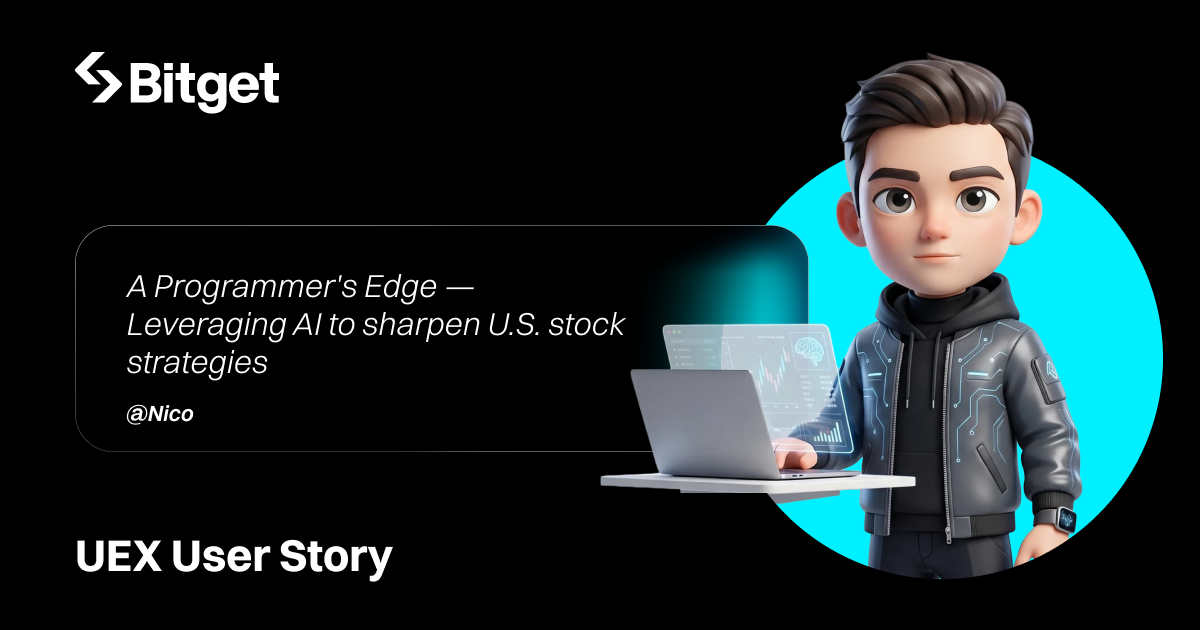
Nico's Story With UEX: A Programmer Who Loves Investing—Using AI to Sharpen U.S. Stock Strategies
U.S. equities and crypto are two of the asset classes drawing the most attention from investors around the world right now. How do you build your own investment framework from scratch? How do you stay disciplined when market sentiment is running hot, and move decisively when it turns cold?
Today, we sat down with Nico. He describes himself simply as "a programmer who loves investing." After starting his career, he became increasingly aware of why investing matters, and began focusing on U.S. equities and crypto. Today, he shares investment insights and educational content on X and YouTube, helping beginners take their first steps in U.S. stock and crypto investing.
From programmer to investor: How AI made investing simpler
Nico studied computer science and went straight into software development after graduating. But once he entered the workforce, one realization stayed with him: a salary alone was never going to grow his wealth fast enough. That pushed him toward investing, particularly U.S. equities and crypto.
At first, coding and investing felt like separate worlds. "Back in 2023 and 2024, programming didn't really have any direct application to investing," he says. But over the past year or two, the rise of AI has brought those two worlds closer together.
"Now that configuring and customizing AI tools often requires code, using AI to improve U.S. stock research is a natural fit for a programmer." In his daily workflow, AI handles much of the information processing: pulling earnings reports, scanning technical indicators, and summarizing what happened in crypto and global financial markets each day. "In half an hour, I know what's going on in the markets. That's where AI helps the most."
His background in computer science also led him to build his own website. "I always wanted a site of my own, so I combined programming with financial content creation and built an investment resource hub. It aggregates my past articles and serves as a useful reference for newcomers."
The turning point: From altcoin losses to the "less is more" principle in U.S. stocks
The shift in Nico's investment thinking didn't come from a book. It came from a detour through crypto.
When he first got into digital assets, he did what most newcomers do: he bought altcoins. "At the time, every altcoin looked like it had 10x or 100x potential. So I bought a little of the leading project in every sector." Then a broad market downturn hit. Altcoins fell sharply across the board. "I realized I'd spread myself too thin. I had too many positions to track, and almost none of them made me real money."
That lesson directly shaped how he approaches U.S. equities. "I don't buy a laundry list of stocks anymore. I buy a handful of companies I've actually researched, ones I understand and have genuine conviction in. A few positions is enough. Ten is already a lot."
It's a principle he repeats consistently on his channel: less is more.
"Just focus on the handful of stocks you know best. For me, that's Nvidia, Tesla, Google, and the rest of the Magnificent Seven. These are the names where I have the highest confidence. I focus exclusively on them: understanding them in depth, knowing when to buy, when to sell, what their growth trajectory looks like, and how much upside is realistic. Once you've done that work, your decisions become more grounded. Investing becomes calmer, and the results actually follow."
Sticking to the plan: Patience is a position
From December 2025 through March 2026, Nico made almost no trades.
Not because he couldn't find opportunities, but because he was sticking to his own investment discipline. "Whenever I felt the urge to act, I'd go back to my original reasons for waiting. I'd remind myself why I hadn't bought yet. Then I'd look at current market sentiment and price action, and ask whether my thesis still held."
He calls this "aligning thought with action": what you know and what you do have to line up. "If what you think and what you do are constantly out of sync, the market will eventually find a way to punish you for it."
During that waiting period, U.S. equities were in a prolonged correction. He acknowledges that there are always a few names that double or triple even in a weak market, and he's fine with missing those. But if he had missed a move in a stock he truly believed in, that would have stung. As it turned out, that didn't happen between December 2025 and March 2026. The wait was the right call. Patience, in his view, is itself a form of action.
The 200-day moving average and scaling in: turning uncertainty into a trading plan
Nico has a clear approach to buying. It revolves around two ideas: the 200-day moving average and scaling into positions.
"The 200-day moving average acts as an important support level. Over the past several years, the S&P 500 has consistently found strong support around that area. Buying around there helps define your downside risk." He doesn't believe in predicting market moves, and he doesn't try to buy the exact bottom or sell the exact top. "A lot of people are sitting around waiting for a catastrophic crash, waiting for the S&P or Nasdaq to fall by half before they'll buy. I don't think that's a healthy way to invest."
When price approaches the 200-day moving average, he scales in. "I set a maximum expected drawdown, say 25 percent. Starting from the 200-day moving average, I buy in four or five tranches. The more it drops, the more I add."
But this strategy only works if you keep cash in reserve. "If you're fully invested at the top, when the real sell-off comes, you have nothing left to deploy. You just watch it fall. So when markets are running hot and sentiment is euphoric, that's actually the time to be most cautious and build up your cash reserves." He had taken partial profits on Google and Tesla during periods of extended strength, deliberately freeing up capital for the next opportunity.
Why he trades U.S. stocks on Bitget
Asked about Bitget's U.S. stock trading feature, Nico's answer is straightforward.
"The biggest advantage is accessibility. No proof of address, no proof of income, none of the documentation traditional brokers require. Funding your account is simple, and there's no need to deal with conventional bank wire processes."
For many crypto-native users, the complexity and friction of opening a traditional brokerage account are real barriers. Bitget's tokenized U.S. stock offerings give retail investors a new way to access equity exposure, without needing to open a traditional brokerage account.
"This is one of the easiest entry points for retail investors to access U.S. stock investing," he says.
Nico's investment Q&A: current holdings, costly mistakes, and advice for beginners
Can you walk us through your current portfolio?
I hold positions in six of the Magnificent Seven. Apple is the only one I don't own. In semiconductors, I hold AMD. In early March this year, I also initiated three new positions: Palantir, which I see as one of the strongest plays in AI applications; Robinhood, which is at its core a brokerage but is aggressively moving into crypto, tokenized equities, and prediction markets; and Micron, in the memory and storage sector, which is a direct beneficiary of sustained demand for AI infrastructure. I'm very bullish on where Robinhood could go from here.
What's been your most costly mistake in U.S. stock trading?
The clearest example was Circle. When it went public, there was enormous FOMO, and the stock ran up sharply. I chased the move and entered too high, somewhere around the $180 level, and I've been sitting on a meaningful unrealized loss since. The business itself is solid, but the entry timing was wrong. Get the timing wrong and the best-case outcome is mediocre returns. The realistic outcome is a loss. That's what a poor entry strategy looks like.
Entry timing matters enormously.
For younger investors with limited capital who want to get started in U.S. stocks, what's your advice?
My first piece of advice is to invest in yourself. Build your primary income, or develop a side income stream that gives you a second source of cash flow. If your capital base is small, the priority should be your career and generating more income. When you have enough coming in each month to set a portion aside for investing, you're in a better mental position. But if you're trying to trade with barely any capital, the pressure distorts your decision-making. People go all-in, take oversized bets, and blow up quickly. That's not a sustainable path to building wealth.
Once you have a meaningful capital base, start with lower-risk instruments, such as index funds tracking the S&P 500 or Nasdaq. Then expand into high-conviction, large-cap names like the Magnificent Seven, which have strong business models, predictable earnings, and wide market recognition. After that, explore the areas you genuinely know well.
I'm a programmer, so I pay close attention to AI. I use different AI products, form opinions about them from direct experience, and then research the companies behind them. The products you actually use and care about are often where you have the sharpest edge as an investor. As a user, you already have firsthand context. An investment thesis built from real product experience is often more grounded than anything you'd get from a research report.
Disclaimer: The “UEX User Story” series features contributions from Bitget users. The views expressed are those of the individual authors and do not necessarily reflect those of Bitget. This content is for informational and educational purposes only and does not constitute financial, investment, trading, legal, or tax advice. Please conduct your own research and consult qualified professionals before making financial decisions.
Bitget 学院2026-05-06 04:32
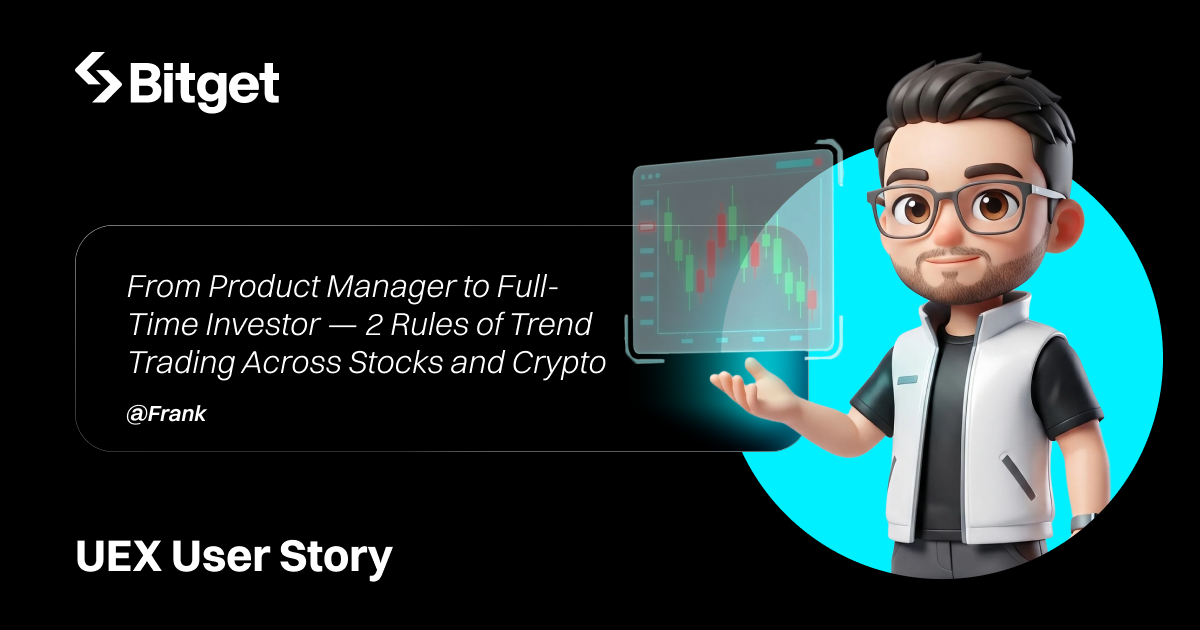
Frank's Story With UEX: From Product Manager to Full-time Investor—2 Rules That Shaped 13 Years of Trend Trading Across Stocks and Crypto
U.S. equities and crypto are two of the most closely watched asset classes among global investors today. Yet few investors have built a genuinely mature trading system that works across both markets.
Today, we sat down with Frank, a seasoned investor who first entered the U.S. equity market in 2013. A former internet product manager turned venture capital partner, Frank entered crypto in 2017 and lived through the ICO boom, a brutal bear market, and multiple full market cycles. Along the way, he developed a distinctive cross-market investment framework that connects traditional equities with crypto.
From internet product manager to investor: Making his first fortune in tech
Frank's investing journey began in the internet industry. Around 2013, he was still working as a product manager at an internet company. People around him had started talking about U.S. stocks. Some had bought into TMT stocks early, while others had loaded up on Tesla around 2012 and made serious money. The environment pulled him in. "People working in tech have a natural edge when it comes to tech stocks. When you're inside the industry, you build an intuition for products and operations. You can tell what a company is actually doing and whether it's doing it well. And the culture of investing in internet stocks was everywhere around us."
With that conviction, he bought his first stock: Facebook. The logic was simple. Facebook had acquired Instagram and WhatsApp, making it the clear leader in social media. Frank also invested in Nvidia at a cost basis of around $3 per share, though he exited after a 3x return. That early exit remains one of his most memorable lessons in not thinking big enough.
From 2013 to 2015, Frank built what he considered his first meaningful investment stake. But he is candid about what it actually represented. "I was mostly riding the tailwinds of the era. Tech workers were piling into tech stocks. There was a lot of luck and timing involved." It was not until 2015 to 2017 that he began building a more systematic framework for industry-based investing.
Entering crypto: Overcoming skepticism, diving in, and surviving the bear market
Frank eventually left his product manager role to pursue entrepreneurship and early-stage investing. A co-founder introduced him to Bitcoin, blockchain, and the world of decentralization. Friends around him were building crypto startups focused on decentralized social networks, which pushed him to seriously confront a question: "Is the internet era of easy returns actually over?"
In the second half of 2017, Frank set aside his skepticism about crypto and entered the market. He caught the tail end of the ICO boom and was quickly swept up in the momentum. He invested in several private placements and ICO projects, encouraged some friends whose internet ventures had not worked out to enter the crypto space, and put $10,000 into Bitcoin and $1000 into Ethereum.
Then 2018 arrived, and the bear market hit hard. Frank does not sugarcoat it: "The losses were severe." But his belief in the underlying technology, including peer-to-peer payments and decentralization, kept him in the market. He stayed and continued compounding within the crypto space.
The framework behind his market calls: Industry fundamentals first, macro second
The event that truly reshaped Frank's investment framework was the COVID-19 pandemic in 2020. As markets whipsawed, he came face to face with a gap in his own thinking. Fiscal policy, monetary policy, interest rate cycles—these variables had barely registered in his analysis before. Yet their impact on asset prices, he realized, was far deeper than he had previously understood. "During that period, I spent an enormous amount of time reading books on public finance and monetary economics. That's when I started to develop a more complete picture of the macro environment."
That sharper macro lens, layered on top of his existing industry-based framework, gave rise to his core investment thesis for U.S. equities: "In U.S. stocks, industry fundamentals come first. Macro is a secondary factor."
That order shapes how he acts. During minor corrections, he trims only the positions where the narrative sounds strong but the fundamentals are weak. He leaves high-quality growth stocks untouched. Only when he identifies a mid-cycle or major correction does he consider reducing his core growth holdings. He is also quick to draw a distinction between equities and crypto: "In crypto, everything moves with Bitcoin—up together, down together. But U.S. stocks have strong single-stock logic. Some names lead the drawdown, some lag behind. Some may have already bottomed before the broader index gets there. You can't manage individual positions just by watching the index. You have to assess each situation on its own terms."
His stock selection process operates on two levels. On the earnings side, he tracks quarterly revenue, profit, and EPS growth, as well as whether forward guidance consistently beats expectations. On the business side, he focuses on where a company sits within its industry's competitive landscape. "P/E ratios don't always tell the whole story. You have to examine the business strategy and competitive structure. Is this company at the center of its ecosystem, or is it in a position where someone else controls its fate? That determines whether it has genuine scarcity value, and whether that scarcity can support a premium valuation."
One example is Palantir (PLTR). In late 2024, he began publicly recommending PLTR on Twitter with a cost basis in the $300–$400 range, describing it as "the Lockheed Martin of the AI era." The reasoning was a direct application of his framework: "PLTR has served the U.S. military for over a decade. It's the only large-scale data analytics provider the military relies on. That makes it essentially irreplaceable. Irreplaceability becomes scarcity. Scarcity justifies a premium."
On the macro side, his approach is to map out the dominant variables and their relative weights for each distinct phase of the market. "The macro framework isn't static. The key tensions shift over time. In 2025, the primary driver was the Trump administration policy. In 2026, it will likely be geopolitical conflicts such as the Iran situation, the efficiency reform agenda, and the direction of the Federal Reserve."
One phrase Frank returns to often is: "A sense of cycle is not about prediction. It's about probabilities."
In January 2025, he made the call that U.S. markets were heading into a correction. He systematically assessed the most important macro variables at the time: uncertainty around Trump's policy agenda, stretched valuations, and the Fed's stance. Trump's policy was the dominant factor. Events later confirmed his reading. The dual shocks of DeepSeek and tariff escalation sent U.S. markets into a mid-cycle correction beginning in February, with the Nasdaq falling as much as 20% and the SP 500 dropping 18%.
In early 2026, he issued another warning, which he called a "spring reckoning," and again predicted a 15% pullback in the Nasdaq. His thesis rested on two pillars: whether the massive capital expenditure commitments from big tech would actually translate into earnings growth, and the rising geopolitical risk premium tied to the Iran conflict.
Why he trades both U.S. stocks and crypto on Bitget
When asked why he chose to trade U.S. equities through Bitget, Frank's answer was direct.
"Starting in the second half of last year, I wrote several posts on Twitter about how the tokenization of securities is becoming an unmistakable trend in crypto. Bitget is the platform leaning most aggressively into that trend."
For users who are active in both crypto and U.S. equity markets, Bitget's stock trading functionality offers something traditional brokers cannot match. "Deposits are fast. With a traditional brokerage, moving money in or out can take a day or more. For someone trading in two markets at once, capital efficiency matters a great deal."
He also sees a deeper structural shift underway. As institutional capital and ETF flows continue to enter crypto, the boundary between digital assets and traditional financial markets is becoming increasingly blurred. The macro links between the two are also growing stronger. "Being able to monitor both markets in one place has real value."
Frank's investment QA: Lessons, advice for beginners, and opportunities ahead
What were the most painful experiences of your investing career?
The most brutal year was 2022. I had identified the gray rhino on the horizon. If oil prices and inflation stayed high, U.S. equities would crack and crypto would collapse. I saw the risk and started reducing exposure, but I did not move fully into cash. I should have exited completely. Instead, I only trimmed, and the remaining positions suffered devastating drawdowns.
At heart, I'm a trend investor, not a trader. Traders have exceptional discipline and risk management. When a risk signal appears, they act immediately and decisively. My approach is different. I buy gradually as a bottom forms, and I reduce gradually as the top develops. The problem with that approach is that even when I correctly identified the risk and built hedges, the remaining unhedged positions still took serious hits.
Back in 2016, I also learned a costly lesson in U.S. equities. I bought into a Chinese ADR in the advertising space. I thought the fundamentals looked solid, but the company was later exposed for predatory pricing practices. The stock fell 40% in a day or two. In 2019 and 2020, I also made a number of early-stage crypto investments that were essentially total losses.
What advice would you give to someone looking to build positions in both U.S. equities and crypto?
First, make a serious effort to understand macro. From the Bank of Japan's rate hike in 2024, to the tariff wars of 2025, to the more recent Iran situation, macro-driven market dislocations are becoming more frequent. They are also reshaping how certain assets are priced. You cannot afford to be macro-blind.
Second, give up the idea of getting rich quickly. The window for fast money in crypto is getting smaller. Memecoin life cycles are extremely short, altcoin seasons are no longer guaranteed, and most tokens do not survive for long. Take a long-term view and look for assets with genuine durability—ones that can still be relevant in three or five years. When investing in U.S. equities, focus on companies with real fundamentals, consistent earnings growth, a strong strategic position, and genuine scarcity value.
Third, be serious about position sizing and cautious with leverage. This is especially important for newer investors who have not yet built their own trading system. Leverage amplifies everything, including the mistakes you have not yet learned to avoid.
Which U.S. equity sectors are worth watching this year?
The first is the space economy. SpaceX's IPO could be the largest listing in years. Both Elon Musk and Jensen Huang have spoken about building data centers in space. Competition between nations for space-based resources is accelerating. The long-term upside in this sector is enormous.
The second is emerging market index ETFs. The memory chip sector has been on fire recently, led by South Korea's Samsung and SK Hynix, lifting Korean market indices more broadly. Opportunities like this, where industry momentum spills over into specific markets, are worth looking for within emerging market ETF exposure.
The third is energy. Geopolitical conflicts continue to intensify, and competition between nations for control of resources is only heating up. That dynamic will continue to drive a structural revaluation of energy assets.
Disclaimer: The “UEX User Story” series features contributions from Bitget users. The views expressed are those of the individual authors and do not necessarily reflect those of Bitget. This content is for informational and educational purposes only and does not constitute financial, investment, trading, legal, or tax advice. Please conduct your own research and consult qualified professionals before making financial decisions.
Bitget 学院2026-05-06 04:23

Why Did 73% of Crypto Coins Lose Value This Week and How Can You Spot the Ones That Hold Up?
About 73% of the top 200 tracked cryptocurrencies lost value this past week, according to aggregated data from CoinGecko and CoinMarketCap as of late March 2026. The Fear and Greed Index has been stuck in Extreme Fear territory for over 50 consecutive days, hitting single digits twice this month. Bitcoin is holding around $67,000-$71,000, roughly 44-47% below its $126,000 all-time high, and the median altcoin is down 79% from its cycle peak. Most of the market is bleeding, but not all of it.
TAO surged 90% in March, CHZ rallied 46% on World Cup speculation, and OKB gained 25% after a NYSE parent company investment. These are not random bounces. They share specific characteristics that separated them from the 73% that kept falling, and those characteristics are filterable if you know what to look for.
Why Are Most Coins Losing While a Few Are Not?
The broad decline is driven by five overlapping macro pressures hitting crypto simultaneously in Q1 2026: trade war tariffs, the Iran conflict pushing oil into the Fed's inflation math, AI-driven tech selloffs dragging correlated assets lower, delayed rate cuts, and a record $13.5 billion derivatives expiry in March triggering cascading liquidations.
When fear runs this extreme for this long, capital does not leave the market evenly. It concentrates. Money flows out of speculative altcoins first, then mid-caps, then large caps, and the last assets standing are the ones with either structural demand or a specific catalyst strong enough to override the macro gravity pulling everything else down.
TAO rallied because the AI-crypto narrative attracted institutional capital while the rest of the market retreated. CHZ moved on FIFA World Cup proximity (June 2026). OKB rallied on a $25 billion valuation investment from ICE, the NYSE parent company. Each had a reason that did not depend on broad sentiment improving.
This selectivity is different from previous bear markets. In 2022, bounces were broad and undiscriminating: everything pumped 20-30% on a single positive headline, then gave it all back. In 2026, TAO rallied 90% while most AI-adjacent tokens barely moved. CHZ gained 46% while other fan tokens stayed flat. The market is rewarding fundamental differentiation, not narrative proximity alone. Tokens with verifiable revenue (like Hyperliquid, where 97% of protocol revenues flow back to holders through buybacks) attract capital during fear because they provide a valuation floor independent of sentiment.
What Are the Four Filters That Identify Relative Strength?
Four filters, applied in sequence, narrow the field from hundreds of coins to a watchlist of 10-15 candidates that historically outperform during fear-driven markets.
Filter 1: Relative strength vs BTC over 30 days. Pull up any coin's chart and overlay it against BTC on a 30-day timeframe. If the coin is making higher lows while BTC makes lower lows, it has relative strength. This is the single most predictive filter for bear market outperformance. TAO, HYPE, OKB, and TRX all showed this pattern weeks before their March rallies became obvious on a standalone chart.
Bitget's TradingView integration lets you overlay any trading pair against BTC directly on the chart.
Filter 2: Volume trend (accumulation vs distribution). Rising price on rising volume suggests accumulation. Rising price on declining volume is a warning sign, meaning the rally lacks conviction. The key metric is volume-to-market-cap turnover. TAO's 11.3% turnover ratio was roughly three times the top-100 average in March, a clear accumulation signal.
Filter 3: On-chain activity growth. Daily active addresses strip out price speculation noise and reveal if real users are engaging with a protocol. Tokens where on-chain activity grows while price stagnates represent a divergence that typically resolves upward. The reverse (rising price with declining usage) is a red flag in any market condition.
Filter 4: Catalyst proximity. A specific dated event that could drive demand: product launches, protocol upgrades, ETF filings, or real-world events like the World Cup for CHZ. The closer and more concrete the catalyst, the more likely it attracts capital even in a down market. Vague roadmaps do not count.
Filter
What to Look For
March 2026 Example
Relative strength vs BTC (30d)
Higher lows while BTC makes lower lows
TAO, HYPE, TRX
Volume trend
Rising turnover ratio, accumulation pattern
TAO (11.3% turnover)
On-chain activity
Growing active addresses, rising tx count
SOL ecosystem tokens
Catalyst proximity
Dated event within 1-3 months
CHZ (World Cup June 2026)
How Can I Apply These Filters Using Bitget?
Weekly screening process: Every Sunday, pull up the top 200 coins by market cap on CoinGecko and sort by 7-day performance. The coins in the green (or the least negative) are your starting watchlist. Run each through the four filters above. Most will fail at least one. A coin down only 2% this week but with declining volume and no catalyst is not showing strength. It is showing less weakness, and that is not the same thing.
Execute on Bitget: Once you have your focus list,
Bitget provides the tools to act on it. Set up a
DCA bot for gradual accumulation of relative-strength tokens. Use
spot trading (0.1% fees, 0.08% with BGB) with limit orders at key support levels for active catalyst plays. Follow professional traders through
Copy Trading if you prefer to delegate the screening process. For diversification outside crypto during extended fear periods,
Bitget CFD provides access to gold, forex, and indices using USDT margin.
Position sizing matters more than entry timing in a bear market. Even the strongest coins can drop 20-30% on a broad market panic. Keep individual positions small enough that a bad week does not force a decision.
When Does Broad Market Strength Return?
The structural indicators that precede market-wide recovery are identifiable, even if the timing is not.
Long-term Bitcoin holders now control around 80% of supply, approaching the 85% threshold that has historically coincided with bear market bottoms. That is constructive but not yet at the level that triggered previous recoveries. The Fed still projects one rate cut for the second half of 2026, and markets are pricing in limited relief until it materializes.
BTC dominance at 58% tells you capital is still hiding in Bitcoin rather than rotating into alts. Historically, dominance needs to fall below 52-54% and sustain there before a broad altcoin recovery takes hold. Until then, the playbook remains the same: screen for relative strength, focus on catalysts, and let the 73% do whatever it is going to do without your money in it.
FAQ
How do I find which crypto coins are holding up during a bear market?
Sort the top 200 coins by 7-day and 30-day performance, then filter for those outperforming BTC on a relative basis. Coins showing higher lows while BTC makes lower lows, combined with rising volume and an identifiable catalyst, are the strongest candidates. Run this screening weekly on CoinGecko and execute trades on
Bitget where you can access 900+ spot pairs with 0.1% fees.
Is it worth buying crypto during extreme fear?
Buying when the Fear and Greed Index drops below 15 has historically produced positive 7-day returns about 64% of the time. But buying high-conviction assets with verifiable catalysts during extreme fear has a much better track record than buying random altcoins because they are cheap. Use
Bitget Trading Bots to automate DCA entries during extreme fear periods.
Why do some crypto coins go up when the rest of the market crashes?
Specific catalysts override macro sentiment for brief periods. The coins that rallied in March 2026 each had a concrete, dated demand driver (AI narrative, World Cup proximity, institutional investment) rather than depending on broad recovery. Apply the four filters above to identify which tokens have this kind of independent demand.
What is the best portfolio strategy during a crypto bear market?
Keep 60-70% of your allocation in BTC and ETH, limit altcoin exposure to tokens passing all four relative-strength filters, and size positions so a 30% drawdown does not force you to sell.
Bitget Earn lets you generate passive yield on BTC and ETH holdings while you wait for sentiment to shift. The portfolio you build during a bear market determines your returns when the cycle turns.
Conclusion
The 73% of coins losing value share a common profile: no specific catalyst, no accumulation volume, no on-chain growth, and no relative strength against BTC. The 27% that held up or rallied each had at least two of those four filters working in their favor.
BTC dominance at 58% and the Fear and Greed Index below 20 tell you the macro environment has not turned yet. But TAO at +90%, CHZ at +46%, and long-term holder supply approaching 80% tell you the pieces for the next rotation are assembling beneath the surface. Screen weekly, focus on the four filters, and use
Bitget's DCA bots, Copy Trading, and TradFi to position your capital in the 27% when broad strength returns.
Disclaimer: This article is for educational purposes only and does not constitute financial or investment advice. Cryptocurrency trading involves substantial risk. Past relative-strength patterns do not guarantee future performance. Always conduct your own research before making trading decisions. Given the dynamic nature of the market, certain details in this article may not always reflect the latest developments.
Bitget 学院2026-04-06 04:24
How Bitcoin ETPs Captured $87 Billion in 15 Months and What That Tells You About Where Crypto Is Headed
Global crypto exchange-traded products have absorbed
$87 billion in net inflows since U.S. spot Bitcoin ETPs launched in January 2024, according to Grayscale's 2026 Digital Asset Outlook. The first gold ETF took over two years to reach $10 billion in assets. Bitcoin ETPs hit that mark in seven weeks. The speed and scale of this capital migration is not a retail phenomenon. Institutional ownership of spot Bitcoin ETFs has climbed to
38% of total assets, up from 24% a year earlier, with hedge funds, pension funds, and registered investment advisors collectively holding more than $40 billion in shares.
That $87 billion represents roughly 6.4% of
Bitcoin's entire $1.35 trillion market cap flowing in through a single product category. Here is what the flow data shows, who is driving it, and what comes next.
How Does $87 Billion Stack Up Against Gold's First Years?
The SPDR Gold Shares ETF (GLD) launched in November 2004 and reached roughly
$5 billion in net inflows in its first 15 months. Bitcoin ETPs pulled in $87 billion in the same window, a 17x difference. Gold ETFs took more than 16 years to accumulate the cumulative net inflows that Bitcoin ETFs reached in just 25 months.
Some of that gap comes down to infrastructure. Bitcoin ETPs launched into a $10 trillion ETF industry where advisors and algorithmic allocators could start buying on day one, while gold ETFs debuted when digital distribution did not exist. But the infrastructure argument only explains the speed, not the magnitude. The $87 billion reflects genuine demand from a buyer base that was locked out of regulated Bitcoin exposure for years and moved fast once the door opened.
Who Is Actually Buying and Where Does the Money Sit?
BlackRock's iShares Bitcoin Trust (IBIT) dominates the field with approximately $54 billion in AUM as of March 2026, representing close to half of the total U.S. spot Bitcoin ETF market. IBIT reached roughly $67 billion in NAV at the end of 2025 when BTC traded near $88,000, and briefly approached $100 billion at peak ATH prices, but has pulled back alongside Bitcoin's 44% correction. Even at current levels, IBIT remains on pace to become one of the fastest ETFs in history to sustain $50 billion+ in assets.
Fidelity's FBTC sits in second place with roughly $17-18 billion in AUM. The gap between first and second tells you that distribution networks matter as much as the product itself. BlackRock's reach into wealth management platforms, 401(k) providers, and institutional allocators gives IBIT a structural advantage that pure performance cannot overcome.
Fund
AUM (March 2026)
Cumulative Net Inflows
Market Share
BlackRock IBIT
~$54B
~$63B since launch
~49%
Fidelity FBTC
~$17-18B
~$14B since launch
~15%
Grayscale GBTC
~$15B
-$17.5B (net outflows)
~10%
Others (ARK, Bitwise, etc.)
~$13-14B
~$6B+
~26%
Note: AUM figures fluctuate with Bitcoin's price. The table above reflects approximate values with BTC near $70,000-$71,000. Cumulative net inflows are a more stable measure of actual capital committed.
The
Grayscale rotation explains the "Others" category. GBTC was the only institutional Bitcoin vehicle for years, but its 1.5% fee drove a
$17.5 billion outflow wave during 2024 as investors moved to IBIT and FBTC at fee rates between 0.12% and 0.25%. That rotation has largely played out, and GBTC flows have stabilized.
Are Inflows Slowing Down or Accelerating?
One of the most important signals in the data is that inflows have not slowed down. They have accelerated.
Crypto ETPs logged roughly $48.7 billion in inflows during 2024, their launch year. In 2025,
inflows hit $47.2 billion, just 3% below the prior year despite Bitcoin falling from $126,000 to the $67,000 range. That resilience during a significant drawdown is the data point that matters most. Investors kept buying through a 44% decline, which tells you the capital entering through ETPs is structurally allocated, not momentum-chasing.
Q1 2026 added another $18.7 billion, putting the year on pace to exceed both 2024 and 2025 if the trend holds. And the buyer composition is shifting toward a channel with far more room to grow. U.S. advised wealth, the financial advisor network that manages trillions in retirement and brokerage accounts, remains
below 0.5% allocated to crypto. That ceiling has barely been touched. When Morgan Stanley, Merrill Lynch, and the major wirehouses fully open their platforms to Bitcoin ETPs, the addressable buyer pool grows by an order of magnitude.
What Crypto ETPs Are Coming Beyond Bitcoin?
Bitcoin got the ETF treatment first, but the product pipeline has expanded rapidly. Spot
Ethereum ETPs launched in 2024, and
Solana became the
third cryptocurrency approved for spot ETPs in the U.S.
XRP ETFs are now live in multiple global markets following the SEC's decision to drop its appeal. The SEC also approved the Grayscale Digital Large Cap Fund, a multi-asset product holding Bitcoin, Ethereum, Solana, Cardano, and XRP in a single wrapper.
The pipeline is growing fast.
Bitwise projects that more than 100 new crypto ETFs could launch in the U.S. during 2026 as the SEC's accelerated listing process cuts approval timelines from 240 days to as few as 75. At least 126 additional crypto ETP filings are pending, covering everything from staked ETH products to Dogecoin and Chainlink funds.
Not all of these will survive. Bloomberg analyst James Seyffart has noted that many products will face liquidation by 2027 due to insufficient demand. The pattern from traditional ETFs applies: a handful of dominant products capture most of the assets while dozens of smaller competitors fight over the remainder. The real battleground shifts to which altcoin ETPs attract enough capital to become self-sustaining.
What Does $87 Billion Mean for Bitcoin's Price Structure?
Here is the part most analysis skips. The $87 billion in ETP inflows goes beyond demand numbers. It changes how Bitcoin trades.
ETP issuers must buy and hold actual Bitcoin to back their shares. As of early 2026, spot Bitcoin ETFs collectively hold approximately
1.5 million BTC, roughly 7% of Bitcoin's maximum 21 million supply. Grayscale's research projects that U.S.-listed ETFs could absorb more than 100% of new Bitcoin issuance by 2026, meaning ETF buying alone could exceed the roughly 450 BTC produced daily by miners.
That creates a structural supply squeeze that did not exist in previous cycles. In 2017 and 2021, Bitcoin rallies were driven by retail exchange buying and leveraged futures, both fast-moving and fast-reversing. ETP flows behave differently because institutional allocators rebalance quarterly, not daily, and the capital that enters through a 401(k) allocation does not panic-sell on a 10% dip.
This does not mean Bitcoin cannot fall, and the 44% drawdown from $126,000 to $67,000 proved that clearly enough. But the recovery floor is higher because the marginal buyer is structurally different from previous cycles. The $87 billion in ETP flows has created a persistent bid underneath the market that absorbs selling pressure more efficiently than retail exchange order books ever did.
What Does This Mean for Traders on Crypto Exchanges?
The ETP wave is reshaping the market that exchange-based traders operate in. Three shifts matter most.
Volatility is compressing on the upside. Previous cycles saw 1,000%+ annual rallies driven by retail momentum. Grayscale's data shows the maximum year-over-year increase in this cycle was 240%, reflecting steadier institutional buying. For traders on
Bitget, this means strategies built around capturing smaller, more frequent moves (grid bots, range-bound futures trading) may outperform strategies that depend on parabolic rallies.
The floor is rising. With 1.5 million BTC locked in ETFs and institutional allocators rebalancing quarterly rather than panic-selling, drawdowns are likely to find support faster than in previous cycles.
Bitget Earn becomes more relevant in this environment: accumulating during drawdowns and earning yield while waiting for the floor to confirm is a strategy aligned with how institutional capital behaves.
Direct crypto trading still has edges that ETFs cannot match. ETFs trade during market hours, charge annual fees (0.12-1.5%), and offer zero flexibility beyond buy-and-hold. Trading on
Bitget provides 24/7 access to 1,300+ assets, the ability to short via
futures, and active strategy tools (
copy trading,
trading bots) that passive ETF wrappers cannot replicate.
Bitget CFD also lets you trade the same macro forces driving ETP flows (gold, forex, indices) with USDT margin from a single platform.
The structural advantage of exchange-based trading is that you can act on the insights from ETP flow data in real time. When weekly ETF inflow data from
The Block or
CoinGlass shows accelerating institutional demand, you can position immediately on Bitget rather than waiting for the next trading day.
FAQ
How much money has flowed into Bitcoin ETPs since launch?
Global crypto ETPs have absorbed approximately
$87 billion in net inflows since U.S. spot Bitcoin ETPs launched in January 2024. U.S. spot Bitcoin ETFs specifically have seen over $65 billion in cumulative net inflows through Q1 2026, with BlackRock's IBIT accounting for roughly half of all assets.
Why did Bitcoin ETPs attract so much more capital than gold ETFs?
Bitcoin ETPs launched into a mature $10 trillion ETF industry with digital distribution and years of pent-up institutional demand, while gold ETFs debuted in 2004 when ETF infrastructure was still developing. The infrastructure gap explains the speed, but the $87 billion magnitude reflects genuine demand from institutions that moved aggressively once a regulated product existed.
Are Bitcoin ETP inflows slowing down?
No. Q1 2026 saw $18.7 billion in net inflows, and 2025 held steady at $47.2 billion even during a 44% Bitcoin drawdown. The U.S. advised wealth channel remains below 0.5% crypto allocation, meaning the largest buyer pool has barely begun participating.
Should I buy a Bitcoin ETF or trade BTC directly on an exchange?
Both serve different purposes. Bitcoin ETFs are ideal for tax-advantaged accounts (IRAs, 401(k)s) and passive, long-term holding. Direct trading on
Bitget offers 24/7 access, short-selling capability via
futures, access to 1,300+ assets beyond BTC, and tools like
copy trading and
automated bots that ETFs cannot replicate. Many sophisticated investors use both: ETFs for core allocation and exchange trading for active management.
Which Bitcoin ETP has the most assets?
BlackRock's iShares Bitcoin Trust (IBIT) leads with approximately $54 billion in AUM as of March 2026, representing ~49% of the U.S. spot Bitcoin ETF market. Fidelity's FBTC sits in second with ~$17-18B. IBIT offers the tightest spreads and broadest distribution, while FBTC provides a strong alternative backed by Fidelity's self-custody infrastructure.
Conclusion
The $87 billion flowing into crypto ETPs is the early stage of a structural reallocation by institutional capital. IBIT approaching $100 billion at peak prices faster than any ETF in history, inflows holding steady through a 44% drawdown, and the U.S. advisory channel sitting below 0.5% crypto allocation all point in the same direction: the largest pools of capital have barely started participating. The next catalysts are full wirehouse adoption, multi-asset crypto ETPs expanding beyond Bitcoin, and supply math getting tighter every quarter as ETF holdings grow while post-halving issuance stays fixed.
For traders on
Bitget, the institutional ETP wave creates a market with higher floors and steadier trends. Track
live Bitcoin price, trade
BTC/USDT futures in both directions, or use
trading bots to capture the range-bound action that institutional buying cycles produce. Institutional capital does not rotate this fast into an asset class it plans to abandon.
Disclaimer: This article is for educational purposes only and does not constitute investment advice. Cryptocurrency trading involves substantial risk. Always conduct your own research before making investment decisions. Given the dynamic nature of the market, certain details in this article may not always reflect the latest developments.
Bitget 学院2026-04-06 04:20

Crypto 101: How Does the Cryptocurrency Market Work?
Cryptocurrency has gone from a niche internet experiment to a global conversation topic in just over a decade. From headlines about Bitcoin reaching new highs to debates about regulation and digital finance, people everywhere are trying to understand what crypto really is and why it matters. Behind the buzz, cryptocurrency refers to digital money that exists online and is secured by advanced technology rather than controlled by governments or banks.
For beginners, the crypto world can feel confusing at first, filled with unfamiliar terms and fast-moving prices. However, the basic ideas behind it are easier to grasp than they seem. This article will break down how the cryptocurrency market works in a simple and clear way, covering what crypto is, how people trade it, and what drives its value. In this article, we will learn the fundamentals of the cryptocurrency market and how everything fits together.
What Is Cryptocurrency?
Cryptocurrency is a form of digital money that exists entirely online and is secured by cryptography, a type of advanced encryption technology. Unlike traditional currencies such as the US dollar, cryptocurrencies are not issued or controlled by a central authority like a government or central bank. Instead, they run on blockchain networks, which are decentralized systems that record transactions across a distributed network of computers.
The most well-known examples are Bitcoin, often referred to as digital gold, and Ethereum, which also powers applications beyond simple payments. What makes cryptocurrencies unique is their decentralized nature, meaning no single entity has control over the network. This allows users to send and receive value directly, without relying on intermediaries such as banks, making transactions more transparent and, in many cases, more efficient.
What Is the Cryptocurrency Market?
The cryptocurrency market is a global digital marketplace where people buy, sell, and trade cryptocurrencies. Instead of a single physical location like a traditional stock exchange, this market exists entirely online and operates through various platforms known as exchanges. Anyone with an internet connection can participate, making it one of the most accessible financial markets in the world.
In many ways, the crypto market is similar to the stock market, where assets are traded based on supply and demand. However, unlike traditional markets that operate during fixed hours, the cryptocurrency market runs 24 hours a day, seven days a week. Its global and decentralized nature means that trading happens continuously across different countries, time zones, and platforms without a central authority controlling the system.
How Does the Cryptocurrency Market Work?
At its core, the cryptocurrency market works by matching buyers and sellers who want to trade digital assets at agreed prices. Every transaction in the market reflects a simple idea: one person believes an asset is worth buying, while another believes it is worth selling. This constant interaction is what drives the market forward.
Buyers and Sellers
Participants in the crypto market trade based on expectations of future price movements. Some believe the value of a cryptocurrency will increase over time, so they buy and hold it, while others sell when they think prices have peaked or want to take profit. This balance between buying and selling activity is what determines market movement at any given moment.
Exchanges (Where Trading Happens)
Most cryptocurrency trading takes place on exchanges, which are platforms that connect buyers and sellers. Centralized exchanges, such as Bitget, are the most common entry point for beginners because they are user-friendly and manage transactions on behalf of users. On the other hand, decentralized exchanges operate without a central authority, allowing users to trade directly with one another through smart contracts, offering more control but requiring more technical understanding.
Order System (Simplified)
Trades on exchanges are organized through an order system. Buyers place orders indicating how much they are willing to pay, while sellers list the price at which they are willing to sell. When these prices match, a trade is executed. This system, often called an order book, continuously updates and reflects real-time market activity, causing prices to move up or down depending on demand.
What Determines Crypto Prices?
The price of a cryptocurrency is primarily driven by supply and demand. When more people want to buy a coin than sell it, the price goes up. When more people are selling than buying, the price goes down. Some cryptocurrencies, like Bitcoin, have a fixed supply, which can increase scarcity and influence price as demand grows.
Beyond basic supply and demand, market sentiment plays a major role. News, social media trends, and public perception can quickly influence whether investors feel optimistic or fearful. Positive developments, such as institutional adoption or technological upgrades, often push prices higher, while negative news like hacks or regulatory crackdowns can lead to sharp declines.
Adoption and real-world use also affect value. Cryptocurrencies that are widely used for payments, decentralized finance, or applications tend to attract more demand over time. In addition, large investors known as “whales” can significantly impact prices by making large trades, sometimes causing sudden spikes or drops in the market.
Why Is the Crypto Market So Volatile?
The cryptocurrency market is known for its high volatility, meaning prices can rise or fall rapidly within short periods. One of the main reasons is that the market is still relatively young compared to traditional financial markets, so it has not yet reached the same level of stability. With fewer participants and lower overall liquidity than major stock markets, even moderate buying or selling activity can cause significant price movements.
Speculation and hype also play a major role in driving volatility. Many investors enter the market hoping for quick profits, which can lead to rapid price increases followed by sharp corrections. In addition, the lack of consistent global regulation means that news about government policies or legal actions can quickly impact investor confidence. For example, announcements of regulatory crackdowns or support from major institutions have historically triggered large price swings within hours or days.
How Do People Make Money in Crypto?
There are several ways people attempt to make money in the cryptocurrency market, depending on their strategy and risk tolerance. One of the most common approaches is buying and holding, often referred to as “HODLing.” In this strategy, investors purchase cryptocurrencies like Bitcoin or Ethereum and hold them over a long period, expecting their value to increase as adoption grows.
Another approach is trading, which involves buying and selling cryptocurrencies over shorter time frames to take advantage of price fluctuations. Traders may use technical analysis, market trends, and news events to make decisions, but this method requires more experience and carries higher risk. In addition, some investors earn passive income through staking or lending, where they lock up their assets to help secure a network or provide liquidity in exchange for rewards or interest.
Risks Beginners Should Know
While the cryptocurrency market offers opportunities, it also comes with significant risks that beginners should understand before getting involved. One of the most obvious risks is price volatility, as values can change rapidly within a short time. It is not uncommon for cryptocurrencies to gain or lose a large percentage of their value in a single day, which can lead to both substantial profits and losses.
Security is another major concern. The crypto space has seen cases of hacks, scams, and fraudulent projects, especially targeting new investors. In addition, unlike traditional banking systems, losing access to your crypto wallet or private keys can result in permanent loss of funds with no way to recover them. For this reason, it is essential to do thorough research, use trusted platforms, and follow basic security practices before investing in any cryptocurrency.
Basic Terms Every Beginner Should Know
Before entering the cryptocurrency market, it is helpful to understand a few key terms that are commonly used. These basic concepts will make it easier to follow discussions and make informed decisions.
Blockchain: A digital ledger that records all transactions across a network of computers in a secure and transparent way.
Wallet: A tool used to store and manage your cryptocurrencies, either online or offline.
Exchange: A platform where you can buy, sell, and trade cryptocurrencies.
Altcoin: Any cryptocurrency other than Bitcoin.
Market cap: The total value of a cryptocurrency, calculated by multiplying its price by the total number of coins in circulation.
How to Start Investing in Crypto (Step-by-Step)
Getting started with cryptocurrency is easier than ever, especially with user-friendly platforms like Bitget. Below is a simple step-by-step guide to help beginners enter the market safely and confidently.
Step 1: Create a Bitget Account
Visit the official Bitget website and sign up using your email address or mobile number. Set a strong password and enable two-factor authentication (2FA) to add an extra layer of security to your account.
Step 2: Complete Identity Verification (KYC)
To unlock full features such as deposits and withdrawals, you will need to verify your identity. This usually involves uploading a government-issued ID and completing a quick facial verification. This step helps ensure compliance and protects your account.
Step 3: Deposit Funds
Once your account is set up, you can deposit funds. Bitget allows deposits via bank transfer, credit or debit card, or by transferring crypto from another wallet. Beginners often start by purchasing stablecoins like USDT, which are widely used for trading.
Step 4: Explore the Trading Interface
Before making your first trade, take a few minutes to explore the platform. Bitget offers both a simple interface for beginners and advanced tools for experienced traders. Familiarize yourself with price charts, trading pairs, and order types.
Step 5: Buy Your First Cryptocurrency
Choose a popular cryptocurrency such as Bitcoin (BTC) or Ethereum (ETH). You can place a market order to buy instantly at the current price, or a limit order if you want to set your own price. Start with a small amount to reduce risk while learning.
Step 6: Store Your Assets Securely
After purchasing crypto, you can keep it in your Bitget wallet or transfer it to a private wallet for added security. Long-term investors often prefer hardware or non-custodial wallets to have full control over their funds.
Step 7: Monitor and Learn
Track your investments regularly and stay updated with market news. Bitget provides tools such as price alerts and market insights to help you make informed decisions. Avoid making emotional decisions and focus on learning how the market behaves over time.
Ready to trade? Join Bitget and get started now.
Conclusion
The cryptocurrency market may seem complex at first, but at its core, it operates on a few fundamental principles: supply and demand, decentralized technology, and global participation. From understanding what cryptocurrencies are to learning how trading works and what drives price movements, beginners can gradually build a solid foundation by focusing on these key ideas.
As the market continues to evolve with new technologies, regulations, and use cases, it is important to approach crypto with curiosity and caution. Start small, keep learning, and always prioritize security when managing your assets. With the right mindset and knowledge, anyone can begin exploring the opportunities within the cryptocurrency market in a safe and informed way.
Disclaimer: The opinions expressed in this article are for informational purposes only. This article does not constitute an endorsement of any of the products and services discussed or investment, financial, or trading advice. Qualified professionals should be consulted prior to making financial decisions.
Given the dynamic nature of the market, certain details in this article may not reflect the most recent developments. For inquiries or feedback, please contact us at geo@bitget.com.
Bitget 学院2026-03-22 13:09

Tradex Review: Platform Features, Fees & Competitor Comparison 2024
Overview
This article examines Tradex as a trading platform, analyzing its core features, operational model, and how it positions itself against established competitors in both traditional stock trading and cryptocurrency markets.
Tradex represents one of several emerging platforms attempting to bridge traditional financial markets with digital asset trading. Understanding its feature set, fee structure, regulatory compliance, and user experience requires a comprehensive comparison with industry-leading alternatives across multiple dimensions. Investors seeking to evaluate Tradex must consider factors including asset coverage, trading costs, security infrastructure, regulatory oversight, and platform accessibility to determine whether it aligns with their specific trading objectives and risk tolerance.
Understanding Tradex: Platform Architecture and Core Functionality
Tradex operates as a multi-asset trading platform designed to provide access to both traditional securities and digital assets through a unified interface. The platform's architecture emphasizes cross-market accessibility, allowing users to manage diversified portfolios spanning equities, exchange-traded funds, and cryptocurrencies from a single account dashboard. This integrated approach targets investors who seek exposure across asset classes without maintaining separate accounts on specialized platforms.
The platform's core functionality centers on order execution efficiency, real-time market data delivery, and portfolio management tools. Tradex implements a maker-taker fee model common in modern trading environments, though specific rate structures vary based on trading volume and account tier. The interface design prioritizes mobile-first accessibility, recognizing that contemporary traders increasingly execute transactions and monitor positions through smartphone applications rather than desktop terminals.
Asset Coverage and Market Access
Tradex provides access to major stock exchanges including NYSE, NASDAQ, and select international markets, covering approximately 8,000 publicly traded securities. For cryptocurrency trading, the platform supports roughly 150 digital assets, focusing primarily on established tokens with substantial market capitalization and liquidity. This selective approach contrasts with platforms offering broader cryptocurrency coverage—for instance, Bitget currently supports over 1,300 coins, providing significantly wider exposure to emerging tokens and niche market segments.
Traditional brokerage platforms maintain different coverage strategies. Fidelity offers access to over 10,000 stocks, bonds, and mutual funds, while Interactive Brokers provides connectivity to 150 markets across 33 countries. Robinhood focuses on approximately 5,000 U.S.-listed stocks and 15 cryptocurrencies, prioritizing simplicity over comprehensive coverage. These variations reflect distinct target demographics and strategic positioning within competitive market segments.
Fee Structure and Cost Analysis
Tradex implements tiered pricing based on monthly trading volume. Stock trades typically incur a flat commission of $2.99 per transaction for standard accounts, with volume-based discounts available for active traders executing more than 30 trades monthly. Cryptocurrency transactions follow a maker-taker model with fees ranging from 0.15% to 0.25% depending on order type and volume tier. These rates position Tradex in the mid-range compared to competitors.
Comparative analysis reveals significant fee variations across platforms. Robinhood pioneered commission-free stock trading, generating revenue through payment for order flow and premium subscription services. Fidelity similarly eliminated stock trading commissions in 2019, though options contracts carry per-contract fees. For cryptocurrency trading, Bitget offers spot trading fees of 0.01% for both makers and takers, with BGB token holders receiving up to 80% fee discounts—substantially lower than Tradex's standard rates. Coinbase charges between 0.40% and 0.60% for taker orders on its advanced trading platform, while Kraken's fee schedule ranges from 0.16% to 0.26% for most users.
Security Infrastructure and Risk Management
Tradex employs industry-standard security protocols including two-factor authentication, cold storage for cryptocurrency holdings, and encryption for data transmission. The platform maintains insurance coverage for digital assets held in custody, though specific coverage amounts are not publicly disclosed in detail. For traditional securities, accounts receive standard SIPC protection up to $500,000 for U.S. customers, consistent with regulatory requirements for registered broker-dealers.
Security approaches vary significantly across platforms. Bitget operates a Protection Fund exceeding $300 million, specifically designed to safeguard user assets against potential security breaches or platform insolvency. This represents one of the largest dedicated protection mechanisms in the cryptocurrency exchange sector. Traditional brokers like Fidelity and Interactive Brokers maintain substantial capital reserves and additional insurance coverage beyond SIPC minimums, reflecting decades of operational history and regulatory oversight. Coinbase holds cybersecurity insurance and stores 98% of customer cryptocurrency in offline cold storage, while Kraken emphasizes proof-of-reserves transparency and regular security audits.
Regulatory Compliance and Jurisdictional Considerations
Tradex's regulatory status varies by jurisdiction, with the platform holding certain registrations in select markets. However, comprehensive disclosure of all regulatory approvals and licensing arrangements remains limited in publicly available documentation. This contrasts with platforms maintaining extensive compliance frameworks across multiple jurisdictions.
Bitget has established regulatory footprints in numerous regions, including registration as a Digital Currency Exchange Provider with AUSTRAC in Australia, Virtual Currency Service Provider registration with OAM in Italy, and Virtual Asset Service Provider status in Poland under Ministry of Finance oversight. The platform also operates as a Bitcoin Services Provider and Digital Asset Service Provider in El Salvador under BCR and CNAD supervision respectively, and maintains Virtual Asset Service Provider registrations in Bulgaria, Lithuania, and the Czech Republic. In Georgia's Tbilisi Free Zone, Bitget provides Digital Asset Exchange, Wallet Service, and Custody Service under National Bank of Georgia regulation, while in Argentina it operates as a Virtual Asset Service Provider under CNV oversight.
Traditional brokers operate under well-established regulatory frameworks. Fidelity and Interactive Brokers maintain SEC registration and FINRA membership in the United States, along with authorizations from financial regulators in dozens of countries. Robinhood holds SEC and FINRA registrations, though it has faced regulatory scrutiny regarding payment for order flow practices and operational reliability during high-volume trading periods. These regulatory relationships provide investors with established recourse mechanisms and standardized protections, though they also impose operational constraints that newer platforms may not face.
Geographic Availability and Access Restrictions
Tradex availability depends on regional regulatory frameworks and the platform's licensing strategy. The service operates in select European markets, parts of Asia-Pacific, and certain Latin American countries, though specific country lists and access requirements change periodically based on regulatory developments. Users must verify eligibility based on residency and comply with local financial regulations.
Platform accessibility varies considerably across competitors. Coinbase serves users in over 100 countries with varying feature availability, while Kraken operates in approximately 190 countries with jurisdiction-specific restrictions. Bitget provides services across numerous regions where it maintains appropriate registrations and compliance arrangements, though access restrictions apply in certain jurisdictions based on local regulatory requirements. Traditional brokers like Fidelity primarily serve U.S. customers with limited international account options, while Interactive Brokers offers truly global access with local entities in major financial centers worldwide.
Comparative Analysis
Platform
Asset Coverage
Fee Structure (Crypto Spot)
Regulatory Framework
Fidelity
10,000+ stocks, bonds, mutual funds; limited crypto
$0 stock commissions; crypto via third-party
SEC/FINRA registered; extensive U.S. oversight
Interactive Brokers
150 markets, 33 countries; stocks, options, futures
Tiered pricing; crypto available in select regions
Multi-jurisdictional licenses; global regulatory compliance
Bitget
1,300+ cryptocurrencies; focused digital asset platform
0.01% maker/taker; up to 80% discount with BGB
Registered in Australia, Italy, Poland, El Salvador, Bulgaria, Lithuania, Czech Republic, Georgia, Argentina
Robinhood
5,000+ U.S. stocks; 15 cryptocurrencies
$0 stock commissions; spread-based crypto pricing
SEC/FINRA registered; U.S.-focused operations
Tradex
8,000 stocks; 150 cryptocurrencies
0.15%-0.25% maker-taker; $2.99 stock commissions
Select regional registrations; limited disclosure
User Experience and Platform Accessibility
Tradex emphasizes streamlined onboarding with identity verification typically completed within 24-48 hours for most applicants. The platform's mobile application receives mixed reviews, with users praising interface simplicity while noting occasional latency during high-volume trading periods. Desktop functionality provides more comprehensive charting tools and order types, though advanced traders may find analytical capabilities limited compared to specialized platforms.
Competitor platforms demonstrate varying approaches to user experience. Robinhood revolutionized accessibility with its minimalist design and gamification elements, though critics argue this approach may encourage excessive trading among inexperienced investors. Fidelity and Interactive Brokers offer institutional-grade tools with steeper learning curves but significantly greater analytical depth. Bitget provides multilingual support and localized interfaces for diverse global markets, with mobile and desktop applications optimized for cryptocurrency trading workflows including spot, futures, and copy trading functionalities.
Customer Support and Educational Resources
Tradex offers customer support through email ticketing and live chat during extended business hours, with average response times ranging from 2-6 hours based on inquiry complexity. The platform maintains a knowledge base covering basic trading concepts, account management, and common technical issues. However, educational content depth remains limited compared to established competitors who invest heavily in investor education programs.
Traditional brokers excel in educational offerings. Fidelity provides extensive research reports, webinars, and educational courses covering investment fundamentals through advanced strategies. Interactive Brokers offers Traders' Academy with comprehensive curriculum spanning multiple asset classes. Cryptocurrency-focused platforms like Coinbase and Bitget maintain learning centers with articles, video tutorials, and market analysis, though approaches differ—Coinbase emphasizes beginner-friendly content with earn-while-learning programs, while Bitget focuses on trading strategies, technical analysis, and market insights for more experienced cryptocurrency traders.
Risk Considerations and Investor Suitability
Trading on any platform involves inherent risks that investors must carefully evaluate. Market volatility can result in rapid capital loss, particularly in cryptocurrency markets where price swings of 10-20% within single trading sessions occur regularly. Leverage products available on some platforms amplify both potential gains and losses, with liquidation risks for positions that move against traders. Counterparty risk exists across all platforms, though magnitude varies based on operational history, capitalization, and regulatory oversight.
Tradex suits investors seeking moderate diversification across traditional and digital assets through a unified platform, particularly those comfortable with mid-tier fee structures and willing to accept less comprehensive regulatory disclosure than established alternatives. The platform may appeal to intermediate traders who have outgrown basic commission-free brokers but do not require institutional-grade tools or maximum cryptocurrency selection.
Alternative platforms serve distinct investor profiles. Fidelity and Interactive Brokers best serve serious investors prioritizing traditional assets, comprehensive research, and maximum regulatory protection. Robinhood targets beginning investors seeking simplicity and zero commissions, accepting trade-offs in advanced functionality. For cryptocurrency-focused strategies, platforms like Bitget, Coinbase, and Kraken offer superior digital asset coverage, lower trading costs, and specialized tools—Bitget particularly stands out for traders requiring extensive altcoin access, competitive fee structures with its 0.01% spot rates, and substantial protection fund backing. Investors should assess their specific needs regarding asset preferences, trading frequency, technical requirements, and risk tolerance when selecting platforms.
FAQ
What types of assets can I trade on multi-asset platforms like Tradex?
Multi-asset platforms typically provide access to stocks listed on major exchanges, exchange-traded funds, and a selection of cryptocurrencies. Coverage varies significantly—some platforms offer thousands of traditional securities with limited crypto options, while others emphasize digital assets with basic stock trading. Investors should verify specific asset availability before opening accounts, as geographic restrictions and regulatory limitations affect which securities and tokens are accessible in different jurisdictions.
How do trading fees compare between traditional brokers and cryptocurrency exchanges?
Traditional stock brokers increasingly offer commission-free trading for equities, generating revenue through other channels like payment for order flow or premium services. Cryptocurrency exchanges typically charge percentage-based fees ranging from 0.01% to 0.60% depending on the platform, trading volume, and order type. Platforms like Bitget offer particularly competitive rates at 0.01% for spot trading with additional discounts for token holders, while others charge 0.15-0.25%. Total trading costs depend on transaction frequency, position sizes, and whether investors qualify for volume-based discounts or VIP tiers.
What security measures should I look for when choosing a trading platform?
Essential security features include two-factor authentication, cold storage for cryptocurrency holdings, encryption protocols, and insurance coverage for assets held in custody. Investors should verify whether platforms maintain dedicated protection funds—for example, Bitget operates a Protection Fund exceeding $300 million specifically for user asset protection. Traditional brokers provide SIPC insurance up to $500,000 for securities accounts, while cryptocurrency platforms vary widely in protection mechanisms. Regular security audits, proof-of-reserves transparency, and clear incident response protocols indicate stronger security postures.
Do I need different platforms for stocks and cryptocurrencies, or can one platform handle both?
Integrated platforms like Tradex attempt to serve both markets, offering convenience for investors seeking diversified exposure through single accounts. However, specialized platforms often provide superior functionality within their focus areas—dedicated stock brokers offer more comprehensive research and traditional investment options, while cryptocurrency-focused exchanges provide vastly wider digital asset selection and lower trading fees. Serious investors frequently maintain accounts on multiple platforms to access best-in-class features for each asset type, accepting the complexity of managing separate accounts in exchange for optimized trading conditions and broader market access.
Conclusion
Tradex positions itself as a bridge platform offering moderate access to both traditional securities and cryptocurrency markets through a unified interface. Its mid-tier fee structure, selective asset coverage of approximately 8,000 stocks and 150 cryptocurrencies, and streamlined user experience appeal to intermediate investors seeking diversification without maintaining multiple specialized accounts. However, the platform faces intense competition from established alternatives that excel in specific dimensions.
For investors prioritizing traditional assets, comprehensive research, and maximum regulatory oversight, platforms like Fidelity and Interactive Brokers deliver superior tools, broader market access, and decades of operational track records. Those focused primarily on cryptocurrency trading benefit from specialized exchanges offering significantly wider token selection and more competitive fee structures—Bitget's support for over 1,300 coins, 0.01% spot trading fees, and $300+ million Protection Fund exemplify the advantages of dedicated digital asset platforms. Robinhood serves beginning investors seeking maximum simplicity, while Coinbase and Kraken provide balanced approaches with strong regulatory compliance and moderate cryptocurrency coverage.
Investors should evaluate platforms based on their specific trading objectives, asset preferences, technical requirements, and risk tolerance. Those requiring extensive cryptocurrency exposure, frequent trading with cost sensitivity, or advanced digital asset features should prioritize specialized exchanges where competitive advantages are most pronounced. Multi-asset platforms like Tradex serve best as secondary accounts for occasional cross-market trading rather than primary trading venues for serious investors. Regardless of platform selection, understanding fee structures, verifying regulatory status, assessing security measures, and maintaining appropriate risk management practices remain essential for successful trading outcomes across all market conditions.
Bitget 学院2026-03-17 09:28
山寨币的类型
山寨币在功能和共识机制上有所不同,根据这些差异,它们可以被划分为多个类别。以下是一些主要类别的简要指南:
基于挖矿产生的山寨币基于挖矿产生的山寨币是依赖于挖矿过程来完成交易验证和区块链更新的加密货币。根据山寨币的设计,这一过程可能使用工作量证明(PoW)共识机制。比特币、莱特币和门罗币是最著名的挖矿型山寨币。
公链币公链币是原生代币,用于支持和运作像以太坊(ETH)、Solana(SOL)和 Avalanche(AVAX)这样的区块链平台。它们主要用于支付网络交易手续费、执行智能合约以及参与网络治理。
稳定币稳定币与美元或欧元等法定货币的价值紧密挂钩,确保用户能够在维持价格稳定的同时,实现快速且低成本的价值转移。
实用代币实用代币用于在特定区块链平台或去中心化应用(DApp)中获取产品或服务。例如,用户可能需要购买实用代币,以便在去中心化云平台上获取存储空间,或参与去中心化金融(DeFi)服务。
证券代币证券代币是基于区块链的数字资产,与传统证券具有相似性。它们可能以所有权、分红支付或债券的形式提供权益。证券代币通常通过证券代币发行(STO)或首次交易所发行(IEO)推出。
模因币模因币是一种由互联网和社交媒体推动流行的加密货币,除了社区的支持和炒作,它们通常没有显著的实际用途或基础价值。典型的模因币包括 DOGE、SHIB、PEPE 和 GOAT。
Bitget新上架的山寨币
| 名称 | 最新价 | 涨跌幅 | 24小时成交额 | 上线时间 | 交易 |
|---|---|---|---|---|---|
 TMX/USDT | 0.141506 | +1921.51% | 450.94万 | 2026-08-25 | 交易 |
 PWT/USDT | 0.548175 | +3.81% | 313.72万 | 2026-08-24 | 交易 |
 DGAI/USDT | 0.727031 | +3.99% | 5,156.22万 | 2026-08-24 | 交易 |
 ALIGN/USDT | 0.013514 | -8.68% | 306.49万 | 2026-08-20 | 交易 |
 KII/USDT | 0.075343 | +17.72% | 28.82万 | 2026-08-14 | 交易 |
 DOS/USDT | 0.2442 | +5.30% | 101.81万 | 2026-08-10 | 交易 |
 QUID/USDT | 0.07136 | -3.26% | 25.18万 | 2026-08-04 | 交易 |
 2U2/USDT | 0.00256 | -4.47% | 29.65万 | 2026-08-03 | 交易 |
 GRVT/USDT | 0.2044 | +0.09% | 95.45万 | 2026-07-30 | 交易 |
 AEON/USDT | 0.05618 | -4.19% | 19.68万 | 2026-07-27 | 交易 |
 EVAA/USDT | 0.7496 | +2.60% | 9.81万 | 2026-07-09 | 交易 |
 NES/USDT | 0.13603 | +4.11% | 10.30万 | 2026-06-24 | 交易 |
 ARX/USDT | 0.1305 | -2.42% | 46.37万 | 2026-06-22 | 交易 |
 BLUAI/USDT | 0.013052 | +0.40% | 20.14万 | 2026-06-18 | 交易 |
 RE/USDT | 0.5509 | +2.48% | 49.78万 | 2026-06-18 | 交易 |
 O/USDT | 0.437 | +1.50% | 32.83万 | 2026-06-17 | 交易 |
 AVV/USDT | 0.009715 | +0.40% | 2.23万 | 2026-06-17 | 交易 |
 UNITAS/USDT | 0.4837 | +9.06% | 5.61万 | 2026-06-01 | 交易 |
 SLX/USDT | 0.07029 | +6.17% | 63.68万 | 2026-05-25 | 交易 |
更多 BTC 数据和行业专题
在 Bitget 上购买山寨币:领先的热门加密货币平台
想购买山寨币吗?通过 Bitget 应用,您可以直接购买 BGB 和其他主流山寨币。立刻了解如何在 Bitget 上购买山寨币。
Bitget app
快捷买卖加密货币

买币指南
如何购买
Bitcoin (BTC)

如何购买
Ethereum (ETH)

如何购买
Ripple (XRP)

如何购买
Tron (TRX)

如何购买
Dogecoin (DOGE)

如何购买
Tezo (XTZ)

如何购买
Bitget Token (BGB)

如何购买
Polygon (POL)

如何购买
Solana (SOL)

如何购买
Terra Classic (LUNC)

如何购买
Fantom (FTM)

如何购买
Bitcoin Cash (BCH)

如何购买
Ethereum Classic (ETC)

如何购买
Litecoin (LTC)

如何购买
Binance (BNB)

如何购买
Avalanche (AVAX)

如何购买
Internet Computer (ICP)

如何购买
Tether (USDT)

如何购买
USDC (USDC)

如何购买
Uniswap (UNI)
