
United Nations identifies USDT as prominent choice for fraud in SEA: FT

Quick Take A United Nations report published Monday suggested that USDT has become a prominent payment method for money laundering and scams in Southeast Asia, according to the Financial Times.
“Online gambling platforms, especially those operating illegally, have emerged as among the most popular vehicles for cryptocurrency-based money launderers, particularly for those using Tether,” the UN report said , per the Financial Times.
The UN also reportedly suggested the world's most-popular stablecoin has been widely used in underground fraud, including romantic scams known as “ pig butchering .” This may not comes as a surprise — in November, Tether said that it assisted the U.S. Department of Justice and froze about $225 million in USDT in external, self-custodied wallets linked to an international human trafficking group in Southeast Asia responsible for a pig-butchering scam.
The report additionally noted how law enforcement agencies have disrupted multiple money laundering networks involved in the transfer of illicit Tether funds in recent years. Last August, for example, Singaporean authorities conducted an operation that led to the dismantling of one such network — resulting in the recovery of around $735 million in both cash and cryptocurrency.
Tether did not immediately respond to The Block’s request for comment.
In December, Tether CEO Paolo Ardoino said in a letter shared with U.S. legislators that it has onboarded the U.S. Secret Service and Federal Bureau of Investigation onto its platform.
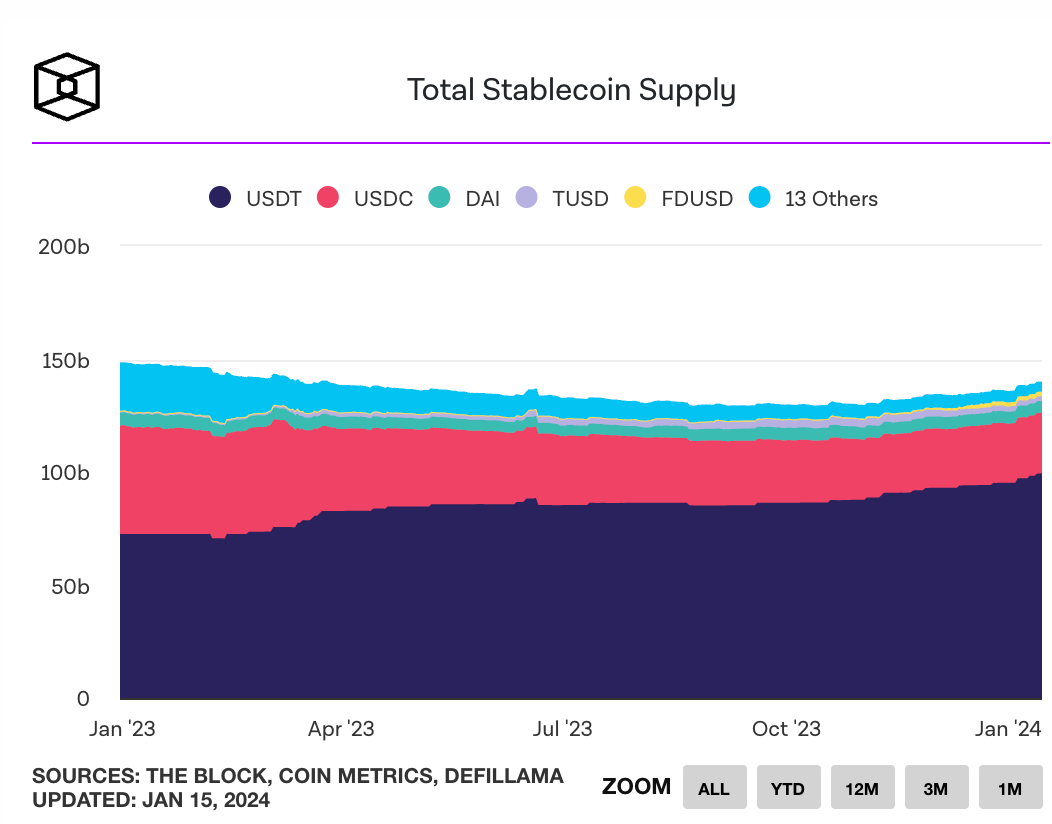
Over the course of 2023, Tether saw its share of global stablecoin supply grow from 50% to 71% , according to The Block data .
Disclaimer: The content of this article solely reflects the author's opinion and does not represent the platform in any capacity. This article is not intended to serve as a reference for making investment decisions.
You may also like
After Pectra comes Fusaka: Ethereum takes the most crucial step towards "infinite scalability"
The Fusaka hard fork is a major Ethereum upgrade planned for 2025, focusing on scalability, security, and execution efficiency. It introduces nine core EIPs, including PeerDAS, to improve data availability and network performance. Summary generated by Mars AI. The accuracy and completeness of this summary are still being iteratively updated by the Mars AI model.

Decoding VitaDAO: A Paradigm Revolution in Decentralized Science

Mars Morning News | ETH returns to $3,000, extreme fear sentiment has passed
The Federal Reserve's Beige Book shows little change in U.S. economic activity, with increasing divergence in the consumer market. JPMorgan predicts a Fed rate cut in December. Nasdaq has applied to increase the position limit for BlackRock's Bitcoin ETF options. ETH has returned to $3,000, signaling a recovery in market sentiment. Hyperliquid has sparked controversy due to a token symbol change. Binance faces a $1 billion terrorism-related lawsuit. Securitize has received EU approval to operate a tokenization trading system. The Tether CEO responded to S&P's credit rating downgrade. Large Bitcoin holders are increasing deposits to exchanges. Summary generated by Mars AI. The accuracy and completeness of this summary are still being iteratively improved by the Mars AI model.

Trending news
MoreCrypto prices
More





