Key Notes
- The exclusion could force passive funds to dump billions in Strategy shares, potentially triggering massive sell-offs.
- Saylor argues DATs operate as legitimate businesses using Bitcoin for shareholder returns, not passive investment funds.
- MSCI's arbitrary 50% digital asset threshold doesn't apply to oil or real estate companies, revealing inconsistent standards.
Strategy Inc , the world’s largest Bitcoin BTC $90 968 24h volatility: 1.9% Market cap: $1.81 T Vol. 24h: $55.44 B treasury company, has formally challenged MSCI’s proposal to exclude digital asset treasury companies (DATs) from its Global Investable Market Indexes, with a public letter on Dec. 10.
The move, which would remove firms with more than 50% of their assets in digital assets, has sparked a heated debate over the future of crypto-focused companies in traditional finance benchmarks.
MSCI’s Proposed Exclusion Because DAT Are Not a Business
The MSCI’s consultation , scheduled to conclude by Jan. 15, 2026, seeks feedback on whether DATs should remain eligible for its indices. The proposal targets companies like Strategy, which holds over 660,000 Bitcoin, with a total value exceeding $60 billion, according to Strategy .
MSCI argues that such companies may resemble investment funds rather than operating businesses, and thus no longer fit the purpose of its equity benchmarks. This is a new vision of the original MSCI index, which added Strategy stocks in May 2024 .
Strategy’s Counterargument to This Vision
Strategy’s executive leadership, including Michael Saylor and Phong Le, has pushed back, stating that DATs are operating companies—not investment funds— in a public letter requesting public support.
Strategy has submitted its response to MSCI’s consultation on digital asset treasury companies. Index standards should be neutral, consistent, and reflective of global market evolution. Read our letter and share your support:
— Michael Saylor (@saylor) December 10, 2025
They emphasize that Strategy actively uses its Bitcoin treasury to create returns for shareholders through innovative digital credit instruments and enterprise analytics software. The company also warns that the proposed 50% threshold is arbitrary and discriminatory, as other industries (oil, real estate, etc.) are not held to similar standards.
Impact of Index Removal for Strategy
If MSCI removes Strategy from its indexes, passive funds tracking MSCI benchmarks could be forced to sell billions of shares, according to the company mentioned in the talks with MSCI. Analysts estimate that up to $8.8 billion in outflows could occur, potentially triggering a major sell-off and further pressuring Strategy’s already volatile stock price.
The company’s market capitalization has recently fallen below the value of its Bitcoin holdings, raising concerns about possible forced sales of its reserves. Despite this, Saylor affirms they are not selling until 2065 .
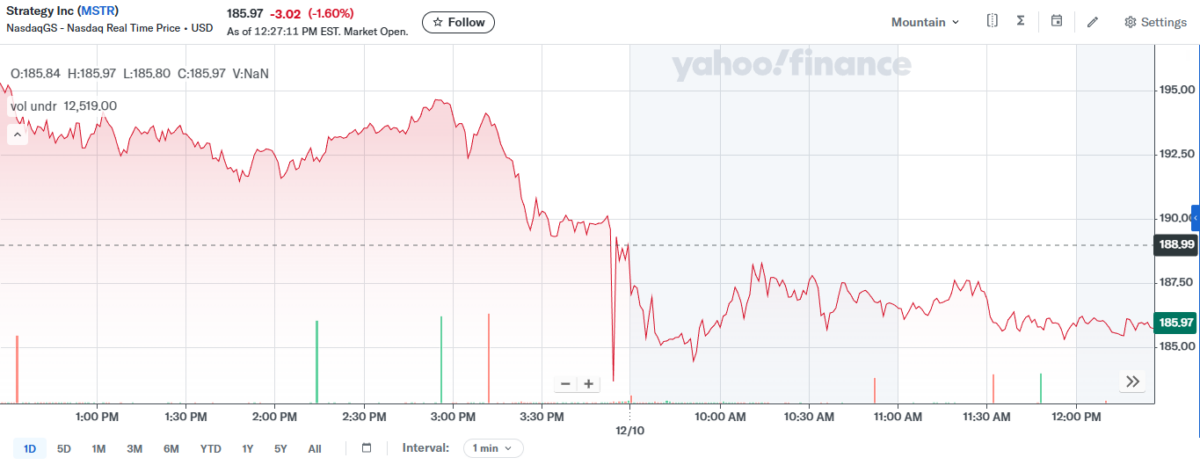
Graph of Strategy’s stock prices in the market | Source: Yahoo! Finance
Despite these institutional movements, Strategy’s stock prices are following Bitcoin’s price changes more than news about the removal of this index.
Removal from the MSCI index would not only deprive Strategy of billions in passive investment flows but also signal to the market the institutional recognition of digital asset treasury strategies.
next