
Crypto Market Review: Bitcoin (BTC) $90,000 Drop Is Nothing, Ethereum (ETH) Mini-Death Cross Is Bullish, Shiba Inu (SHIB) Bears Are Not in Control

Bitcoin's brief decline below $90,000 appears dramatic, but structurally, it barely changes anything. This move was a volatility event within an ongoing macro uptrend, not a break in the trend. Almost instantly, the price returned to the high-$80,000 range after flushing liquidity and resetting leverage. A similar story is relevant for Ethereum's future as the asset is seeing a mini-death cross formation. Smaller assets like SHIB are in waiting mode, though.
Bitcoin's strong base
Despite a steep sell-off, Bitcoin is still higher on the daily chart than its long-term trend base. The overall structure looks more like a corrective leg than a trend reversal, and the 200-day moving average is still significantly below the current price. The fact that a decline below $90,000 did not result in consistent follow-through is more important. Sellers had the opportunity but were unable to take it. That in and of itself indicates that demand is still beneath the market.
That point is supported by volume behavior. Following the sell-off, there was a classic liquidation-driven flow spike in activity, which was followed by a decline in volume on the bounce. That typically indicates that forced sales, not natural distribution, are being absorbed.
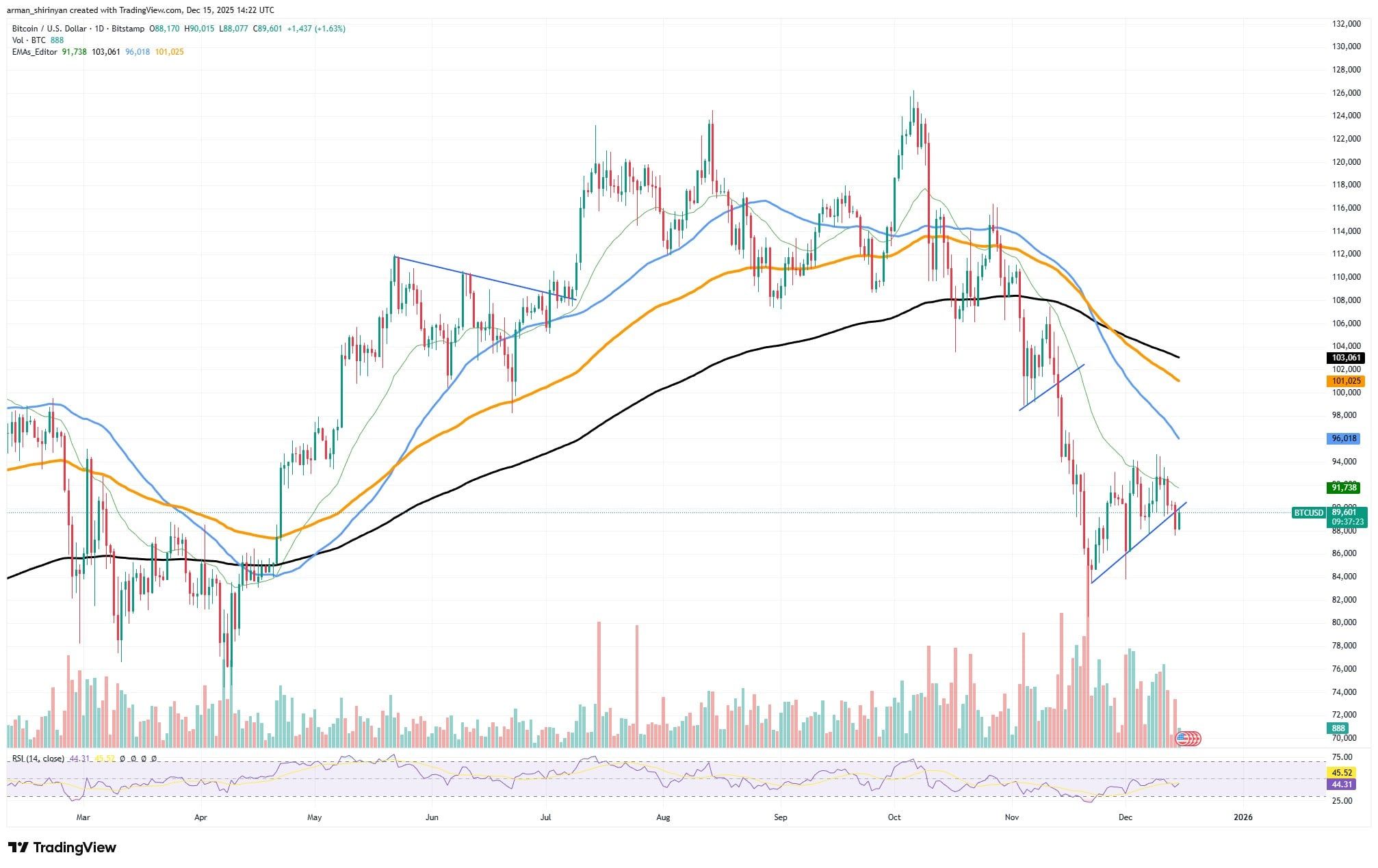
This perspective is further supported by the RSI, which is currently in the low-to mid-40s. Bitcoin cooled off without going into severe oversold territory. Instead of collapsing, momentum is reset. Over-weighting round-number psychology is the main error that many traders make. Although $90,000 seems significant, Bitcoin does not hold emotional values for very long. Liquidity positioning and trend structure are all respected.
The recent dip appears to be more of a springboard than a ceiling from that angle. The price is currently forming a base that usually precedes continuation rather than failure, as it consolidates in a tightening range. When you zoom out, the overall story remains the same.
ETF flows continue to be a structural bid. Exchange supply is still historically limited. Long-term holders have not exhibited signs of panic. Such dips actually tend to strengthen conviction rather than undermine it. In order to reduce excess leverage and reprice risk, the market required this retreat.
Ethereum's fuel incoming
A mini-death cross on Ethereum's daily chart initially appears to be bad news. When short-term moving averages fall below longer-term ones, reactive selling and bearish headlines typically follow. However, given the current state of the Ethereum market, that signal is more of a setup than a warning, and volatility is the primary cause.
Following a protracted decline and a distinct volatility compression phase, there was a recent crossover between faster EMAs and the midterm trend. For weeks, ETH was steadily declining, its volume was thinning out and its momentum was flattening. Strong downtrends typically do not continue like that. Actual bearish extensions typically pick up speed rather than stagnate. Rather, Ethereum went into a coiled state, and the release valve is essentially the mini-death cross.
In the past, Ethereum has benefited more from volatility than the majority of large-cap assets. It has a strong connection to leveraged positioning, DeFi liquidity and derivatives markets. ETH typically moves faster and harder than Bitcoin in both directions when volatility increases, and upside movements frequently take the lead following protracted cooling periods. Both implied and realized volatility are currently rising above suppressed levels.
Technically speaking, the price and moving averages are no longer collapsing. After several defenses, ETH is stabilizing around the $3,100-$3,200 range. Instead of being oversold, the RSI is holding close to neutral, indicating that sellers are losing ground rather than gaining control. Crucially, the death cross occurs at the end of the move rather than at the beginning.
Positioning is another aspect that is often ignored. Early shorts are encouraged, and late longs are shaken out by mini-death crosses. It is an imbalance. Short-covering can rapidly intensify the move if the price stays above recent lows and volatility increases. For that, Ethereum just needs movement, not a flawless macro backdrop.
Shiba Inu's divergence
At this point, Shiba Inu's price action appears dull on the surface, but the underlying structure reveals a different picture. SHIB is no longer speeding downward after months of decline. It is compressing instead, and that is important. Compression following a downtrend typically indicates that selling pressure is waning rather than weakness.
The volume-price divergence is currently the most significant signal. Although the price has been reaching slightly lower lows, volume has not increased in tandem with those movements. In actuality, compared to previous sell-offs, the most recent downside attempts occurred on noticeably weaker volume.
From a technical perspective, SHIB is developing a short-term rising structure close to local lows. Even though the general downtrend is still apparent on longer time frames, higher lows are emerging. This implies accumulation as opposed to distribution. Instead of chasing green candles, big players create positions when sentiment is dead and volatility is low. SHIB is currently trading in precisely that kind of environment.
Casual traders are kept cautious by the moving averages' continued overhead position, which is also the original purpose of this setup. Trend continuation begins when pressure subtly builds beneath resistance, not when everything appears to be in order. The move may quickly reverse if volume starts to increase and the price stays above the most recent high low.
RSI strengthens the case. Rather than falling into oversold conditions, it is holding in neutral territory. That indicates that momentum is increasing rather than decreasing. Bears failed to decisively push SHIB lower, despite having plenty of time to do so.
Disclaimer: The content of this article solely reflects the author's opinion and does not represent the platform in any capacity. This article is not intended to serve as a reference for making investment decisions.
You may also like
DEX users keep full custody as smart contracts replace exchange middlemen
J.P. Morgan Launches First Tokenized Money Market Fund on Ethereum, Bringing $4T Giant On-Chain

Trending news
MoreCrypto prices
More





