
Alphabet Stock Outlook 2026–2027: How to Trade GOOGL on Bitget
Alphabet (NASDAQ: GOOGL), the parent company of Google, is entering 2027 with one of the most ambitious artificial intelligence strategies in the technology industry. From Google Search and Gemini to Google Cloud, YouTube, and its custom AI processors, Alphabet is investing heavily in a future where artificial intelligence becomes part of nearly every digital service.
The company's latest financial results show just how quickly that business is changing.
In Q3 2026, Alphabet reported revenue of $127.6 billion, up 25% year over year. Google Cloud revenue surged 103% to $30.7 billion, supported by enormous demand for AI infrastructure, enterprise computing, and Google's Tensor Processing Units (TPUs). Meanwhile, Google Search continued generating substantial advertising revenue, and the Gemini app reached one billion users.
However, those impressive results did not prevent a significant stock-market correction.
After reaching a 52-week high of $408.61 in May 2026, GOOGL declined to $280.03 by November 3, approximately 31.5% below its peak. Investors have become increasingly concerned about the profitability of AI-powered Search, weaker-than-expected advertising performance, and Alphabet's plans to spend 195 billion-205 billion on capital expenditure in 2026.
Can Google Cloud, Gemini, and AI-powered Search drive another Alphabet stock rally in 2027, or will rising infrastructure costs and competition put further pressure on its valuation?
This article examines Alphabet's 2026 stock performance, latest financial results, growth opportunities, major risks, analyst forecasts for 2027, and the different ways to trade Alphabet on Bitget.
Key Takeaways
-
Alphabet delivered strong Q3 2026 revenue growth. Total revenue reached $127.6 billion, up 25% year over year, while operating income increased 30% to approximately $40.6 billion.
-
GOOGL has experienced significant volatility. Shares closed at $280.03 on November 3, 2026, down approximately 10.5% year to date and 31.5% below their May high of $408.61.
-
Google Cloud and AI infrastructure remain major growth drivers. Cloud revenue surged 103% to $30.7 billion, supported by enterprise AI demand, TPU systems, and Google Cloud Platform services.
-
AI Search presents both opportunities and challenges. Google Search revenue increased 12%, but investors remain concerned about advertising monetization as users increasingly interact with AI-powered search experiences.
-
Alphabet's capital spending is substantial. The company expects 195billion–205 billion in capital expenditure during 2026, with a significant increase anticipated in 2027.
-
Bitget provides multiple ways to access Alphabet-related markets, including real GOOGL shares through Stock+, rGOOGL tokenized stocks, GOOGLUSDT perpetual futures, U.S. stock options, Stock Dual Investment, UTA, Crypto Loans, and Auto-Invest+.
Alphabet (GOOGL) Stock Performance in 2026
Alphabet operates some of the world's most widely used digital products and services, including Google Search, YouTube, Android, Chrome, Google Maps, Gmail, Gemini, and Google Cloud.
The company's business is divided into three main segments: Google Services, Google Cloud, and Other Bets.
Google Services includes Search advertising, YouTube, subscriptions, and consumer products. Google Cloud provides infrastructure, enterprise software, and AI services, while Other Bets includes emerging businesses such as Waymo.
For years, Google Search has been the company's biggest source of revenue and profit.
However, artificial intelligence is changing how people search for information, interact with software, and access computing resources.
Alphabet is investing heavily to remain competitive across these markets.
That strategy has produced strong revenue growth, but it has also introduced new financial pressures.
Alphabet Stock Price and Key Market Data
The following figures use Alphabet's completed regular-session closing price on November 3, 2026, together with its latest reported financial results.
| Metric |
Alphabet (GOOGL) |
| Stock ticker |
NASDAQ: GOOGL |
| Share class |
Class A |
| Last completed closing price |
$280.03 (Nov. 3, 2026) |
| 52-week range |
270.70-408.61 |
| 52-week high date |
May 18, 2026 |
| 52-week low date |
November 14, 2025 |
| 2025 year-end closing price |
$313.00 |
| 2026 YTD price return |
Approximately −10.53% |
| Market capitalization |
Approximately $3.43 trillion |
| Trailing P/E ratio |
Approximately 14.6 |
| Latest quarterly revenue |
$127.6 billion |
| Q3 2026 Google Cloud revenue |
$30.7 billion |
| Q3 2026 diluted EPS |
$2.12 |
| Quarterly common stock dividend |
$0.22 per share, latest declared |
| Average analyst price target |
$400.37 |
Sources: Alphabet Investor Relations, GOOGL Historical Prices, Alphabet Q3 2026 Earnings, and GOOGL Analyst Forecasts. Price returns exclude dividends. Market prices, valuations, and analyst estimates may change.
How Has Alphabet Stock Performed in 2026?
Alphabet ended 2025 at $313 per share, supported by investor optimism surrounding Google Cloud, Gemini, AI infrastructure, and the company's expanding technology ecosystem.
The stock entered 2026 with considerable momentum.
During the first several months, investors remained optimistic about Google's position in the rapidly growing artificial intelligence market.
Alphabet continued expanding its cloud infrastructure, developing advanced AI models, and introducing AI-powered features across Google Search and other products.
That optimism helped push GOOGL to an intraday high of $408.61 on May 18, 2026.
The price represented an increase of approximately 30.5% from its 2025 year-end closing price.
However, the stock subsequently experienced a substantial correction.
Investors became increasingly concerned about the cost of developing AI infrastructure and the possibility that AI-powered search experiences could change the economics of Google's advertising business.
The biggest short-term shock came after Alphabet released its Q3 financial results on October 28.
GOOGL closed at $324.89 that day.
On October 29, the stock declined 12.64% to $283.82, one of its most significant single-day declines.
The selloff followed weaker-than-expected Search advertising performance, disappointing quarterly free cash flow, and growing concerns about future capital expenditure.
Shares continued experiencing volatility in the following sessions.
GOOGL closed at $279.84 on October 30 and $278.99 on November 2.
The stock recovered slightly on November 3, gaining 0.37% to close at $280.03.
Despite that rebound, Alphabet remained approximately 31.5% below its May high and 10.5% lower than at the end of 2025.
The contrast between strong business growth and weaker share-price performance highlights an important concern.
Investors are not necessarily questioning whether Alphabet can benefit from AI. They are questioning how much it must spend to capture that opportunity—and whether AI will strengthen or disrupt Google's existing advertising business.
Alphabet's Latest Financial Results: Q3 2026
On October 28, 2026, Alphabet announced its third-quarter financial results, covering the three months ended September 30.
The company delivered its 13th consecutive quarter of double-digit revenue growth.
Key results included:
-
Total revenue: $127.58 billion, up 25% year over year.
-
Google Services revenue: $96.30 billion, up 11%.
-
Google Search and other revenue: $63.35 billion, up 12%.
-
YouTube advertising revenue: $11.21 billion, up approximately 9%.
-
Google subscriptions, platforms, and devices revenue: $14.29 billion, up 11%.
-
Google Cloud revenue: $30.71 billion, up 103%.
-
Google Cloud operating income: $11.12 billion, compared with $3.59 billion a year earlier.
-
Consolidated operating income: $40.58 billion, up 30%.
-
Operating margin: 31.8%.
-
Net income attributable to common stockholders: $26.17 billion.
-
Diluted EPS: $2.12.
-
Quarterly free cash flow: Negative $9.07 billion.
The strongest performance came from Google Cloud.
Revenue more than doubled, and Cloud operating income increased from approximately $3.6 billion to $11.1 billion.
Cloud operating margin also improved from 23.7% to 36.2%.
These figures demonstrate that Google Cloud is becoming an increasingly important contributor to Alphabet's profitability.
However, the company's overall financial performance was more complicated.
Despite higher operating income, net income declined from approximately $35 billion a year earlier to $26.2 billion.
A significant factor was an $8.22 billion net non-operating expense during the quarter, compared with substantial non-operating income in the prior-year period.
Alphabet also recorded negative free cash flow of approximately $9.1 billion as spending on AI infrastructure increased.
The company generated $42.29 billion in operating cash flow but spent approximately $51.36 billion on property and equipment.
That difference pushed quarterly free cash flow into negative territory.
For investors, the results demonstrate both the commercial success of Alphabet's AI expansion and the substantial financial resources required to support it.
Why Did Alphabet Stock Fall After Strong Earnings?
Alphabet's October earnings announcement illustrates how investor expectations have changed.
A company can report 25% revenue growth and still experience a major stock selloff when the results fall short of what investors anticipated.
According to Reuters, Alphabet's Q3 revenue was below Wall Street's approximately $128.2 billion estimate.
Google's advertising business was also weaker than analysts had expected.
Search revenue increased 12%, but its growth rate had slowed from earlier quarters.
Meanwhile, the company reported negative quarterly free cash flow and reiterated substantial infrastructure spending plans.
Investors also became concerned about the increasing popularity of AI-powered search experiences.
Traditional Google Search generates revenue through advertisements displayed alongside search results.
However, conversational AI systems may change how users discover information and interact with advertisers.
If users increasingly receive answers directly from AI systems, Google's advertising formats and monetization methods may need to evolve.
Alphabet argues that AI is creating additional search activity, including more commercial queries.
But investors want evidence that those additional queries can generate attractive advertising revenue.
For 2027, this will be one of the biggest questions affecting GOOGL's valuation.
Alphabet's 2026 Capital Expenditure and 2027 Guidance
Alphabet's management expects infrastructure investment to remain substantial.
During its Q3 earnings call, the company confirmed:
| Metric |
Latest guidance or outlook |
| Full-year 2026 capital expenditure |
195 billion-205 billion |
| 2027 capital expenditure |
Expected to increase significantly |
| Google Cloud TPU system sales |
Expected to scale further in Q4 2026 |
| TPU-related revenue in 2027 |
Meaningful growth expected |
| Google Cloud infrastructure demand |
Strong, with capacity expansion underway |
| Near-term Cloud margins |
Potential pressure from third-party compute capacity and infrastructure costs |
The midpoint of Alphabet's 2026 capital expenditure guidance is approximately $200 billion.
These investments primarily support data centers, AI computing equipment, networking, and other technical infrastructure.
Management expects capital spending to increase significantly again in 2027.
This creates an important question for investors.
How quickly can Alphabet convert its enormous AI infrastructure investments into sustainable free cash flow?
If Google Cloud and AI services continue expanding rapidly, the company could benefit from increased utilization and higher revenue.
However, elevated spending may continue pressuring cash flow, while depreciation and data center operating costs could affect future margins.
Alphabet Stock Outlook 2026–2027: Key Growth Drivers
Alphabet has several established businesses capable of supporting long-term growth.
However, artificial intelligence is increasingly connecting those businesses.
Google is integrating AI into Search, Cloud, Android, productivity software, advertising, and consumer applications.
This gives Alphabet multiple opportunities to generate revenue from the same underlying technology.
1. Google Search, AI Overviews, and AI Mode
Google Search remains one of Alphabet's most important businesses.
In Q3 2026, Google Search and other advertising revenue reached approximately $63.35 billion.
That represents nearly half of Alphabet's total quarterly revenue.
The company is now integrating artificial intelligence more deeply into Search through AI Overviews and AI Mode.
These features allow users to receive AI-generated responses, ask follow-up questions, and complete more complex research tasks.
Alphabet believes these experiences can encourage additional search activity.
During its October earnings call, CEO Sundar Pichai said Google's year-over-year Search query growth rate was the highest in five years.
That is an encouraging sign for user engagement.
However, more searches do not automatically translate into more advertising revenue.
Traditional Search advertising benefits from well-established formats and strong commercial intent.
AI-powered search experiences introduce different user interactions, which may require new advertising formats and monetization models.
For example, users researching a product may interact with an AI-generated recommendation before visiting a retailer's website.
Google must determine how to create advertising opportunities within those experiences without compromising usefulness.
If Alphabet successfully monetizes AI-powered Search, it could strengthen one of the world's largest advertising businesses.
If monetization proves less effective than traditional Search, revenue growth and profit margins could face pressure.
2. Google Cloud and Enterprise AI Infrastructure
Google Cloud is becoming one of Alphabet's most important growth engines.
The business provides computing infrastructure, data storage, networking, cybersecurity, and AI services to enterprise customers.
As more businesses adopt AI, they require increasingly powerful computing systems.
Google Cloud is benefiting directly from that demand.
In Q3 2026, revenue increased 103% to approximately $30.7 billion.
That represented an annualized revenue run rate of more than $122 billion.
More importantly, Cloud operating income increased to approximately $11.1 billion, more than three times the prior-year level.
The growth was driven by Google Cloud Platform, including AI infrastructure, AI solutions, and traditional cloud services.
Demand for Google Cloud's enterprise AI products continues increasing.
The company also reported a substantial backlog of contracted business, providing greater visibility into potential future revenue.
However, cloud infrastructure is capital-intensive.
Google must continue expanding data center capacity and purchasing or manufacturing computing equipment to serve customers.
The company has also begun utilizing additional third-party compute capacity to meet demand.
That may create near-term margin pressure.
For 2027, investors should monitor whether Google Cloud can sustain high growth while maintaining attractive profitability.
3. Gemini 4 and Google's Expanding AI Ecosystem
Gemini has become central to Alphabet's AI strategy.
Google is developing advanced models designed for reasoning, coding, multimodal tasks, and AI agents.
In October 2026, the company introduced Gemini 4 Argon and Gemini 4 Carbon.
These models are designed to support increasingly sophisticated tasks across consumer applications and enterprise workflows.
Alphabet has also been integrating Gemini into Search, Android, Chrome, Workspace, and other products.
During its Q3 earnings announcement, the company reported that the Gemini app had reached one billion users.
Meanwhile, Google's first-party model APIs were processing nearly 32 billion tokens per minute, more than four times the volume recorded a year earlier.
These figures demonstrate the scale of Gemini adoption.
The opportunity is substantial.
Alphabet can monetize AI through subscriptions, cloud usage, enterprise software, advertising, and consumer services.
For example, a business may use Gemini through Google Cloud, while an individual consumer may access AI features through Google One or Workspace.
However, advanced AI models are expensive to develop and operate.
Alphabet must continue investing in computing infrastructure, researchers, and model development.
For investors, the key question is whether Gemini can generate additional revenue and improve customer engagement at a pace that justifies these costs.
4. Google's TPU Chips and Custom AI Infrastructure
Alphabet's custom AI chips provide another important growth opportunity.
Google has been developing Tensor Processing Units, or TPUs, for machine learning and AI computing workloads.
Unlike general-purpose processors, TPUs are designed specifically to accelerate selected AI tasks.
Google uses these processors within its own infrastructure and offers TPU-based computing solutions to enterprise customers.
This gives Alphabet more control over its technology stack.
The company can combine custom processors, data center infrastructure, AI models, and cloud software into an integrated offering.
That may help improve performance and efficiency while reducing dependence on external chip suppliers for certain workloads.
In Q3 2026, Alphabet reported that TPU system sales contributed meaningfully to Google Cloud's revenue growth.
Management expects TPU sales to expand in Q4 2026, followed by a more substantial revenue increase in 2027.
The opportunity extends beyond using TPUs internally.
Google can also generate revenue by providing TPU systems and related infrastructure to customers.
However, building these systems requires significant investment in chips, servers, networking equipment, and other components.
Competition from NVIDIA, AMD, and other AI hardware providers remains intense.
For Alphabet, success will depend on whether TPU systems offer attractive performance, pricing, and operational efficiency.
5. YouTube Advertising and Subscription Revenue
YouTube remains another important part of Alphabet's business.
The platform generates revenue through advertising, subscriptions, creator services, and other commercial activities.
In Q3 2026, YouTube advertising revenue increased approximately 9% to $11.21 billion.
Meanwhile, Google subscriptions, platforms, and devices revenue grew 11% to $14.29 billion.
Subscription growth was supported by YouTube Music, YouTube Premium, and paid AI services through Google One.
Alphabet also reported surpassing 150 million YouTube Music and Premium subscribers globally, including trial subscriptions.
YouTube's business continues expanding beyond traditional video advertising.
The platform is increasingly connected to streaming television, shopping, creator monetization, and subscription services.
AI could create additional opportunities through improved content recommendations, automated video production, and advertising optimization.
However, YouTube faces competition from TikTok, Netflix, streaming platforms, and other digital entertainment services.
Advertising demand is also sensitive to economic conditions.
For investors, continued subscription growth and improved advertising monetization could help diversify Alphabet's revenue.
6. Waymo and Autonomous Transportation
Alphabet's growth opportunities extend beyond Search, advertising, and cloud computing.
Waymo, its autonomous driving business, is one of the most prominent examples.
Waymo operates self-driving transportation services in selected U.S. cities.
During Alphabet's October 2026 earnings call, management reported that Waymo had completed more than 300 million fully autonomous miles.
The company also indicated that Waymo was operating in 15 major U.S. cities, with additional international expansion plans.
These developments suggest that autonomous transportation is becoming a more established commercial service.
However, Waymo remains part of Alphabet's Other Bets segment.
That segment generated approximately $372 million in revenue during Q3 2026 while recording an operating loss of $2.05 billion.
The business therefore remains a long-term investment rather than a major contributor to Alphabet's consolidated profitability.
Future opportunities may include robotaxi services, commercial partnerships, and broader autonomous vehicle applications.
However, expansion depends on regulatory approval, safety performance, consumer adoption, and operating economics.
Investors should avoid assuming that Waymo's long-term commercial potential will translate into near-term earnings.
7. Strong Operating Profitability and Financial Resources
Alphabet's profitability remains an important advantage.
In Q3 2026, the company generated operating income of approximately $40.6 billion.
Google Services contributed $39.2 billion in operating profit, while Google Cloud generated $11.1 billion.
Alphabet also ended the quarter with approximately $265.1 billion in cash and marketable securities, including equity investments.
These financial resources give the company significant flexibility to invest in AI infrastructure, research, and new products.
However, its cash flow profile is changing.
Quarterly free cash flow turned negative as capital expenditure increased.
Alphabet's trailing 12-month free cash flow remained positive at approximately $19.7 billion, but that was substantially lower than the cash generation investors had become accustomed to.
For 2027, the challenge is balancing rapid AI expansion with sustainable profitability and financial discipline.
What Are the Biggest Risks for Alphabet Stock in 2027?
Alphabet has several promising growth opportunities, but its investments also introduce meaningful risks.
1. AI Could Change the Economics of Google Search
Google Search is a highly profitable advertising business.
However, AI-powered search engines and conversational assistants are changing how users discover information.
If users increasingly receive answers without clicking traditional search results, established advertising formats may become less effective.
Alphabet is developing new advertising experiences, but their long-term monetization potential remains uncertain.
2. Enormous AI Capital Expenditure
Alphabet expects 195 billion-205 billion in capital expenditure during 2026 and a significant increase in 2027.
These investments support data centers, TPUs, networking equipment, and other infrastructure.
However, AI infrastructure requires substantial upfront spending.
If customer demand grows more slowly than expected or operating costs increase, Alphabet's cash flow and profitability could face pressure.
3. Competition From OpenAI, Microsoft, Amazon, and Other AI Providers
Alphabet faces intense competition across artificial intelligence and cloud computing.
OpenAI and other AI developers are introducing new ways for users to search, research, and complete digital tasks.
Microsoft and Amazon are also expanding their cloud infrastructure and enterprise AI offerings.
Google must continue improving its products while maintaining competitive pricing and performance.
4. Google Cloud Infrastructure Costs
Google Cloud's recent revenue growth has been extraordinary.
However, building the necessary infrastructure is expensive.
Third-party computing capacity, depreciation, electricity costs, and equipment purchases could affect future operating margins.
Investors should monitor whether Cloud profitability continues improving as the business expands.
5. Regulation and Antitrust Risks
Alphabet operates in several heavily regulated markets.
Governments and regulators continue examining Google's search distribution agreements, advertising practices, app ecosystem, and competition policies.
Changes to regulations or adverse legal decisions could affect business operations, costs, or revenue.
The company also faces data privacy and AI-related regulatory requirements across different regions.
6. Valuation and Investor Expectations
At the November 3 closing price, Alphabet traded at approximately 14.6 times trailing earnings.
That valuation may appear relatively modest compared with some other major AI-related technology companies.
However, the company's reported earnings include non-operating items, including investment-related gains and losses.
Investors should therefore evaluate operating profits, normalized earnings, cash flow, and capital expenditure alongside the P/E ratio.
If Search revenue slows further or AI spending continues increasing faster than expected, GOOGL could face additional valuation pressure.
Alphabet Stock Price Prediction for 2026–2027
Can Alphabet stock return to $350 or reach $400 in 2027?
Wall Street analysts remain broadly optimistic, supported by Google Cloud growth, Gemini adoption, and Alphabet's established advertising ecosystem.
However, forecasts vary depending on assumptions about AI monetization, capital spending, competitive pressure, and profitability.
What Are Analysts' Alphabet Price Targets?
As of November 4, 2026, StockAnalysis reports the following estimates based on S&P Global analyst data.
| Analyst metric |
Price target |
| Average 12-month target |
$400.37 |
| Median target |
$400 |
| Lowest target |
$300 |
| Highest target |
$500 |
| Analyst consensus |
Strong Buy |
| Number of analysts |
58 |
Source: Alphabet Stock Forecast and Analyst Price Targets. These are rolling 12-month estimates, not guaranteed year-end 2027 prices.
Compared with Alphabet's November 3 closing price of $280.03, the average analyst target implies approximately 43% potential upside.
However, several analysts lowered their price targets following the company's October earnings release.
Recent revisions include:
-
Jefferies: Reduced its target from $445 to $400.
-
BMO Capital Markets: Reduced its target from $480 to $425.
-
Wells Fargo: Reduced its target from $417 to $371, with a subsequent update to $365.
-
Cantor Fitzgerald: Reduced its target from $420 to $350.
These revisions highlight the concerns surrounding Search monetization and infrastructure spending.
Analysts generally remain positive about Alphabet's AI and Cloud opportunities, but expectations for near-term profitability have become more cautious.
Price targets are forecasts rather than guarantees.
Alphabet Stock Outlook: Bull, Base, and Bear Scenarios
Rather than relying on one exact Alphabet stock price prediction for 2027, investors can evaluate three possible outcomes.
| Scenario |
Key assumptions |
Potential market direction |
| Bull case |
Google Cloud maintains strong growth, AI Search monetization improves, and Gemini adoption accelerates |
GOOGL could recover toward higher analyst targets |
| Base case |
Search remains profitable and Cloud continues expanding, but elevated infrastructure spending limits free cash flow |
Stock performance could broadly follow normalized earnings growth |
| Bear case |
AI Search weakens advertising monetization, capital spending rises faster than revenue, or competition intensifies |
GOOGL could face further valuation pressure |
-
Bull case: Alphabet successfully monetizes AI-powered Search while Google Cloud continues expanding rapidly. Gemini attracts additional subscribers and enterprise customers, and TPU sales support new revenue opportunities.
-
Base case: Alphabet maintains healthy revenue growth, but capital expenditure and depreciation weigh on free cash flow. Google Search remains profitable, while Cloud contributes a growing share of operating income.
-
Bear case: Traditional Search monetization weakens as users shift toward conversational AI. Infrastructure costs remain elevated, competition intensifies, and investors reassess Alphabet's growth expectations.
These scenarios are illustrative rather than guaranteed future trading ranges.
Should You Buy Alphabet Stock in 2026 or Wait Until 2027?
Alphabet's recent correction may attract investors interested in artificial intelligence, cloud computing, and digital advertising.
The company has several established advantages, including Google Search, YouTube, Android, Gemini, and Google Cloud.
Its operating businesses continue generating substantial profits.
However, a stock that has declined significantly from its high is not automatically undervalued.
Alphabet's capital expenditure plans and the uncertainty surrounding AI Search monetization remain important considerations.
Long-term investors may focus on Google Cloud revenue, Search profitability, Gemini adoption, and free cash flow.
Those concerned about infrastructure spending may prefer to monitor quarterly earnings and capital expenditure trends before making decisions.
Short-term traders may focus on earnings announcements, AI product releases, analyst revisions, and broader technology-sector sentiment.
There is also another consideration.
Buying and holding traditional Alphabet shares is no longer the only way to participate in GOOGL-related markets.
Through Bitget, eligible users can access real Alphabet shares, tokenized stocks, perpetual futures, options, structured investment products, and additional capital-management tools.
How to Trade Alphabet (GOOGL) on Bitget
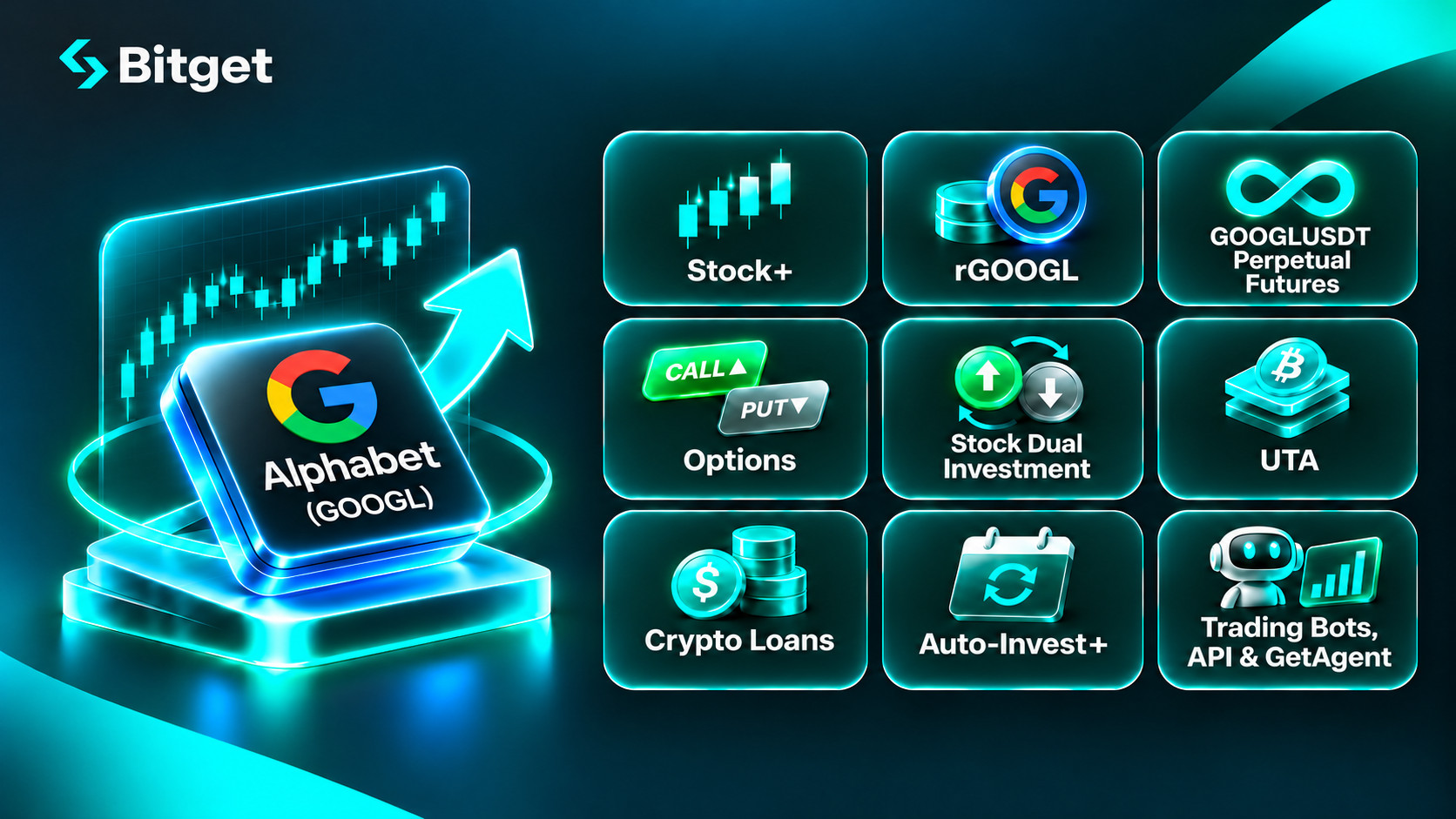
Alphabet is supported across several products within Bitget's expanding U.S. stock trading ecosystem.
Rather than limiting users to traditional share purchases, Bitget brings together real U.S. stocks, tokenized assets, derivatives, structured Earn products, and capital-management tools.
Eligible users can choose different approaches depending on whether they prefer direct ownership, USDT-based trading, leveraged exposure, recurring investing, or advanced strategies.
1. Buy Real Alphabet Shares With Bitget Stock+
For investors who prefer traditional stock ownership, Bitget Stock+ provides access to real Alphabet shares through compliant securities brokerage infrastructure.
Alphabet Class A shares (GOOGL) are explicitly included among the stocks promoted on the Stock+ platform.
Eligible users can purchase GOOGL shares within Bitget without arranging a separate external brokerage account.
Key features include:
-
Real stock ownership: Purchase actual Alphabet shares held through compliant brokerage infrastructure, with applicable shareholder rights.
-
Fractional investing: Buy supported shares in increments as small as 0.0001 shares.
-
24/5 trading: Access supported pre-market, regular, after-hours, and overnight weekday sessions.
-
USDC funding: Transfer USDC into a Stock+ account, with conversion into USD for stock transactions.
-
Zero management fees: No separate management fee, although trading and other applicable charges may apply.
-
Market information: Access stock quotes and eligible Nasdaq TotalView market-depth data.
-
Stock transfers: Transfer eligible positions from participating brokerage accounts.
For investors interested in Alphabet's long-term AI and Cloud growth, Stock+ provides a way to build traditional equity exposure while remaining within Bitget's broader financial ecosystem.
Alphabet also pays regular cash dividends.
In October 2026, the company declared a quarterly common stock dividend of $0.22 per share, payable on December 14 to shareholders of record on December 7.
Eligible Stock+ shareholders can receive applicable dividend distributions according to brokerage and corporate-action rules.
Unlike tokenized stocks or perpetual futures, Stock+ provides real share ownership through the brokerage arrangement.
Explore Alphabet Stock Trading With Bitget Stock+
2. Trade Alphabet rTokens (rGOOGL) With USDT
For crypto-native investors, Bitget rGOOGL/USDT offers tokenized exposure to Alphabet Class A shares.
rGOOGL is a Reality-issued tokenized stock designed to track GOOGL through 1:1 backing with underlying securities held through licensed brokerage and custody arrangements.
Unlike Stock+, holding rGOOGL does not provide direct registered ownership of Alphabet shares or shareholder voting rights.
Instead, users hold a token representing economic exposure to the underlying stock.
Key features include:
-
USDT-based trading: Buy and sell rGOOGL directly against USDT.
-
Fractional exposure: Access Alphabet-linked markets without purchasing an entire traditional share.
-
Extended trading access: Trade during supported sessions, including weekends where available.
-
Dividend-related benefits: Receive eligible net cash-dividend distributions in USDT according to the token's terms.
-
Collateral integration: Use qualifying rGOOGL holdings with supported UTA and Crypto Loans arrangements.
-
Reserve-backed structure: Underlying shares support the token's 1:1 asset-backing arrangement.
Bitget's Super Match infrastructure can connect eligible rToken orders with external equity-market liquidity during supported U.S. market sessions.
Orders are evaluated through Bitget's internal matching system before unmatched quantities are routed externally, subject to order settings and market conditions.
Outside those sessions, execution depends more heavily on internal token-market liquidity.
This can provide additional trading flexibility, although spreads and tracking differences may vary.
For investors already holding USDT, rGOOGL offers a way to gain Alphabet-linked exposure without moving funds into a separate brokerage environment.
3. Trade Alphabet Stock Perpetual Futures (GOOGLUSDT)
Traders looking for exposure to Alphabet's price movements in either direction can use Bitget GOOGLUSDT Perpetual Futures.
These USDT-margined derivative contracts provide exposure to Alphabet-related price movements without requiring ownership of the underlying shares.
Traders can open:
-
Long positions: Gain exposure to potential increases in GOOGL.
-
Short positions: Gain exposure to potential declines in Alphabet's stock price.
-
Leveraged positions: Control larger notional exposure using margin, subject to contract limits.
Bitget supports 24/7 trading for GOOGLUSDT perpetual futures.
Under the platform's published September 14, 2026 position-tier schedule, eligible GOOGLUSDT positions support leverage of up to 100x in the smallest position tier.
Larger positions have lower maximum leverage limits.
This provides additional trading flexibility for experienced users following Alphabet earnings, Gemini announcements, or developments in the AI sector.
For example, a trader expecting a positive reaction to stronger Google Cloud earnings may consider a long GOOGLUSDT position.
A trader anticipating a short-term decline could consider a short position.
However, leverage significantly increases risk.
At 100x leverage, even a small unfavorable price movement may lead to liquidation.
Traders should review funding rates, trading fees, margin requirements, and position limits before opening positions.
Trade GOOGLUSDT Perpetual Futures on Bitget
4. Trade Alphabet Stock Options on Bitget
Alphabet is also supported through Bitget U.S. Stock+ Options, giving eligible users access to GOOGL call and put options.
Options provide additional ways to express market views, hedge existing positions, and develop strategies around earnings announcements.
For example:
-
Call options: Gain exposure to potential increases in Alphabet's stock price.
-
Put options: Gain exposure to potential declines or hedge an existing position.
-
Protective puts: Purchase put contracts to establish downside protection.
-
Covered calls: Combine eligible share holdings with call selling to collect premiums while accepting limited potential upside.
-
Multi-leg strategies: Explore supported spreads, collars, straddles, and other options structures.
Bitget's options interface provides contract information including strike prices, expiration dates, implied volatility, market quotes, and Greeks.
On July 31, 2026, Bitget also introduced pre-market trading for selected U.S. stock options, explicitly including both GOOGL Class A and GOOG Class C shares.
Eligible GOOGL options can be traded between 4:00 AM and 9:30 AM Eastern Time through participating market makers, subject to contract availability.
This may be particularly useful for traders reacting to earnings announcements or major AI developments.
Bitget advertises zero trading commission on supported U.S. stock options, although platform fees, premiums, spreads, clearing charges, and other applicable costs may still apply.
Options involve substantial risks, including the possibility of losing the entire premium paid.
More complex strategies can create additional obligations and losses.
Explore Alphabet Stock Options on Bitget
5. Use rGOOGL With Bitget Stock Dual Investment
For investors interested in target-price strategies, Bitget Stock Dual Investment provides another way to access Alphabet-linked markets.
Bitget launched Stock Dual Investment on July 25, 2026, with rGOOGL among its first six supported tokenized stocks.
The product offers two main approaches:
-
Buy Low: Subscribe using USDT and select a target price at which you would be comfortable acquiring rGOOGL.
-
Sell High: Use eligible rGOOGL holdings in a strategy based on a higher target selling price.
Users receive yield according to the selected product's terms, while final settlement depends on the token's observation price and the agreed conditions.
For example, suppose an investor is interested in Alphabet but prefers to enter at a lower price.
Instead of immediately purchasing rGOOGL, the investor could consider an available Buy Low product with a lower target price.
If the settlement conditions are met, the subscription may be converted into rGOOGL.
Otherwise, the investor may receive USDT plus the specified yield according to the product rules.
This creates an alternative to an ordinary limit order, although the settlement mechanism and risks differ.
Stock Dual Investment is not principal-protected.
If Alphabet declines significantly, the market value of tokens received at settlement may be lower than the initial investment.
Available APRs, target prices, and settlement dates depend on the current subscription terms.
Explore rGOOGL Stock Dual Investment on Bitget
6. Use rGOOGL as Collateral With Bitget Unified Trading Account (UTA)
Bitget supports eligible Alphabet tokenized stock holdings through its Unified Trading Account (UTA).
UTA is designed to improve capital efficiency by allowing supported assets to contribute collateral value across eligible trading activities.
Bitget explicitly includes rGOOGL among the stock tokens supported within its UTA collateral framework.
This allows qualifying users to retain Alphabet-linked exposure while using its recognized collateral value to support additional positions.
For example, a trader holding rGOOGL may be able to use its eligible collateral value within a shared margin arrangement rather than selling the tokens first.
This can provide greater capital flexibility.
For advanced traders, Bitget's Delta Neutral Mode also supports eligible hedging arrangements between tokenized stocks and their corresponding stock perpetual futures.
A qualifying strategy could combine an rGOOGL spot holding with an offsetting GOOGLUSDT futures position.
This may help traders explore basis or funding-rate strategies while managing directional exposure.
However, such strategies are not risk-free.
Funding rates can change, execution costs can reduce returns, and imperfect hedges can generate losses.
Collateral value is also subject to discount ratios, position limits, and account requirements.
If Alphabet's stock price declines, the recognized value of rGOOGL collateral may also fall, increasing margin or liquidation risk.
Explore Bitget UTA and rGOOGL Collateral Trading
7. Borrow Against rGOOGL With Bitget Crypto Loans
Investors who want additional liquidity without immediately selling their Alphabet-linked holdings can explore Bitget Crypto Loans.
On July 8, 2026, Bitget expanded Crypto Loans to support 26 popular U.S. stock and ETF tokens as collateral, explicitly including rGOOGL.
Eligible users can pledge rGOOGL and borrow supported assets such as USDT or USDC.
For example, an investor holding rGOOGL may want stablecoin liquidity while maintaining exposure to Alphabet's future stock-price movements.
Instead of selling the tokenized position, the investor could consider a collateralized loan.
Bitget's published rGOOGL collateral parameters include:
| Parameter |
Published rGOOGL terms |
| Individual collateral limit |
12 million USDT |
| Initial LTV |
78% |
| Margin call LTV |
85% |
| Liquidation LTV |
91% |
These parameters are based on Bitget's published collateral schedule and may change. Users should check current loan terms before borrowing.
Borrowing against rGOOGL can provide additional flexibility, but it introduces interest costs and collateral risks.
If Alphabet's price declines, the loan-to-value ratio may increase.
Users could face a margin call or liquidation if their position breaches the applicable thresholds.
For eligible investors who understand these risks, Crypto Loans provide another way to access liquidity while retaining Alphabet-linked exposure.
Explore rGOOGL Crypto Loans on Bitget
8. Build Alphabet Exposure Automatically With Bitget Auto-Invest+
For investors who prefer recurring purchases rather than trying to time every market movement, Bitget Spot Auto-Invest+ provides an automated approach.
On October 27, 2026, Bitget expanded Spot Auto-Invest to more than 3,000 U.S. stock and ETF rTokens, covering all rTokens supported for spot trading.
This includes rGOOGL.
The feature allows eligible users to configure recurring purchases based on their investment preferences.
Available schedules include:
-
Hourly purchases.
-
Daily purchases.
-
Weekly purchases.
-
Monthly purchases.
For example, an investor interested in Alphabet's long-term AI and Cloud growth could choose to purchase a fixed USDT amount of rGOOGL every week.
Instead of manually placing every order, the system executes eligible purchases according to the configured schedule.
This supports a dollar-cost averaging approach, spreading purchases across multiple dates.
Users can also create investment plans involving multiple supported assets.
However, automated investing does not eliminate market risk.
If Alphabet's share price declines, the value of rGOOGL holdings may also fall.
Scheduled purchases may be skipped when an instrument is unavailable for trading, and missed purchases are not necessarily executed later.
Explore rGOOGL Auto-Invest+ on Bitget
9. Explore Trading Bots, API, Smart Portfolio, and GetAgent
Bitget's broader ecosystem also offers tools for users interested in automated trading and portfolio management.
Through the Bitget rToken Trading API, eligible users can access supported market data and trading functions for tokenized U.S. stocks.
These tools can support price monitoring, order execution, and advanced trading workflows.
Bitget also provides Trading Bots for eligible instruments.
Users can explore supported automated strategies through the trading bot interface, although the availability of specific bot types for rGOOGL should be checked before creating a strategy.
For portfolio management, Bitget's Smart Portfolio tools support eligible stock-token and cryptocurrency allocations with automated rebalancing capabilities, subject to the supported asset list.
Another option is Bitget GetAgent, its AI-powered trading assistant.
GetAgent can help users explore market developments, research trading ideas, and analyze supported financial assets.
For Alphabet, this may include monitoring Google Cloud earnings, Gemini developments, Search advertising trends, and broader AI industry news.
However, the availability of individual trading and automation functions depends on the instrument and account.
AI-assisted research and automated strategies should be independently reviewed before making financial decisions.
Which Alphabet Trading Product Should You Choose on Bitget?
| Bitget product |
Main use case |
| Buy real Alphabet Class A shares |
|
| Trade tokenized Alphabet exposure using USDT |
|
| Leveraged long and short positions |
|
| Calls, puts, hedging, and supported options strategies |
|
| Buy Low and Sell High strategies with conditional yield |
|
| Use eligible rGOOGL as margin collateral |
|
| Borrow against supported rGOOGL holdings |
|
| Automated recurring rGOOGL purchases |
|
| Supported automated trading and portfolio strategies |
|
| Market research and advanced trading workflows |
Each product serves a different purpose.
Stock+ is designed for investors seeking real Alphabet share ownership, while rGOOGL provides tokenized economic exposure through a USDT-based market.
Futures and options offer additional trading flexibility, while Dual Investment, UTA, and Crypto Loans introduce different structured investment and capital-management strategies.
Bitget also offers Fixed Coupon Notes for selected stock rTokens. However, an active rGOOGL-specific FCN subscription has not been confirmed, so users should check the live product list rather than assume Alphabet is eligible.
Product availability, fees, leverage limits, trading hours, and regional eligibility depend on applicable rules.
What Should Alphabet Investors Watch in 2027?
Several developments could significantly influence Alphabet's stock performance over the coming quarters.
-
Google Search monetization: Investors will monitor whether AI Overviews and AI Mode can generate additional advertising revenue while maintaining Search profitability.
-
Google Cloud growth: Enterprise AI demand, infrastructure services, and contracted customer commitments will remain important indicators of future revenue.
-
Gemini adoption: Growth in Gemini users, enterprise API consumption, and paid subscriptions could provide evidence of successful AI monetization.
-
TPU system sales: Alphabet expects a meaningful increase in TPU-related revenue during 2027.
-
Capital expenditure: Spending on data centers, chips, and computing infrastructure will remain a central concern as management expects investment to increase significantly.
-
Operating margins and free cash flow: Investors will want to see whether AI-driven revenue growth can offset higher depreciation, equipment, and infrastructure costs.
-
YouTube advertising and subscriptions: Growth in YouTube Premium, Music, advertising, and other services could strengthen Alphabet's diversified revenue base.
-
Waymo expansion: New commercial deployments may influence long-term expectations for autonomous transportation.
-
Competition and regulation: Developments involving AI search competitors, cloud providers, and antitrust proceedings could affect the company's business outlook.
-
Quarterly earnings: Future earnings announcements will provide important information about whether Alphabet's AI investments are producing sustainable financial returns.
Together, these developments will help determine whether Alphabet can regain market momentum in 2027.
Final Thoughts
Alphabet enters 2027 with strong revenue growth, a rapidly expanding Google Cloud business, and one of the most comprehensive AI ecosystems in the technology industry. Gemini, custom TPU processors, and AI-powered Search could provide substantial opportunities as businesses and consumers adopt more advanced AI services. However, the company's recent stock correction demonstrates that investors are becoming increasingly focused on advertising monetization, infrastructure spending, and the financial returns generated by these investments.
For investors following GOOGL, traditional share ownership is no longer the only way to participate in Alphabet's market movements. Bitget brings together real Alphabet stock trading, rGOOGL tokenized assets, perpetual futures, options, structured investment products, automated investing, and collateral management within one ecosystem. Eligible users can choose different approaches depending on whether they prefer direct ownership, USDT-based trading, leveraged exposure, or more advanced capital-management strategies.
As Alphabet moves into 2027, the question is not whether Google can build competitive AI technology. It is whether the company can turn that technology into stronger advertising revenue, sustainable Cloud profits, and long-term shareholder value.
Frequently Asked Questions
1. What Is the Alphabet Stock Forecast for 2027?
As of November 4, 2026, Alphabet's average 12-month analyst price target is $400.37, with individual estimates ranging from $300 to $500. The outlook reflects expectations for Google Cloud, Gemini, Search advertising, and future profitability. These forecasts are not guaranteed year-end 2027 prices.
2. Can Alphabet Stock Reach $400 in 2027?
Alphabet could potentially return to $400 if Google Cloud maintains strong growth, AI Search monetization improves, and infrastructure investments generate attractive returns. However, capital expenditure, competition, regulation, and market conditions could affect the outcome.
3. How Has Alphabet Stock Performed in 2026?
Alphabet ended 2025 at $313 per share and closed at $280.03 on November 3, 2026, representing a year-to-date price decline of approximately 10.5%. The stock reached a 52-week high of $408.61 on May 18 before experiencing a substantial correction.
4. Why Is Google Cloud Important to Alphabet's Stock Outlook?
Google Cloud is one of Alphabet's fastest-growing businesses. In Q3 2026, revenue increased 103% to $30.7 billion, while operating income reached approximately $11.1 billion. Continued demand for enterprise AI and cloud computing could support future earnings growth.
5. Is Alphabet Stock a Good Long-Term Investment?
Alphabet provides exposure to AI, cloud computing, digital advertising, YouTube, and other technology businesses. However, its infrastructure spending requirements, Search monetization risks, competition, and regulatory challenges should be considered when evaluating long-term investment potential.
6. What Is the Difference Between GOOGL and GOOG?
GOOGL represents Alphabet's Class A shares, which generally carry one vote per share. GOOG represents Class C shares, which generally do not have voting rights. Both classes provide economic exposure to Alphabet, but their market prices may differ.
7. Does Alphabet Pay Dividends?
Yes. Alphabet pays quarterly cash dividends. In October 2026, the company declared a dividend of $0.22 per common share, payable on December 14 to shareholders of record on December 7. Future payments remain subject to company decisions.
8. Can I Buy Real Alphabet Shares on Bitget?
Yes. Eligible users can access real Alphabet Class A shares through Bitget Stock+, which supports fractional investing and extended weekday trading sessions.
9. Can I Trade Alphabet With USDT on Bitget?
Yes. rGOOGL/USDT allows eligible users to trade tokenized Alphabet exposure using USDT. Bitget also offers GOOGLUSDT perpetual futures for leveraged long and short trading.
10. Does Bitget Offer Alphabet Stock Options and Collateral Products?
Yes. Bitget supports eligible GOOGL stock options, while rGOOGL is supported under applicable UTA and Crypto Loans arrangements, subject to collateral ratios, borrowing requirements, and account rules.
Explore Alphabet Trading Opportunities on Bitget
Disclaimer: This article is for educational and informational purposes only and does not constitute financial or investment advice. Stock prices, analyst forecasts, and product availability may change. Trading stocks, tokenized assets, options, derivatives, and structured products involves risk, including possible loss of principal. Users should review applicable product terms and assess their financial circumstances before trading.


- Key Takeaways
- Alphabet (GOOGL) Stock Performance in 2026
- Alphabet Stock Outlook 2026–2027: Key Growth Drivers
- What Are the Biggest Risks for Alphabet Stock in 2027?
- Alphabet Stock Price Prediction for 2026–2027
- How to Trade Alphabet (GOOGL) on Bitget
- What Should Alphabet Investors Watch in 2027?
- Final Thoughts
- Frequently Asked Questions