
Bitget US Stock 2.0 vs Traditional Brokers: Which Is Better?
For decades, buying U.S. stocks followed one familiar route: open a brokerage account, deposit fiat currency, wait for the market to open, and purchase shares. That model still works, but it was built for a financial world where stocks, crypto, stablecoins, derivatives, lending, and automated trading existed on separate platforms.
Bitget US Stock 2.0 takes a broader approach. Instead of giving users only one way to access the stock market, it combines direct share ownership through Stock+, tokenized stock exposure through rToken, and leveraged long or short trading through Stock Perps. Traditional brokers help investors buy stocks. Bitget gives eligible users more ways to own, trade, hedge, and put stock-linked capital to work.
Key Takeaways
-
Bitget US Stock 2.0 offers three ways to access U.S. stock opportunities: Stock+ for direct ownership, rToken for tokenized exposure, and Stock Perps for leveraged long and short trading.
-
Bitget Stock+ delivers a broker-style stock experience inside Bitget: Eligible users can access more than 10,000 U.S.-listed stocks and ETFs, fractional shares, extended trading hours, dividends, and applicable shareholder rights.
-
Bitget rToken brings stocks into a crypto-native environment: Users can trade more than 500 tokenized stocks and ETFs with USDT, while eligible rTokens can support features such as margin, Crypto Loans, copy trading, and automated strategies.
-
Bitget Stock Perps expand trading flexibility: Experienced traders can go long or short, hedge other positions, trade 24/7, and use leverage on supported contracts.
-
Bitget may offer more flexibility than a traditional broker: Instead of separating stocks from crypto and derivatives, Bitget connects them within one multi-asset ecosystem.
What Is Bitget US Stock 2.0?
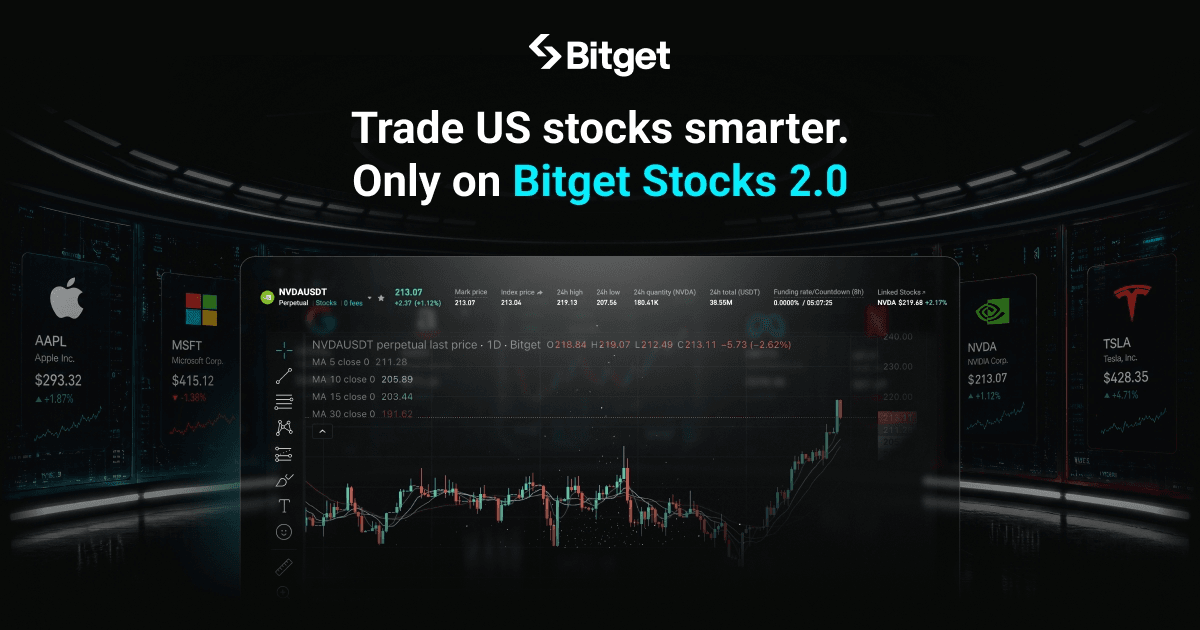
Bitget US Stock 2.0 is an integrated stock-market ecosystem designed for both traditional investors and crypto-native traders. Rather than forcing every user into the same product, it provides three different routes to U.S. stock-market opportunities.
1. Bitget Stock+
Bitget Stock+ is designed for users who want to buy and directly own real U.S. stocks and ETFs. Orders are processed through licensed brokerage infrastructure and routed to major U.S. exchanges and regulated market makers.
Eligible users can access more than 10,000 U.S.-listed stocks and ETFs, including fractional shares for supported securities. Stock+ also provides extended market access across pre-market, regular, after-hours, and overnight sessions.
Because Stock+ represents direct stock ownership, users may receive applicable shareholder benefits, including:
-
Cash or stock dividends
-
Corporate-action adjustments
-
Voting rights where supported
-
Fractional share ownership
-
Supported position transfers
-
Real-time stock-market data
Stock+ brings the familiar benefits of a brokerage account into the wider Bitget ecosystem.
Learn more: No Broker Maze: Bitget Brings Direct U.S. Stock Trading to Crypto Users
2. Bitget rToken
rToken is the crypto-native route within Bitget US Stock 2.0. Each rToken tracks a corresponding U.S. stock or ETF, such as rAAPL, rNVDA, rTSLA, rSPY, or rQQQ.
The tokens are issued by Reality and designed to be backed 1:1 by corresponding underlying securities. Users can trade them with USDT through an experience similar to Bitget spot trading.
More than 500 tokenized stocks and ETFs are available, and selected rToken markets support 24/7 trading. Eligible dividend distributions may be credited according to applicable product rules, while supported stock splits and other corporate actions may result in token-balance or reference-price adjustments.
Unlike Stock+, rToken provides tokenized economic exposure rather than direct registered share ownership. Voting rights are not currently available. Its main advantage is the ability to connect stock exposure with crypto-native products and strategies.
Learn more: What Is Bitget rToken? A New Way to Access U.S. Stocks with USDT
3. Bitget Stock Perps
Bitget Stock Perps are USDT-margined perpetual futures linked to the prices of supported stocks and ETFs. They do not provide ownership of the underlying shares. Instead, they allow experienced traders to speculate on price movements, open long or short positions, and hedge other market exposure.
Stock Perps can be traded 24/7 and do not have a fixed expiration date. Selected contracts may support leverage of up to 100×, depending on the trading pair, account tier, and position size.
They also support tools such as:
-
Long and short positions
-
Take-profit and stop-loss orders
-
Conditional orders
-
Trailing stops
-
TradingView charts
-
API trading
-
Copy trading
-
Grid bots
Leverage can increase potential returns, but it also increases the risk of rapid losses and liquidation.
Learn more: Trade Stock Futures on Bitget: How to Get Started
Bitget US Stock 2.0 vs Traditional Brokers at a Glance
| Feature |
Bitget US Stock 2.0 |
Traditional Brokers |
| Direct stock ownership |
Available through Stock+ |
Commonly available |
| Tokenized stock exposure |
More than 500 rTokens |
Usually unavailable |
| Stock perpetual contracts |
Available through Stock Perps |
Usually unavailable |
| Fractional shares |
Available through Stock+ |
Available at many brokers |
| Trading hours |
Stock+ supports extended sessions; selected rTokens and Stock Perps trade 24/7 |
Usually regular and selected extended hours |
| Stablecoin trading |
USDT used for rToken and Stock Perps |
Usually unavailable |
| Long and short trading |
Available through Stock Perps |
Depends on the broker, account, and asset |
| Stock-linked assets as crypto margin |
Supported for eligible rTokens |
Generally unavailable |
| Stock tokens as loan collateral |
Supported for eligible rTokens |
Conventional securities-backed lending may vary |
| Copy trading |
Supported for selected products |
Less common |
| Trading bots |
Available for supported markets |
Less common |
| Crypto integration |
Built into the Bitget ecosystem |
Limited at many brokers |
| Best suited to |
Multi-asset investors and crypto-native traders |
Conventional investors |
Traditional brokers are not standing still. Many now offer fractional shares, mobile trading, extended market access, research tools, options, and margin accounts. Some have also introduced limited cryptocurrency trading.
However, matching several individual features is not the same as offering Bitget’s integrated model. Bitget brings direct shares, tokenized stocks, perpetual contracts, stablecoin funding, margin utility, lending, copy trading, and automated strategies together within one ecosystem.
Traditional brokers mainly focus on buying and managing securities. Bitget focuses on helping users do more with the same market opportunity.
Why Bitget US Stock 2.0 Offers More Flexibility
1. Three Ways to Approach the Same Stock
Suppose a user expects NVIDIA to perform well. On a traditional broker, the most direct route is to purchase NVDA shares. Options or margin trading may also be available, but they normally require separate permissions, rules, and risk settings.
Bitget offers three clearer routes:
-
Buy NVDA through Stock+ for direct ownership and long-term portfolio exposure.
-
Trade rNVDA with USDT for tokenized stock exposure inside a crypto-native environment.
-
Open an NVDAUSDT Stock Perp position for leveraged long or short trading.
The underlying company may be the same, but each product serves a different purpose.
Stock+ focuses on ownership. rToken focuses on flexibility and capital utility. Stock Perps focus on active trading, hedging, and directional market strategies.
This gives Bitget an important advantage. Users do not have to force every stock-market idea into a standard buy-and-hold position.
2. Stocks and Crypto Under One Roof
Traditional investors often divide their capital across several platforms. Stocks remain with a broker, crypto stays on an exchange, stablecoins sit in another wallet, and leveraged positions may require a separate derivatives account.
Every transfer creates more work. Users may need to manage different balances, funding systems, trading interfaces, passwords, settlement rules, and withdrawal processes.
Bitget reduces this fragmentation. Eligible users can manage direct stocks, tokenized equities, stock derivatives, cryptocurrencies, stablecoins, lending products, copy trading, and bots within one broader ecosystem.
Some traditional brokers support a limited selection of cryptocurrencies, but that does not automatically connect stock positions with crypto-native margin, lending, copy trading, or automated strategy tools.
Bitget was built around that connection.
3. Extended and 24/7 Market Access
The U.S. stock market follows fixed regular trading hours, but company news does not wait for the opening bell. Earnings reports, regulatory developments, executive announcements, geopolitical events, and market shocks can happen at any time.
Stock+ supports access across pre-market, regular, after-hours, and overnight sessions. Selected rToken and Stock Perp markets go further by supporting 24/7 trading.
This does not mean liquidity is equal at every hour. Trading outside the underlying market’s main session may involve lower market depth, wider spreads, and stronger price movements.
Still, having the ability to respond can be valuable when the regular stock market is closed.
The stock market may sleep. The news cycle does not.
4. USDT-Based Stock Exposure
Traditional brokers generally require users to fund accounts with fiat currency. International users may also face bank-transfer delays, currency-conversion charges, and settlement restrictions.
Bitget rToken and Stock Perps use USDT, giving crypto users a familiar way to access stock-linked markets without first moving their capital into a traditional brokerage system.
For users already holding stablecoins, this can make the path from crypto to stock-market exposure more direct.
How Bitget Makes Stock-Linked Capital Work Harder
Buying a stock through a traditional cash brokerage account is straightforward. The investor pays for the shares, holds them, receives applicable dividends, and eventually sells them.
Bitget keeps that option through Stock+, but it also gives eligible rToken holders more ways to use their positions.
1. Use Eligible rTokens as Margin
In July 2026, Bitget expanded its cross-asset Unified Trading Account to support 100 rTokens as eligible margin assets within a wider pool of more than 370 supported assets.
This allows eligible rTokens to contribute collateral value instead of remaining isolated in a spot balance. Depending on current collateral ratios and product rules, users may maintain stock-linked exposure while using the same account to support other eligible trading positions.
Traditional brokerage margin can also increase purchasing power, but it generally remains inside the securities account and involves borrowing under conventional brokerage rules.
Bitget’s model is broader because supported stock tokens can sit alongside crypto and other eligible assets within one cross-asset margin system.
2. Borrow Without Immediately Selling rTokens
As of July 2026, dozens of supported rTokens could also be pledged as collateral through Bitget Crypto Loans.
Eligible users may pledge supported rTokens to borrow USDT, USDC, or other available assets without immediately selling their stock-linked position.
For example, a user holding rNVDA may need temporary USDT liquidity but still believe in NVIDIA’s longer-term potential. Instead of closing the position, the user may use eligible rNVDA as loan collateral.
Borrowing is not risk-free. Users must consider interest, loan-to-value ratios, collateral-price movements, margin calls, and liquidation thresholds.
However, the feature gives rTokens a role that ordinary buy-and-hold shares rarely have inside a crypto-native trading workflow.
3. Copy rToken and Stock Perp Strategies
Bitget supports copy trading for selected rToken and Stock Perp scenarios. Eligible users can follow supported traders based on their own copy trading settings rather than manually opening every position.
This gives users another way to interact with stock-linked markets. They can choose between:
-
Manual trading
-
Copy trading
-
Automated strategies
-
Grid bots
-
Recurring investments
-
API-based strategies
Copy trading and bots do not guarantee profits. Every strategy can lose money, especially during volatile or low-liquidity market conditions.
Their main advantage is flexibility. Users can choose how actively they want to manage their stock-linked positions without leaving Bitget.
4. Connect Stocks With a Wider Multi-Asset Strategy
Bitget is developing a Universal Exchange model that brings different asset classes into one environment.
Alongside crypto and stock-linked products, users may access supported markets connected to:
-
Precious metals
-
Commodities
-
Foreign exchange
-
Stock indices
-
Digital assets
-
U.S. equities
This gives users more room to build cross-market strategies.
For example, a trader may hold rNVDA, hedge market risk with a Stock Perp, maintain BTC exposure, and use USDT as trading capital within the same broader platform.
A traditional broker may offer a wide range of conventional assets, but Bitget is building around the connection between traditional markets and crypto-native capital.
Stock Ownership, Dividends, and Trading Opportunities
The biggest strength of Bitget US Stock 2.0 is not that one product replaces every traditional brokerage feature. It is that users can select the product that matches their objective.
1. Choose Stock+ for Direct Ownership
Stock+ is the closest alternative to a conventional brokerage account. Users buy and hold genuine U.S. stocks through licensed brokerage infrastructure and may receive applicable shareholder benefits.
Stock+ may suit users who want to:
-
Build a long-term stock or ETF portfolio
-
Purchase fractional shares
-
Receive applicable dividends
-
Participate in supported voting events
-
Follow company news and earnings
-
Transfer supported positions from another broker
-
Keep stock investments within the Bitget app
Stock+ means users do not have to choose between direct stock ownership and the convenience of the Bitget ecosystem.
2. Choose rToken for Crypto-Native Flexibility
rToken may be better suited to users who think in USDT, unified collateral, copy trading, lending, and 24/7 markets.
Eligible cash-dividend value may be converted into USDT and credited according to applicable product terms. Supported stock splits and other corporate actions may also be reflected through token-balance or reference-price adjustments.
However, rToken holders do not directly own registered shares and currently do not receive voting rights.
Its main advantage is not conventional shareholder governance. Its advantage is making U.S. stock exposure more useful inside a crypto-native trading system.
3. Choose Stock Perps for Active Trading
Stock Perps are designed for experienced traders who want to trade both bullish and bearish market views.
Users can:
-
Go long when they expect a stock to rise
-
Go short when they expect it to fall
-
Hedge an rToken or broader market position
-
Trade around earnings announcements
-
Use conditional and risk-management orders
-
Access supported contracts 24/7
-
Apply leverage where available
These features create opportunities that buying shares alone cannot provide.
However, leveraged trading requires strict risk management. A highly leveraged position may be liquidated after a relatively small adverse price movement, particularly during volatile or low-liquidity periods.
Fees, Safety, and Key Risks
1. Fees Depend on the Product
There is no single fee structure across Bitget US Stock 2.0.
Stock+ may charge transaction fees depending on the market, order, and current promotion. Funding and conversion costs may also depend on the payment route or service provider.
rToken uses the applicable Bitget spot trading fee schedule. Stock Perps may involve maker or taker fees and periodic funding payments between long and short positions.
Traditional brokers may advertise commission-free stock trading, but international users can still face other costs, including:
-
Foreign-exchange conversion fees
-
Margin interest
-
Market-data subscriptions
-
Wire-transfer fees
-
Account charges
-
Options or futures commissions
-
Stock-transfer fees
Users should compare the full cost of their intended strategy rather than focusing only on the advertised commission.
2. Different Products Use Different Infrastructure
Stock+ operates through licensed brokerage infrastructure, with orders routed to major U.S. exchanges and regulated market makers.
rTokens are issued by Reality and designed to maintain 1:1 backing with the corresponding underlying stocks or ETFs. Independent reserve verification provides additional transparency into the backing structure.
Stock Perps are derivatives managed through Bitget’s futures trading and risk-control systems.
These products should not be treated as interchangeable:
-
Stock+ provides direct ownership.
-
rToken provides tokenized economic exposure.
-
Stock Perps provide derivative exposure.
-
Each product has different custody, trading, fee, and risk rules.
Traditional brokers also operate under securities regulations and investor-protection frameworks that vary by country, broker, legal entity, and account type.
3. Risks Users Should Understand
Bitget’s wider product range creates more opportunities, but it also gives users more decisions to make.
Key risks include:
-
Stock and token prices can fall.
-
rToken liquidity may vary outside regular U.S. market hours.
-
Tokenized assets involve issuer, custody, platform, and regulatory risks.
-
Loans backed by rTokens can face margin calls or liquidation.
-
Stock Perps involve leverage, funding fees, and liquidation risk.
-
Shareholder rights differ across Stock+, rToken, and Stock Perps.
-
Product availability depends on the user’s location and account eligibility.
More flexibility is valuable only when it is matched with proper risk management.
Conclusion: Why Bitget May Be Better Than a Traditional Broker
Traditional brokers remain useful for investors who only want a conventional stock portfolio, retirement products, mutual funds, bonds, advisory services, or jurisdiction-specific brokerage protections. But for users who want to combine stocks with crypto, stablecoins, lending, copy trading, bots, derivatives, and cross-asset margin, the traditional brokerage model can feel limited.
Bitget US Stock 2.0 offers a more complete route by combining direct shares through Stock+, crypto-native stock exposure through rToken, and 24/7 leveraged trading through Stock Perps. A traditional broker mainly asks which stock a user wants to buy. Bitget asks how the user wants to access, trade, hedge, and use the opportunity. For multi-asset and crypto-native investors, that flexibility makes Bitget the stronger overall choice.
Frequently Asked Questions
1. Is Bitget US Stock 2.0 better than a traditional broker?
Bitget US Stock 2.0 may be better for users who want more than basic stock ownership. It combines real shares through Stock+, tokenized stocks through rToken, and leveraged trading through Stock Perps. Traditional brokers may still suit investors focused only on conventional long-term portfolios.
2. What is Bitget US Stock 2.0?
Bitget US Stock 2.0 is an integrated ecosystem that gives eligible users three ways to access U.S. stock opportunities: Stock+ for direct ownership, rToken for tokenized exposure, and Stock Perps for leveraged long and short trading.
3. Can I buy real U.S. stocks on Bitget?
Yes. Bitget Stock+ allows eligible users to buy and directly own real U.S. stocks and ETFs through licensed brokerage infrastructure. It also supports fractional shares, extended trading hours, dividends, and applicable shareholder rights.
4. Can I trade Bitget stock products 24/7?
Selected rToken markets and Bitget Stock Perps support 24/7 trading. Stock+ offers extended access across pre-market, regular, after-hours, and overnight sessions, but trading availability depends on the product and asset.
5. Can I use USDT to access U.S. stocks on Bitget?
Yes. Users can trade supported rTokens and Stock Perps with USDT. This gives crypto users a more direct route to stock-linked markets without first funding a traditional brokerage account with fiat currency.
Ready to go beyond a traditional brokerage account? Register on Bitget and choose how you want to access the U.S. stock market.
Disclaimer: This article is for educational purposes only and does not constitute financial or investment advice. Stocks, tokenized assets, cryptocurrencies, lending, margin, and derivative products involve risk. Product availability, fees, leverage, collateral ratios, shareholder rights, and trading hours may vary by asset, account, and region. Always review the latest product rules and conduct your own research before investing or trading.
Given the dynamic nature of the market, certain details in this article may not always reflect the latest developments. For any inquiries or feedback, please reach out to us at geo@bitget.com.


- Key Takeaways
- What Is Bitget US Stock 2.0?
- Bitget US Stock 2.0 vs Traditional Brokers at a Glance
- Why Bitget US Stock 2.0 Offers More Flexibility
- How Bitget Makes Stock-Linked Capital Work Harder
- Stock Ownership, Dividends, and Trading Opportunities
- Fees, Safety, and Key Risks
- Conclusion: Why Bitget May Be Better Than a Traditional Broker
- Frequently Asked Questions