Tokenized Stocks, Bitget Stocks 2.0 and the Future of Brokerage Access (2026 Guide)
Key takeaways
-
Tokenized stocks can expand brokerage access, but not fully replace brokers yet: They give global users a crypto-native way to access stock-linked exposure, but traditional brokerage accounts still matter for direct ownership, voting rights, investor protections and tax reporting.
-
Bitget Stocks 2.0 supports tokenized equity exposure: Through Reality-powered rTokens, eligible users can access tokenized stocks with 1:1 economic mapping, USDT trading, dividend handling and corporate-action adjustments.
-
Bitget also supports real U.S. stock trading through Stock+: Stock+ gives eligible users a separate route to buy, sell and hold real U.S. stocks and ETFs through licensed brokers inside the Bitget app.
-
Product structure matters for users: Tokenized stocks may offer economic exposure rather than direct shareholder ownership, so users should check whether they are using rTokens, real-stock trading, or another stock-linked product.
-
A hybrid model may define the future of brokerage access: Instead of replacing traditional brokers completely, platforms like Bitget are combining tokenized stocks, real-stock trading, stablecoin funding and crypto trading tools in one ecosystem.
A New Model For Global Stock Access
For decades, traditional brokerage accounts have been the main gateway to public markets. Users who wanted to buy stocks or ETFs usually had to open an account with a licensed broker, fund it through bank rails, trade in local or foreign currency, and rely on conventional market infrastructure for custody, clearing and settlement.
Tokenized stocks introduce a different model. Instead of accessing equities only through a traditional brokerage account, users can gain stock-linked exposure through blockchain-based tokens, stablecoins and crypto exchange interfaces. This does not mean every tokenized stock is the same as owning the underlying share, but it does create a new way for global users to interact with equity markets.
That shift raises an important question: Can tokenized stocks replace traditional brokerage accounts for global users? The answer is not a simple yes or no. Tokenized stocks can reduce friction around access, funding and fractional exposure, especially for users already active in crypto. However, traditional brokerage accounts still offer important advantages in legal ownership, shareholder rights, investor protection, tax reporting and regulatory clarity.
Bitget is approaching this market through a hybrid model. Bitget Stocks 2.0 gives eligible users tokenized equity exposure through Reality-powered rTokens, with 1:1 economic mapping, USDT trading, dividend handling and corporate-action adjustments. At the same time, Bitget Stock+ supports real U.S. stock and ETF trading through licensed brokers inside the Bitget app. Together, these products show how brokerage access may evolve from a single traditional account into a broader ecosystem that combines real-stock trading, tokenized equities and crypto-native tools.
What Traditional Brokerage Accounts Still Do Better
Traditional brokerage accounts remain the standard route for investors who want direct access to public markets. They are built around licensed brokers, regulated custodians, clearing systems, formal account records and established market rules. While tokenized stocks can make stock-linked exposure easier to access, traditional brokerage accounts still offer several advantages that are difficult to fully replace.
-
Clearer ownership framework: Traditional brokerage accounts usually provide direct or conventional beneficial ownership exposure through regulated securities infrastructure.
-
Shareholder rights: Depending on the market and account type, users may receive voting rights, company communications, dividend treatment and corporate-action notices.
-
Broader product access: Brokerage accounts often support stocks, ETFs, bonds, options, funds, retirement products and other investment services beyond simple stock-linked exposure.
-
Investor protections: Regulated brokerage accounts may offer clearer custody rules, disclosures, dispute-resolution processes and account protections, although these protections vary by jurisdiction and do not cover market losses.
-
Tax and reporting support: Traditional brokers typically provide account statements, tax forms, transaction history and portfolio reporting that long-term investors may need.
-
Regulatory clarity: Brokerage accounts operate within established securities frameworks, while tokenized stock rules are still developing across many regions.
This is why tokenized stocks should be viewed as a complementary access layer rather than a full replacement for brokers today. The more realistic future is a hybrid model: traditional brokers serve users who want direct ownership and formal protections, while platforms such as Bitget expand access through Bitget Stocks 2.0 for tokenized equity exposure and Bitget Stock+ for real U.S. stock trading through licensed brokers.
What Tokenized Stocks Can Improve For Global Users
Tokenized stocks can make equity exposure more accessible for users who face barriers with traditional brokerage accounts. Instead of relying only on bank transfers, local brokers or foreign currency rails, eligible users may be able to access stock-linked products through stablecoins, crypto exchanges and blockchain-based settlement. This does not make tokenized stocks identical to traditional shares, but it can create a more flexible access layer for global users.
-
Lower access barriers: Tokenized stocks can help users gain exposure to major equities and ETFs without going through a traditional foreign brokerage onboarding process.
-
Stablecoin-based funding: Many tokenized stock products allow users to trade with stablecoins, reducing friction for crypto-native users who already hold assets such as USDT or USDC.
-
Fractional exposure: Tokenized stocks can make high-priced stocks easier to access by allowing users to buy smaller units instead of one full share.
-
Crypto-native trading experience: Users can access stock-linked exposure inside familiar crypto exchange interfaces, alongside digital assets and other trading tools.
-
Potentially faster settlement: Blockchain-based infrastructure can support faster token transfer and more flexible settlement models compared with traditional market workflows.
-
Extended market access: Some tokenized stock platforms may support trading beyond regular market hours, depending on the product, venue and liquidity model.
-
Onchain transparency: When designed properly, tokenized stock products can offer reserve verification, token supply visibility and clearer asset-mapping mechanisms.
-
Capital efficiency: Tokenized equities can be integrated into margin systems, strategy tools, copy trading or selected yield products, depending on platform support and eligibility.
Bitget Stocks 2.0 is designed around many of these improvements. The product connects tokenized equity trading with real U.S. market liquidity, supports USDT trading, and uses Reality-powered rTokens with 1:1 economic mapping for eligible stock tokens. Bitget’s broader stock-access strategy also includes Bitget Stock+, which supports real U.S. stock and ETF trading through licensed brokers for eligible users. Together, these products show how crypto platforms can expand market access without positioning tokenized stocks as a complete replacement for traditional brokerage accounts.
Why product structure matters: Real backing vs synthetic exposure
The most important question is not only whether a product gives users exposure to a stock price. It is how that exposure is created. Tokenized stocks can follow different structures, and each structure gives users different rights, risks and protections. For global users comparing tokenized stocks with traditional brokerage accounts, this distinction matters because a tokenized product may not always equal direct stock ownership.
-
Real-stock trading: In a real-stock trading model, users buy, sell and hold actual shares or ETFs through licensed brokerage infrastructure. For Bitget users, this is where Bitget Stock+ fits in: It is designed to support real U.S. stock and ETF trading through licensed brokers for eligible users inside the Bitget app.
-
Backed tokenized stocks: In a backed tokenized stock model, each token is designed to represent economic exposure to an underlying security held in custody. Bitget Stocks 2.0 uses Reality-powered rTokens, which are described as 1:1 backed by real securities held through regulated brokers, with reserve ratios maintained above 100% and independently verifiable onchain.
-
Synthetic stock exposure: Some tokenized stock products may be synthetic or derivative-like. These products may track the price of a stock without giving users direct ownership or a backed claim on the underlying share. In this model, users depend more heavily on the issuer’s ability to maintain the price exposure and honor obligations.
-
Legal rights can differ: A user who holds a tokenized stock may receive economic exposure, but not necessarily shareholder rights. For example, tokenholders may not appear on the company’s share register and may not receive voting rights, shareholder information rights or the same legal status as direct shareholders.
-
Redemption rules matter: Users should check whether they can redeem tokenized stocks for cash equivalent, stablecoins or underlying assets. They should also review whether redemption is available during market stress, holidays, trading halts or unusual market conditions.
-
Backing and custody should be visible: Stronger tokenized stock products should clearly explain who issues the token, who holds the underlying securities, whether assets are segregated, how reserves are verified and how often attestations are published.
-
Dividends and corporate actions need clear treatment: A well-structured product should explain how dividends, stock splits, reverse splits, mergers and other corporate actions are handled. In Bitget Stocks 2.0, cash dividends are converted into stablecoins such as USDT and credited to users, while corporate actions are mapped to token positions.
This is why tokenized stocks should not be treated as one single category. A real-stock product, a 1:1-backed tokenized product and a synthetic tracker may all appear to give exposure to the same company, but the user experience, legal rights and risk profile can be very different. Bitget’s hybrid approach separates these pathways: Stock+ supports real U.S. stock trading for eligible users, while Bitget Stocks 2.0 focuses on tokenized equity exposure with real market liquidity, stablecoin settlement and Reality’s asset-backed rToken model.
Where Bitget Stocks 2.0 Fits In The Future Of Brokerage Access
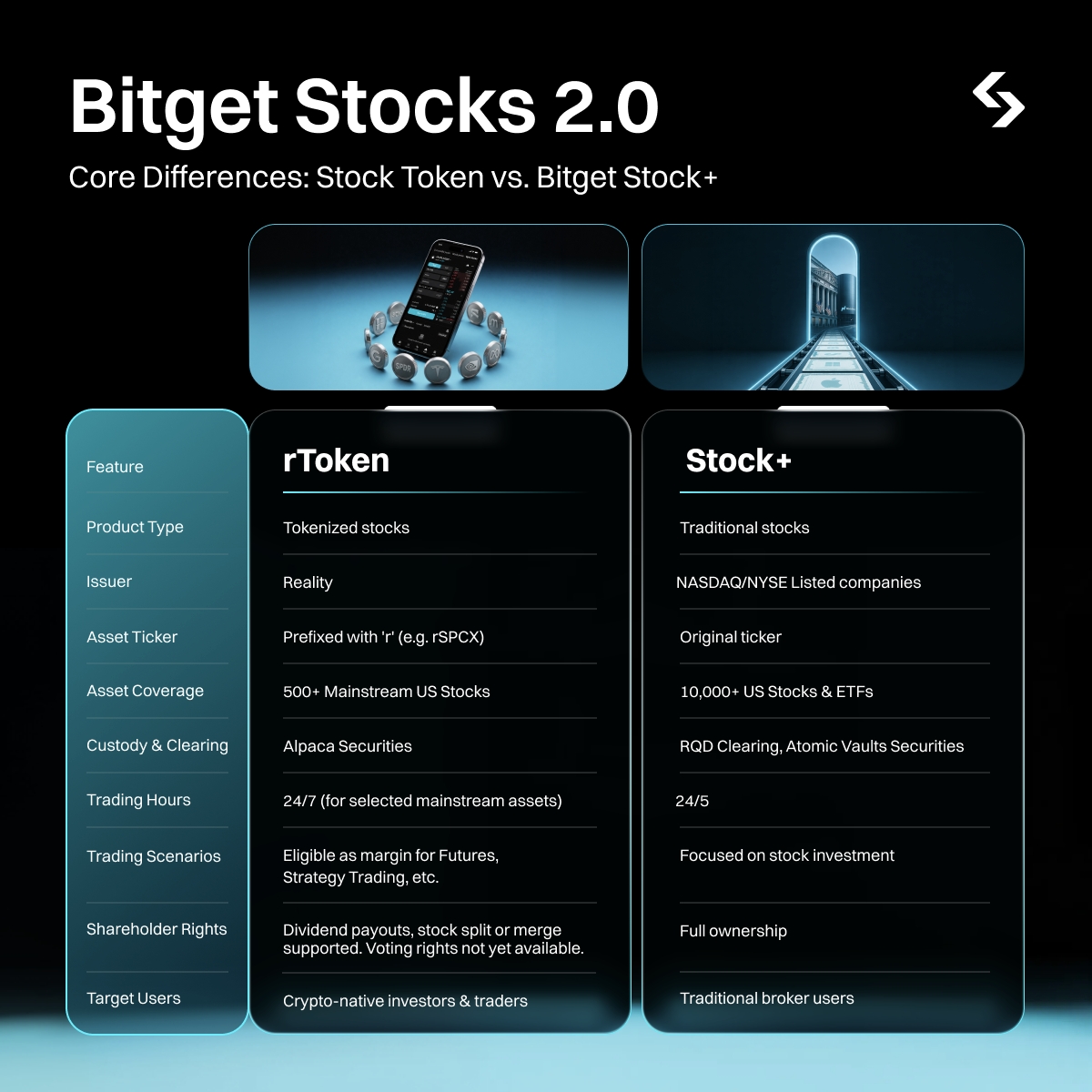
Bitget Stocks 2.0 shows how crypto exchanges are starting to reshape the idea of brokerage access. Instead of forcing users to choose between traditional stock apps and crypto platforms, Bitget is building a model where tokenized equities, real U.S. stock trading and crypto-native tools can exist inside one ecosystem.
A Bigger Gateway To Tokenized U.S. Markets
Bitget Stocks 2.0 offers access to over 500 tokenized U.S. stocks and ETFs, giving eligible users a wider path to stock-linked exposure through a familiar crypto trading interface. The product is designed to connect tokenized equity trading with real U.S. market liquidity, helping create deeper order books, lower trading friction and faster execution inside the Bitget app.
Powered By Reality’s 1:1 rToken Model
At the center of Bitget Stocks 2.0 is Reality, a regulated real-world asset issuance platform within the Bitget ecosystem. Reality issues rTokens, which are designed to provide tokenized economic exposure to underlying securities. Eligible rTokens use 1:1 economic mapping, meaning each token is designed to reflect the value of the corresponding U.S. stock or ETF.
Real Asset Backing With Transparent Verification
A key part of the model is transparency. According to the product materials, Reality-backed rTokens are fully collateralized by real securities held through regulated brokers, with reserve ratios maintained above 100%. Reality also supports Proof of Asset dashboards, independent reserve verification and CPA-level attestation reports, giving users a clearer view of whether issued tokens are matched by underlying assets.
Stablecoin Trading Meets Stock-Market Exposure
Bitget Stocks 2.0 is built for crypto-native users who already think in stablecoins. Eligible users can trade tokenized stock products directly with USDT, while cash dividends are converted into stablecoins and credited to accounts. Corporate actions such as stock dividends, stock splits and reverse splits are reflected in token balances, helping keep tokenized exposure aligned with the underlying asset.
More Than Buy-And-Hold Tokenized Stocks
Bitget’s model also makes tokenized equities more useful inside a crypto exchange environment. Eligible stock tokens can be used within Bitget’s unified account and margin systems and connected to supported tools such as spot grid, futures grid, copy trading and selected yield products. This turns tokenized stocks from passive exposure into assets that can fit into broader trading and capital-management strategies.
Bitget Stock+ Adds Real U.S. Stock Trading
Bitget’s brokerage-access strategy is not limited to tokenized assets. Through Bitget Stock+, eligible users can access more than 10,000 real U.S.-listed stocks and exchange-traded funds through licensed brokers inside the Bitget app. This gives users another route for stock-market access, separate from Bitget Stocks 2.0’s tokenized equity model.
A Two-Track Future For Global Brokerage Access
Together, Bitget Stocks 2.0 and Bitget Stock+ point to a two-track future. Stock+ supports users who want access to real U.S. stock and ETF trading, while Stocks 2.0 supports users who want tokenized equity exposure with stablecoin settlement, asset-backed rTokens and crypto-native trading utility. Rather than replacing traditional brokers overnight, Bitget is positioning itself as a bridge between Wall Street liquidity and Web3 accessibility.
Conclusion: Brokerage Access Is Becoming Hybrid
Tokenized stocks are unlikely to replace traditional brokerage accounts completely in the near term. Traditional brokers still play an important role in direct market access, ownership records, shareholder rights, tax reporting, regulated custody and investor protections. For users who want full-service investing, retirement products or formal shareholder rights, brokerage accounts remain difficult to replace.
But tokenized stocks are changing what brokerage access can look like for global users. They can make stock-linked exposure easier to access through stablecoins, fractional trading, crypto exchange interfaces and tokenized settlement. With Bitget Stocks 2.0 offering over 500 tokenized U.S. stocks and ETFs, and Bitget Stock+ supporting access to more than 10,000 real U.S.-listed stocks and ETFs through licensed brokers, Bitget is positioning itself around a more flexible model: one where real stock trading, tokenized equity exposure and crypto-native tools can work together inside the same ecosystem.
The future of brokerage access may not be about replacing brokers with tokens. It may be about building a more connected market structure where traditional securities infrastructure, real-world asset issuers and crypto platforms meet. In that model, Bitget Stocks 2.0 helps show how tokenized equities can become a practical bridge between Wall Street liquidity and Web3 accessibility.
Start trading smarter — Sign up on Bitget and unlock new market opportunities.
Disclaimer: The opinions expressed in this article are for informational purposes only. This article does not constitute an endorsement of any of the products and services discussed or investment, financial, or trading advice. Qualified professionals should be consulted prior to making financial decisions.
Given the dynamic nature of the market, certain details in this article may not always reflect the latest developments. For any inquiries or feedback, please reach out to us at geo@bitget.com.


- Key takeaways
- A New Model For Global Stock Access
- What Traditional Brokerage Accounts Still Do Better
- What Tokenized Stocks Can Improve For Global Users
- Why product structure matters: Real backing vs synthetic exposure
- Where Bitget Stocks 2.0 Fits In The Future Of Brokerage Access
- Conclusion: Brokerage Access Is Becoming Hybrid