
S&P 500 Prediction 2026: Technical Analysis, Institutional Forecasts, and Key Risks
The S&P 500 enters 2026 with strong momentum, but the outlook is no longer as straightforward as it was during the earlier phase of the bull market. Investors are now weighing several powerful forces at the same time: resilient corporate earnings, the long-term AI investment cycle, interest-rate expectations, stretched valuations, and rising geopolitical risks in the Middle East.Current institutional forecasts suggest the S&P 500 may still finish 2026 at higher levels, but the path is expected to be uneven and increasingly sensitive to macro headlines.
This article provides a complete guide to the S&P 500 outlook for 2026, with a focus on institutional targets, technical analysis, sector leadership, and the geopolitical risks that could shape market sentiment throughout the year.
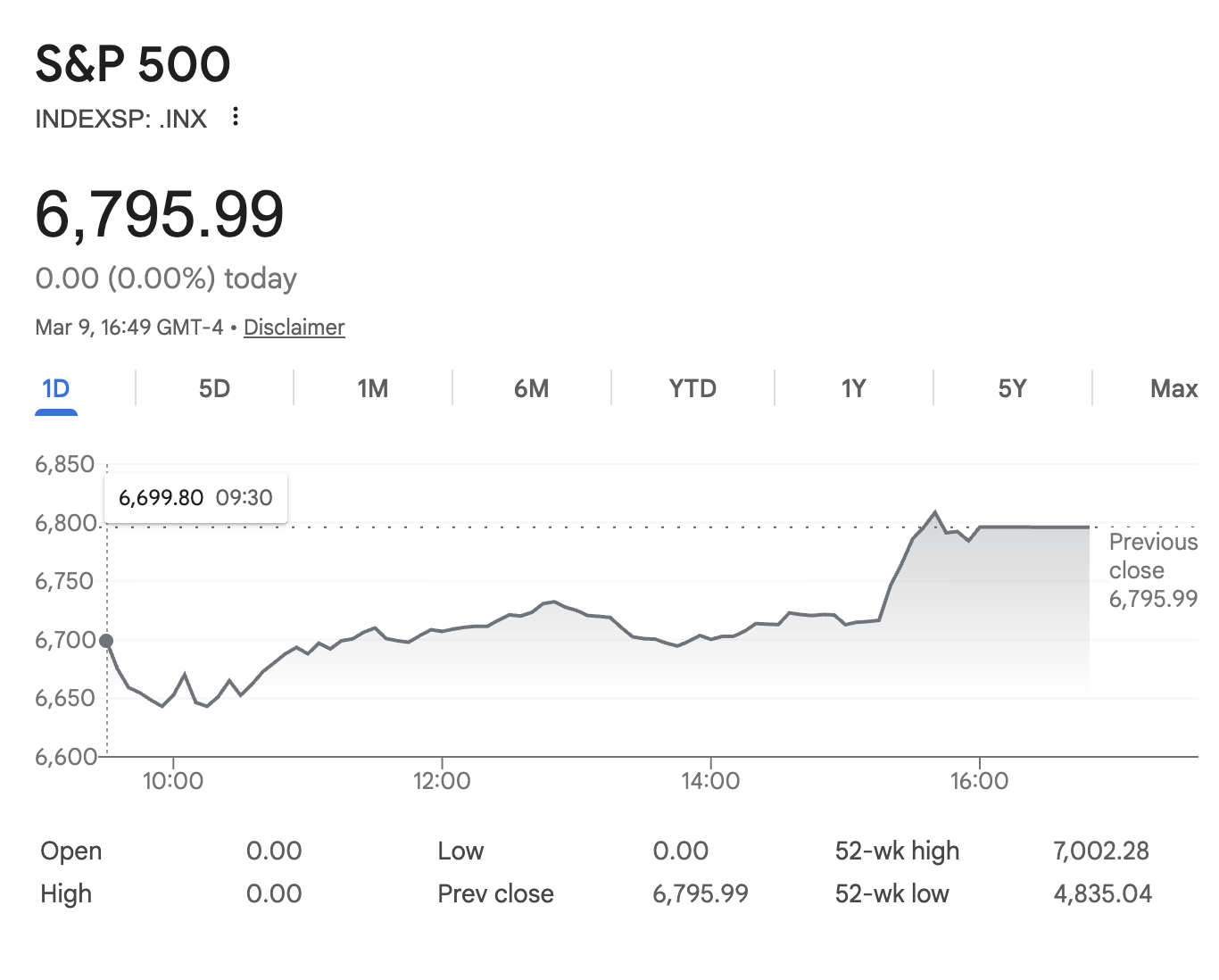
Source: Google Finance
What Is Driving the S&P 500 in 2026?
The S&P 500 is being shaped by a combination of earnings growth, monetary policy, technology investment, and geopolitical uncertainty. While the long-term trend remains constructive, markets are no longer pricing only optimism. They are also pricing risk.
Several major themes are likely to influence the S&P 500 in 2026:
-
AI-led earnings growth across large-cap technology and related sectors
-
Federal Reserve policy expectations, especially around the pace of any rate cuts
-
Valuation pressure, as the index remains elevated versus historical averages
-
Oil price shocks linked to the ongoing U.S.-Iran conflict and wider regional instability
-
Risk sentiment following developments such as the Lebanon-Israel ceasefire and broader Middle East diplomacy
For investors, this means the S&P 500 in 2026 is likely to remain a market driven by both fundamentals and headline risk.
Institutional S&P 500 Prediction for 2026
Large financial institutions remain broadly constructive on the S&P 500, although most no longer expect a smooth rally. Instead, their outlooks point to moderate upside with intermittent corrections.
JPMorgan: Bullish Long Term, Cautious on Geopolitical Risk
JPMorgan’s broader 2026 base case remains constructive for the S&P 500, with a year-end target around 7,500. The bank’s bullish view is supported by continued earnings expansion, stable consumer activity, and a favorable backdrop for large-cap U.S. equities.
However, JPMorgan has also warned that geopolitical escalation—particularly involving Iran and disruptions to oil supply—could trigger a sharp downside move in the S&P 500. If crude oil were to surge toward $100 or higher for a sustained period, the bank sees the potential for a correction of roughly 10% from peak levels.
Morgan Stanley: Earnings Leverage Supports Further Upside
Morgan Stanley expects the S&P 500 to trend higher in 2026, with targets around 7,200 in its more conservative framework and as high as 7,800 under a stronger earnings scenario. The firm’s thesis centers on operating leverage, especially among companies benefiting from AI adoption, improving productivity, and margin expansion.
In Morgan Stanley’s view, the S&P 500 can continue to rise if earnings growth broadens beyond mega-cap technology and begins to include industrials, financials, and selected cyclical names.
Goldman Sachs: Broad Market Gains, but More Selectivity
Goldman Sachs has projected a roughly 12% total return scenario for the S&P 500 in 2026, implying a year-end level near 7,600. The firm sees room for gains, but it expects leadership to widen beyond the largest technology companies.
Goldman’s outlook suggests the S&P 500 could perform well if economic growth remains stable, inflation continues to cool gradually, and corporate profitability holds up despite elevated input costs.
Oppenheimer: The Most Bullish Institutional Call
Among major firms, Oppenheimer stands out as one of the more optimistic voices on the S&P 500, with a target near 8,100. This view is based on the idea that the AI investment cycle is still in its early stages and could support another leg higher in corporate spending, productivity, and earnings.
Under this scenario, the S&P 500 would continue to benefit from strong capital expenditure trends and improving business confidence.
Institutional Summary
Overall, institutional forecasts suggest a year-end 2026 range for the S&P 500 of roughly 7,100 to 8,100, with most major firms clustering in the 7,500 to 7,800 area. That consensus implies upside potential remains, but expectations are becoming more measured.
S&P 500 Technical Analysis for 2026
Technical analysis remains essential when evaluating the S&P 500 outlook for 2026. While institutional forecasts provide a macro framework, chart structure helps identify support, resistance, and the probability of trend continuation or reversal.
Primary Trend: Still Bullish, but More Mature
On the long-term chart, the S&P 500 remains in a broader bullish structure. The index continues to trade above major moving averages, and the primary trend has not yet broken. However, this is now a more mature phase of the bull cycle, which means upside may come with sharper pullbacks.
From a technical perspective, the S&P 500 is no longer in the early stage of a breakout. Instead, it appears to be in a later expansion phase, where momentum can remain positive but becomes increasingly vulnerable to macro shocks.
Key Resistance Levels
For 2026, the following resistance areas are important for the S&P 500:
-
7,000: A major psychological level and recent reference point
-
7,345 to 7,490: A key resistance zone based on Fibonacci projections and prior trend extensions
-
7,800: A major upside target aligned with more bullish institutional forecasts
-
8,000 to 8,100: A stretch target under a strong AI-driven bull case
If the S&P 500 can break and hold above these zones with improving breadth and volume, it would strengthen the case for further gains into year-end.
Key Support Levels
Support is equally important because it defines whether a pullback remains healthy or becomes more dangerous. Key support areas for the S&P 500 include:
-
6,780 to 6,720: A near-term support zone and an important technical floor
-
6,520: Around the 200-day moving average in many technical models
-
6,300: A deeper correction target consistent with a 10% downside scenario
As long as the S&P 500 remains above major support, the broader bullish thesis remains intact. A sustained break below these levels would likely shift sentiment toward a more defensive market outlook.
Elliott Wave and Fibonacci Perspective
Some technical analysts interpret the S&P 500 as being in a late-stage fifth-wave advance. In practical terms, this means the index may still have room to move higher, but the trend is becoming more extended.
Fibonacci extension analysis places important upside targets in the 7,345 to 7,490 region, while correction scenarios suggest that a failure near resistance could send the S&P 500 back toward the 6,520 to 6,300 area before a new base forms.
This technical setup supports a balanced view: medium-term upside is still possible, but the reward-to-risk profile is less favorable than it was earlier in the rally.
How Geopolitics Could Affect the S&P 500 in 2026
One of the most important variables for the S&P 500 in 2026 is geopolitical risk. Markets are closely watching the ongoing confrontation involving the U.S. and Iran, as well as the broader regional impact across energy routes and neighboring countries.
Iran-U.S. Conflict and Oil Market Sensitivity
If the conflict intensifies and leads to disruptions in oil transport or production, the S&P 500 could come under pressure. Higher oil prices would raise inflation concerns, tighten financial conditions, and potentially reduce the likelihood of aggressive Federal Reserve easing.
For the S&P 500, this matters because elevated energy costs can squeeze profit margins across multiple sectors, especially transport, consumer, and industrial businesses.
Lebanon-Israel Ceasefire and Risk Sentiment
On the other hand, any sustained stabilization in the region—such as a durable Lebanon-Israel ceasefire—could help improve market sentiment. A reduction in military escalation would likely lower the risk premium embedded in energy prices and support equity valuations.
While geopolitical relief alone may not be enough to drive the S&P 500 to new highs, it can reduce downside pressure and help the market refocus on earnings, productivity, and monetary policy.
Federal Reserve Policy and the S&P 500 Outlook
The Federal Reserve remains a major driver of the S&P 500 in 2026. Even if inflation continues to moderate, policymakers are likely to remain cautious. That means equity markets may not receive the same level of policy support that investors once expected.
If the Fed shifts toward rate cuts, the S&P 500 could benefit from improving valuations, lower discount rates, and stronger investor appetite for risk assets. However, if inflation proves sticky—especially due to energy prices—the Fed could remain restrictive for longer.
This makes the S&P 500 highly sensitive to inflation data, labor market trends, and commodity price movements throughout 2026.
Sector Outlook: Which Parts of the S&P 500 Could Lead?
A key question for investors is not only where the S&P 500 is headed, but also which sectors are likely to lead.
Technology
Technology remains the core engine of the S&P 500, especially companies tied to AI infrastructure, semiconductors, cloud services, and enterprise software. As long as earnings remain strong, this sector is likely to continue supporting index performance.
Financials
Financials could play a larger role in the S&P 500 if the rate environment stabilizes and credit conditions remain manageable. Banks and diversified financial firms may benefit from better margins and improving business activity.
Industrials and Cyclicals
If economic growth stays resilient, industrials and selected cyclical sectors could become more important contributors to the S&P 500. This would be a healthy development because it would show broader market participation beyond a narrow group of mega-cap names.
Energy
Energy is a more complex sector within the S&P 500. Rising oil prices can support energy earnings, but if oil rises too quickly due to conflict, the negative effect on the broader market may outweigh the benefits.
Bull Case for the S&P 500 in 2026
The bullish case for the S&P 500 rests on several assumptions:
-
Earnings growth remains strong
-
AI investment continues to drive capex and productivity
-
Inflation gradually cools
-
The Federal Reserve moves toward a more supportive stance
-
Geopolitical tensions do not trigger a sustained energy shock
Under this scenario, the S&P 500 could trade toward 7,800 to 8,100 by the end of 2026.
Bear Case for the S&P 500 in 2026
The bearish case for the S&P 500 centers on valuation pressure and macro disruption:
-
Oil prices remain elevated due to conflict
-
Inflation stops falling or reaccelerates
-
The Federal Reserve keeps rates high for longer
-
Earnings expectations are revised lower
-
Market breadth weakens and technical support breaks
In this scenario, the S&P 500 could face a correction toward 6,520, with a deeper downside move to around 6,300 possible if risk sentiment deteriorates sharply.
Base Case S&P 500 Prediction for 2026
Taking institutional forecasts, technical analysis, and macro risks together, the most balanced S&P 500 prediction for 2026 is a higher year-end finish, but with elevated volatility along the way.
Base case:
-
Year-end target range: 7,500 to 7,800
-
Bull case: 8,000 to 8,100
-
Bear case: 6,300 to 6,520
This suggests that the S&P 500 still has upside potential in 2026, but investors should expect a more selective and risk-sensitive market than in previous phases of the rally.
Final Thoughts
The S&P 500 outlook for 2026 remains constructive, but it is no longer a simple momentum story. Institutional investors still see room for gains, particularly if earnings and AI-driven investment continue to support corporate America. At the same time, technical analysis shows the market is moving through a more mature stage of the cycle, where corrections can become faster and more meaningful.
For long-term investors, the most likely path for the S&P 500 in 2026 is not a straight line higher, but a volatile climb shaped by earnings resilience, Federal Reserve policy, oil prices, and geopolitical developments. In that environment, disciplined risk management and close attention to support and resistance levels will remain essential.
Disclaimer: This article is for informational purposes only and does not constitute investment advice. Markets are volatile, and investors should conduct their own research before making financial decisions.


- What Is Driving the S&P 500 in 2026?
- Institutional S&P 500 Prediction for 2026
- S&P 500 Technical Analysis for 2026
- How Geopolitics Could Affect the S&P 500 in 2026
- Federal Reserve Policy and the S&P 500 Outlook
- Sector Outlook: Which Parts of the S&P 500 Could Lead?
- Bull Case for the S&P 500 in 2026
- Bear Case for the S&P 500 in 2026
- Base Case S&P 500 Prediction for 2026
- Final Thoughts
 DXY: 99.95 Supply Wall vs. 98.55 Rebound2026-09-03 | 5m
 Bitget TradFi: How to build an all-weather portfolio2026-09-02 | 5m