US30: The AI Crash Is Fueling the Dow's Breakout
The Philadelphia Semiconductor Index has fallen for seven straight days. The Nasdaq 100 is down 3% this week. The Dow? It just gained 550 points on Thursday.
That's not a typo. Capital is rotating — fast — out of AI-heavy tech and into the defensive, value-oriented names that dominate the Dow Jones. And the catalyst isn't just sentiment. It's data.
📊 Why This Matters Right Now
September core CPI came in at 2.7% year-on-year, above the 2.5% forecast. PPI surged 6.3% year-on-year — the sharpest annual rise since December 2022. The 10-year Treasury yield spiked to 5.33% post-CPI before retreating to 5.09%. December Fed hike odds now sit at 88%.
Here's what that means: the market is repricing for higher rates for longer. When rates rise, the companies most leveraged to AI infrastructure spending — CoreWeave, Dell, HPE — get hit first. Meanwhile, the Dow's healthcare, financials, and consumer staples look like a safer place to park capital. The FOMC meets October 27–28. That's the next real test for this rotation thesis.
📈 Core Thesis: Rotation, Not Randomness
This isn't a one-day bounce. Since October 1, the DJIA has gained 2.46% while the Nasdaq 100 has fallen 1.86% — a 4.32-percentage-point spread. Over the same window, the PHLX Semiconductor Index has dropped 9.73%.
UnitedHealth provided a fundamental catalyst: Q3 earnings beat expectations, management raised guidance, and commentary pointed to tentative moderation in government healthcare cost trends. Amgen, Merck, Johnson & Johnson, and Nike all contributed. The Dow isn't rallying on hope — it's rallying because its sector composition is exactly what outperforms when AI enthusiasm cools and the Fed stays hawkish.
TSMC's cautious 2027 commentary despite another record quarterly profit added fuel to the semiconductor selloff, accelerating the rotation into defensive names.
On the daily chart, US30 has reclaimed the 52,330–52,375 breakout zone and is holding above its moving-average cluster. Short-term moving averages are turning up. As long as price stays above this reclaimed area, the structure remains bullish.
⚠️ Risk View
The FOMC meets October 27–28. If the Fed actually hikes — currently a 29% probability — all equities, including the Dow, could pull back. A stabilization in semiconductor stocks could also slow the rotation. And with the 10-year yield still above 5%, equity valuations aren't getting a free pass.
Watch: A sustained move below 52,100 weakens the immediate bullish setup. A break below 51,880 suggests the recovery has lost momentum. If the semiconductor index stabilizes, the rotation trade may pause and the Dow's relative advantage could fade.
🎯 Key Levels & Bias
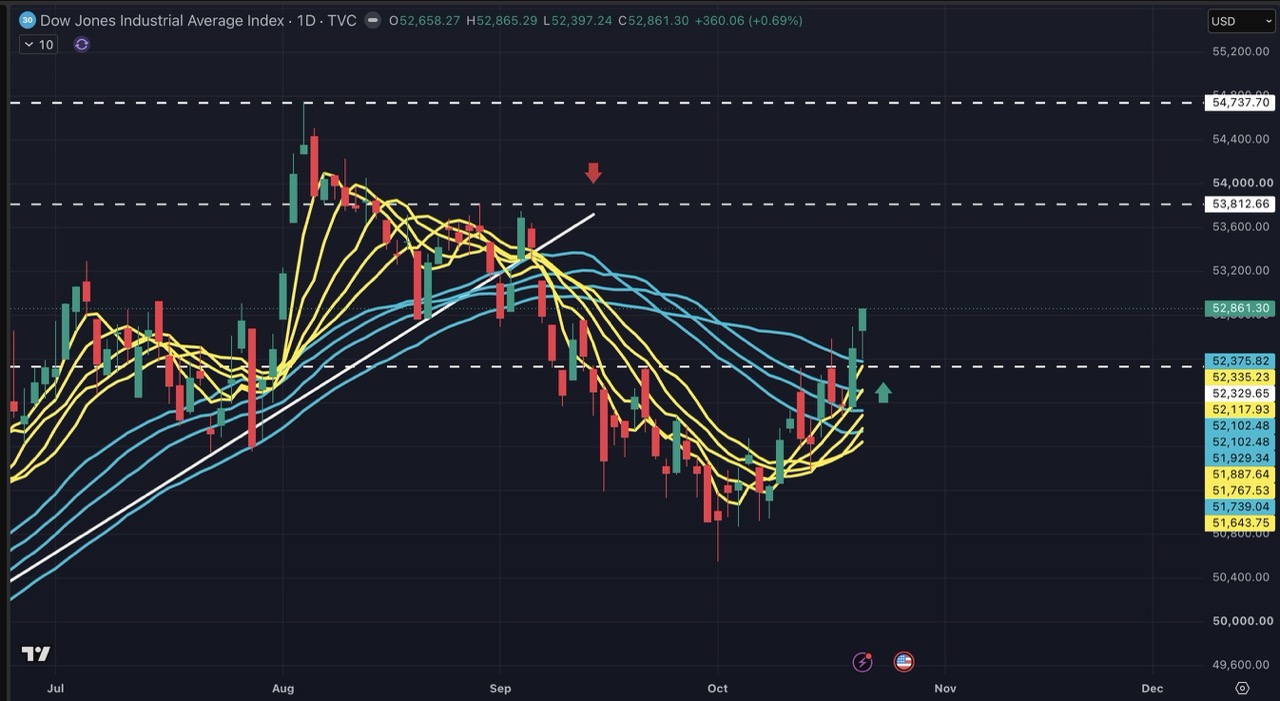
Support Zone: 52,330–52,375 — the reclaimed breakout area. A daily hold above this keeps the bullish recovery structure intact.
Secondary Support: 52,100–52,120 / 51,880–51,640 — a pullback into these zones could still be constructive if buyers defend the area and price forms a higher low.
Upside Targets: 53,100 (near-term, consistent with the 52,390 breakout projection) → 53,812 (major resistance) → 54,000 (psychological) → 54,738 (higher-timeframe target).
My bias: Bullish while price holds above 52,330–52,375. I'd rather wait for a clean daily close above current levels, or a controlled pullback toward the reclaimed support zone with bullish confirmation — not chase an extended candle.
As long as AI financing concerns and hawkish Fed expectations keep pressure on mega-cap tech, the Dow's defensive composition gives it a structural edge. The rotation is the trade.
This is a market analysis based on chart structure and current sentiment, not financial advice. CFD prices may differ slightly between brokers.
All trading education provided by Bitget is for educational purposes only and should not be considered financial advice. The strategies and examples shared are for reference only and may not reflect actual market conditions. CFD trading involves significant risk, including the potential loss of capital. Past performance does not guarantee future results. Please conduct thorough research and ensure that you understand the risks involved. Bitget is not responsible for any trading decisions made by users.


- 📊 Why This Matters Right Now
- 📈 Core Thesis: Rotation, Not Randomness
- ⚠️ Risk View
- 🎯 Key Levels & Bias