What Is American Dollar Reserve (ADR)? The Solana Meme Coin Built on a “New World Order” Narrative
Can a meme coin borrow the language of global finance and turn it into a speculative crypto asset? American Dollar Reserve (ADR) does exactly that. Built on the Solana blockchain, ADR positions itself around a provocative “New World Order” narrative, using dollar-reserve symbolism and geopolitical satire to capture attention in a crowded meme coin market. The branding suggests monetary authority, but in reality, ADR is a community-driven token whose value is shaped entirely by market sentiment.
Despite its official-sounding name, ADR is not a stablecoin and has no verified backing in U.S. dollar reserves. It is not affiliated with the U.S. government, the Federal Reserve, or any regulated financial institution. Instead, ADR trades as a standard Solana SPL token, with price movements determined by decentralized exchange liquidity and speculative demand. In this article, we will examine what American Dollar Reserve (ADR) is, who created it, how it works, its tokenomics, and what its future price trajectory could look like in the coming years.
What Is American Dollar Reserve (ADR)?

American Dollar Reserve (ADR) is a meme cryptocurrency built on the Solana network using the SPL token standard. It trades under the ticker ADR and exists purely as an on-chain digital asset without intrinsic utility, governance rights, or protocol functionality. Unlike stablecoins that aim to maintain a 1:1 peg with the U.S. dollar, ADR does not have a reserve mechanism, collateral backing, or algorithmic stabilization model.
The project’s branding centers on the concept of an “American Dollar Reserve” tied to a so-called “New World Order” or “New World Age” narrative. However, there is no verified connection to the U.S. government, the Federal Reserve System, or any traditional financial institution. The dollar-themed positioning functions as satire and marketing rather than as a financial structure.
Who Created American Dollar Reserve (ADR)?
The creators of American Dollar Reserve (ADR) have not publicly disclosed their identities. There is no verified information about a founding team, registered company or venture backing behind the project, and it appears to have been launched anonymously, which is common in the Solana meme coin sector.
ADR is primarily promoted through social media channels that focus on its “New World Order” satire and dollar-themed branding. No formal whitepaper, audit or detailed development roadmap has been made public, meaning the project operates without identifiable leadership or institutional oversight.
How American Dollar Reserve (ADR) Works
American Dollar Reserve (ADR) operates as a standard SPL token on the Solana blockchain. It does not have its own chain, consensus mechanism or native protocol features. Instead, it exists as a transferable digital asset within the Solana ecosystem. ADR’s price is determined entirely by decentralized exchange activity, meaning its value fluctuates based on liquidity, buy and sell pressure, and broader market sentiment. There is no reserve backing, algorithmic stabilization mechanism or yield-generating system supporting the token.
Key operational features include:
-
Token Standard: SPL token issued on Solana
-
Trading Venues: Primarily traded on decentralized exchanges such as Meteora and Raydium, with routing available via Jupiter
-
Trading Pairs: Commonly paired against SOL or USDC in automated market maker (AMM) liquidity pools
-
Wallet Compatibility: Can be stored in Solana-compatible wallets such as Phantom or Solflare
-
Price Discovery: Determined by supply and demand within liquidity pools, without any peg to the U.S. dollar
-
Contract Address: h11bCiMTybZsStCDaeuTrH3DqraJrn5w9F9AKDaAADR
As a result, ADR functions purely as a speculative on-chain asset, with volatility influenced by liquidity depth and market participation rather than by underlying fundamentals.
American Dollar Reserve (ADR) Tokenomics
American Dollar Reserve (ADR) has a fixed total supply of 600,000,000 tokens, with 100% reportedly in circulation since launch. There are no publicly disclosed vesting schedules, staking mechanisms or token burn programs. The supply structure is fully unlocked, meaning there is no programmed inflation, but also no built-in scarcity or yield incentives.
As of early March 2026, ADR trades in the low-cent range with a market capitalization in the multi-million-dollar range. Daily trading volume typically remains below $1 million, and the token has several thousand on-chain holders. Liquidity is mainly concentrated in ADR/SOL pools on Solana-based decentralized exchanges, making price movements sensitive to trading activity and overall market sentiment.
American Dollar Reserve (ADR) Price Prediction for 2026, 2027–2030
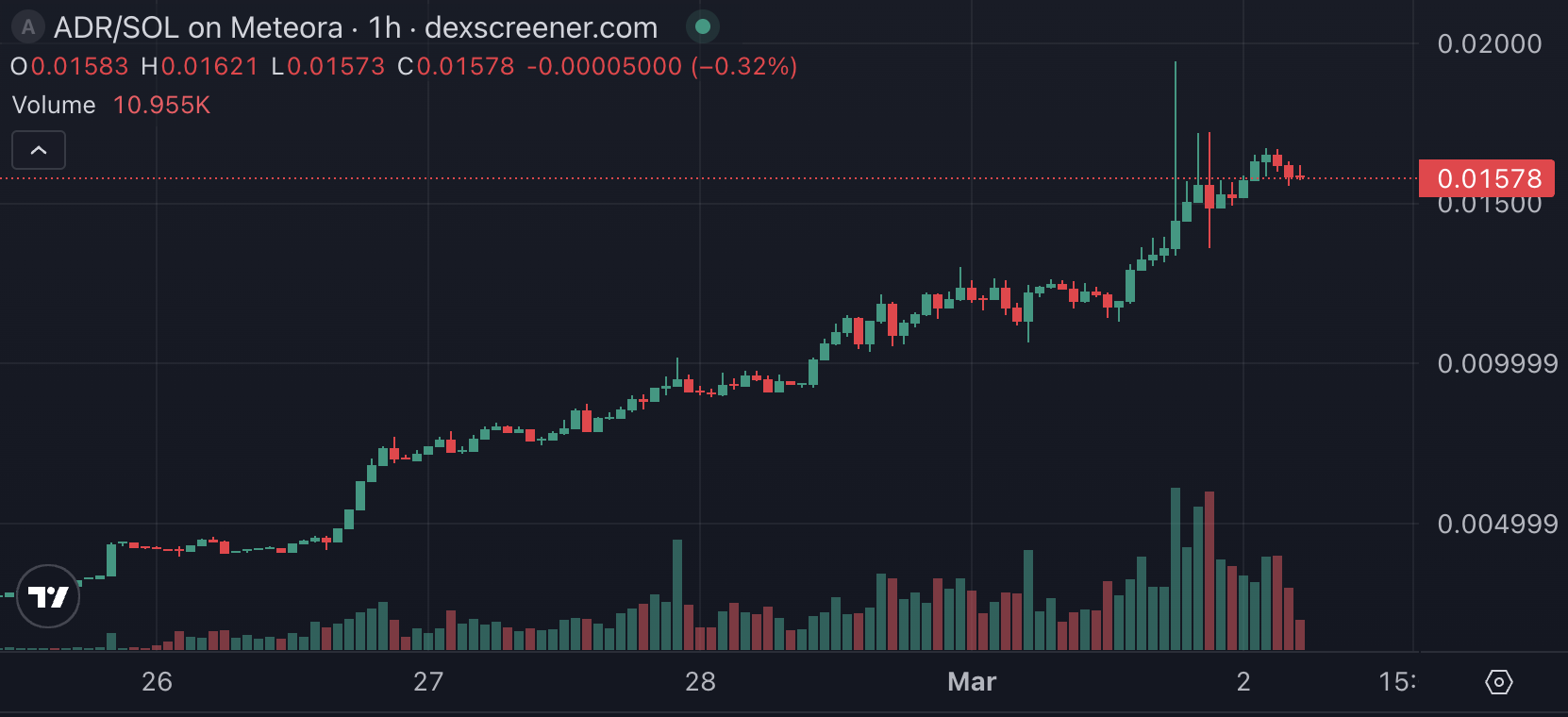
American Dollar Reserve (ADR) Price
Source: dexscreener
As of this writing, American Dollar Reserve (ADR) is trading at $0.015, with a multi-million-dollar market capitalization and moderate daily trading volume. Given its micro-cap structure and limited liquidity depth, price movements remain highly sensitive to market sentiment and speculative activity.
-
2026 Outlook: In a bullish meme cycle on Solana, ADR could test the $0.025–$0.035 range if trading volume expands. In a neutral environment, it may fluctuate between $0.010–$0.020. In a bearish scenario marked by declining liquidity, prices could retrace toward $0.005.
-
2027–2030 Outlook: Over the longer term, projections remain highly speculative. In a sustained crypto bull market, ADR could revisit or exceed $0.05 during peak momentum phases. However, without fundamental utility or structural demand, a more conservative range between $0.003–$0.02 is plausible. In the event of prolonged market weakness, prices could drift below $0.003, reflecting reduced liquidity and fading narrative relevance.
As with most meme coins, these projections are scenario-based estimates rather than fundamental valuations.
Conclusion
American Dollar Reserve (ADR) is a Solana-based meme coin built around a dollar-themed, “New World Order” narrative rather than a functional financial framework. Despite its official-sounding name, the token has no verified U.S. dollar backing, no affiliation with government institutions and no built-in utility beyond trading on decentralized exchanges.
With a fully circulating supply, multi-million-dollar market capitalization and moderate liquidity, ADR operates as a speculative micro-cap asset whose price is driven by sentiment and short-term momentum. As with many meme tokens, volatility can be significant, and long-term sustainability depends largely on continued community engagement and broader market cycles. Investors should approach ADR with caution and conduct independent research before making any financial decisions.
Disclaimer: The opinions expressed in this article are for informational purposes only. This article does not constitute an endorsement of any of the products and services discussed or investment, financial, or trading advice. Qualified professionals should be consulted prior to making financial decisions.


- What Is American Dollar Reserve (ADR)?
- Who Created American Dollar Reserve (ADR)?
- How American Dollar Reserve (ADR) Works
- American Dollar Reserve (ADR) Tokenomics
- American Dollar Reserve (ADR) Price Prediction for 2026, 2027–2030
- Conclusion