

What Is Pons (PONS)? The Memecoin Bringing Pump.fun-Style Trading to Robinhood Chain
Memecoin launchpads have made it easier than ever to turn an internet joke, community idea, or trending narrative into a tradable token. Pump.fun helped popularize this model on Solana, and now similar activity is starting to appear on Robinhood Chain.
One of the projects gaining attention is pons, a permissionless token launchpad that allows users to create and trade tokens directly from their wallets. At the center of the ecosystem is Pons (PONS), a memecoin that has become closely associated with the growth of the platform.
What makes PONS more interesting than a typical memecoin is its connection to protocol activity. A portion of the fees generated by pons is used to buy back PONS and send the tokens to a burn address, linking launchpad usage with the token's supply.
Key Takeaways
-
Pons (PONS) is a memecoin associated with the pons launchpad on Robinhood Chain.
-
pons allows users to create and trade fixed-supply tokens without building their own smart contracts.
-
The platform offers a simple launch experience similar in spirit to Pump.fun, although the mechanics are different.
-
PONS originally launched with a maximum supply of 1 billion tokens.
-
The protocol currently uses 80% of protocol fees to buy back PONS, which is then sent to a burn address.
-
PONS is an independent crypto asset and is not an official Robinhood token.
What Is Pons (PONS)?

Pons (PONS) is a memecoin on Robinhood Chain and the reference token of the pons token-launch ecosystem.
There are two parts to understand.
PONS is the cryptocurrency token. pons is the launchpad where users can create, discover, and trade tokens on Robinhood Chain.
PONS was launched through the earlier version of the pons protocol and has already reached the platform's graduated stage. Although PONS is closely connected to activity on Robinhood Chain, it is not issued by Robinhood and does not represent shares or ownership in Robinhood Markets.
What Is the pons Launchpad?
pons is a permissionless platform designed to make token launches simple.
Instead of creating a smart contract, setting up liquidity, and building a trading market manually, users can launch a token by choosing basic information such as its name, ticker, image, description, and social links.
Each new token created through the current system has a fixed supply of 1 billion tokens. A liquidity pool is created during the launch, and liquidity is automatically locked.
Tokens trade against WETH, while users interact with the platform through their own wallets.
This gives pons a similar appeal to Pump.fun: users do not need much technical knowledge to create and trade new tokens.
However, the two platforms do not work exactly the same way. On pons, tokens continue trading in the same liquidity pool after graduation instead of moving to a new pool.
How Does pons Work?
The process can be divided into three main stages.
1. Create a Token
A creator enters the token's name, symbol, image, description, and other basic details.
The protocol then creates the token and its liquidity pool in the same transaction.
New tokens have a fixed supply of 1 billion tokens, while the standard launch fee is 0.0005 ETH.
2. Start Trading
Once the token is launched, users can immediately buy and sell it through its liquidity pool.
The pool charges a 1% trading fee.
For tokens created through the current system, 70% of liquidity fees go to the creator and 30% go to the protocol.
Older tokens, including PONS, follow the legacy fee structure.
3. Graduate
A token reaches graduation when the amount of WETH in its liquidity pool reaches the required threshold, currently set at around 4.2 ETH by default.
Graduation does not guarantee that a project is legitimate, valuable, or liquid. It simply means the token has reached a specific liquidity milestone.
What Makes PONS Different From a Typical Memecoin?
Most memecoins depend heavily on community attention, social-media hype, and speculative trading.
PONS has those characteristics too, but it also has a direct connection to the activity generated by the pons launchpad.
The protocol earns fees when users trade tokens launched through the platform. Under the current model, 80% of protocol fees are used to buy PONS through an automated TWAP strategy.
The purchased PONS is then sent to a burn address and removed from circulation.
The basic idea is simple:
More platform activity → more protocol fees → more PONS buybacks → more PONS burned.
The remaining 20% of protocol fees is used to support infrastructure and the development of the pons ecosystem.
This mechanism gives PONS a clearer economic narrative than many memecoins. However, token burns do not guarantee that the price of PONS will increase.
The project has also stated that the current 80% allocation is not yet immutable and could change in the future.
PONS Tokenomics
PONS originally launched with a maximum supply of:
1,000,000,000 PONS
Its basic token structure includes:
-
Token name: Pons
-
Ticker: PONS
-
Network: Robinhood Chain
-
Maximum supply: 1 billion PONS
-
Category: Memecoin / launchpad ecosystem token
-
Contract: 0x39dBED3a2bd333467115dE45665cC57F813C4571
-
Buyback mechanism: Protocol fees are used to purchase PONS
-
Burn mechanism: Purchased PONS is sent to a burn address
-
Current protocol fee allocation to buybacks: 80%
Because the burn system is connected to protocol revenue, activity on the pons launchpad is one of the main metrics to watch.
Higher trading activity can generate more protocol fees, which may lead to larger buybacks under the current model.
Why Is Pons (PONS) Getting Attention?
PONS is benefiting from several narratives at the same time.
The first is Robinhood Chain. The network launched its mainnet on July 1, 2026 as an Ethereum-compatible Layer 2 built using Arbitrum technology. It is designed to support crypto assets, tokenized financial products, and other onchain applications.
As one of the early memecoin launchpads on the network, pons has attracted traders looking for new projects in the emerging Robinhood Chain ecosystem.
The second factor is the token-launchpad narrative.
Platforms such as Pump.fun showed that making token creation simple can attract large numbers of traders, creators, and speculative communities. pons is applying a similar idea to Robinhood Chain.
The third factor is the PONS buyback-and-burn mechanism.
Because a large share of protocol fees is currently used to buy and burn PONS, traders can track platform activity alongside the token's price.
Pons has already generated hundreds of millions of dollars in cumulative trading volume, helping the project become one of the more visible applications in the early Robinhood Chain ecosystem.
PONS Price Performance
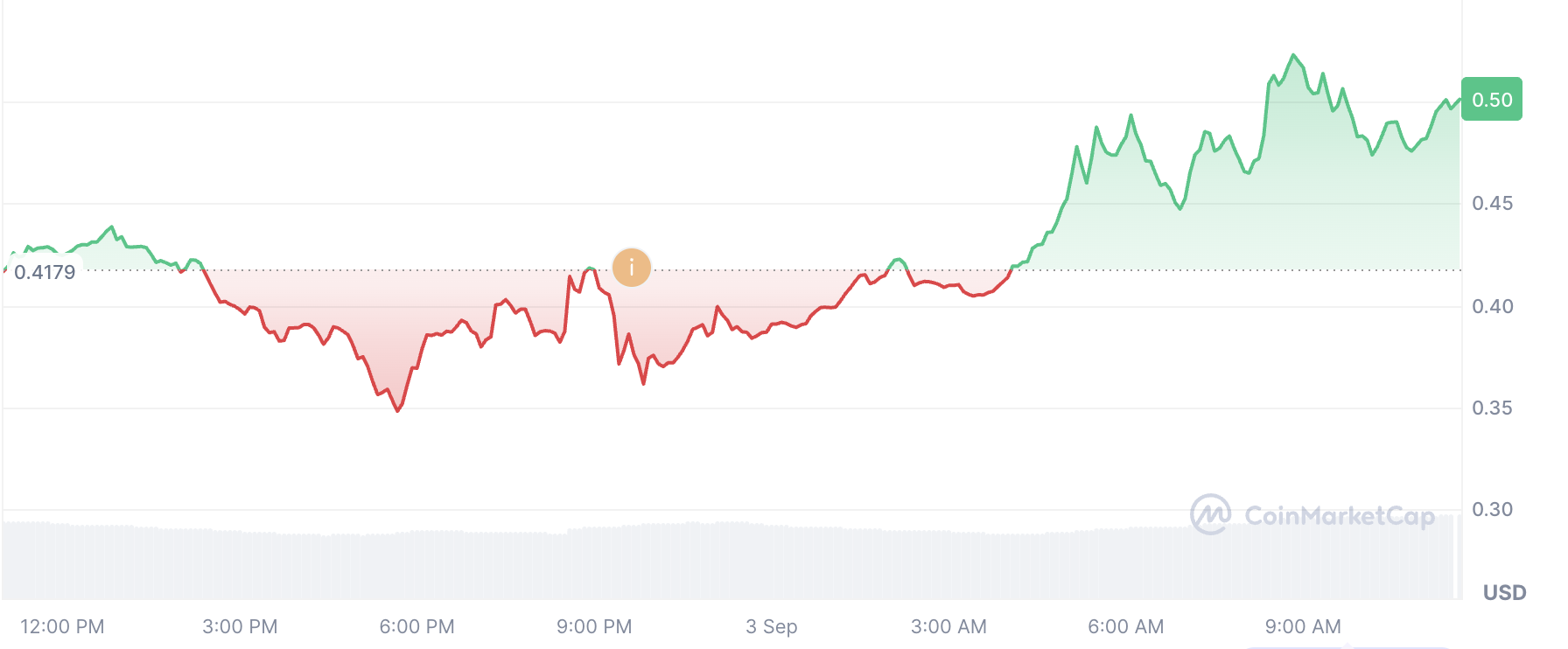
Source: CoinMarketCap
PONS has experienced strong price volatility since launch.
As of early September 2026, the token was trading around $0.39, after reaching an all-time high of approximately $0.52 on September 3, 2026.
Its earlier all-time low was around $0.0033 in July 2026.
This means PONS moved from a relatively small memecoin into a token worth hundreds of millions of dollars within a short period.
Several factors may have contributed to the rally, including growing attention around Robinhood Chain, rising launchpad activity, speculative demand, and interest in the PONS burn mechanism.
However, rapid gains can also mean higher risk. Memecoins can experience sharp corrections when trading activity or market attention begins to slow.
Is PONS Just a Memecoin?
PONS should still be considered primarily a memecoin.
Its connection to a functioning launchpad gives it more utility and a stronger economic narrative than many meme tokens, but its market value remains highly speculative.
PONS can still be strongly influenced by community sentiment, market hype, liquidity, Robinhood Chain growth, and broader memecoin trends.
The buyback-and-burn system may support the PONS ecosystem, but protocol revenue does not automatically translate into higher token prices.
What Are the Risks of PONS?
PONS combines the risks of a memecoin with the uncertainty of a relatively new blockchain ecosystem.
Key risks include:
-
High volatility: PONS can experience large price swings in a short period.
-
Speculative demand: Memecoin prices often depend heavily on market attention and sentiment.
-
Platform dependency: Part of the PONS narrative depends on continued usage of the pons launchpad.
-
Competition: Other launchpads may compete for traders, creators, and liquidity.
-
Buyback policy changes: The current 80% fee allocation is not yet immutable.
-
Launchpad token risk: Tokens created permissionlessly may have limited liquidity or little long-term value.
-
Robinhood Chain risk: The network itself is still relatively new.
Users should therefore treat PONS and tokens launched through pons as highly speculative assets.
Should You Invest in Pons (PONS)?
PONS stands out because it connects memecoin speculation with activity from a real token-launch platform.
If more users create and trade tokens through pons, the protocol can generate more fees. Under the current model, part of those fees is used to buy and burn PONS.
That gives investors additional metrics to follow, including trading volume, protocol revenue, token burns, liquidity, and overall Robinhood Chain activity.
Still, PONS remains a high-risk memecoin. Its price can rise or fall quickly, and neither protocol growth nor token burns guarantee future returns.
Anyone considering PONS should look beyond short-term price moves and carefully evaluate the project's activity, token distribution, liquidity, and broader market conditions.
Conclusion
Pons (PONS) is one of the early memecoins emerging from the Robinhood Chain ecosystem. Its associated launchpad makes it easy for users to create and trade new tokens, bringing a Pump.fun-style experience to a relatively new blockchain.
What makes PONS different is its connection to the launchpad's fee model. With part of protocol revenue currently used to buy and burn PONS, the token combines memecoin speculation with a platform-driven economic narrative. That gives PONS more to watch than social hype alone, but it remains a highly volatile and speculative crypto asset.


- Key Takeaways
- What Is Pons (PONS)?
- What Is the pons Launchpad?
- How Does pons Work?
- What Makes PONS Different From a Typical Memecoin?
- PONS Tokenomics
- Why Is Pons (PONS) Getting Attention?
- PONS Price Performance
- Is PONS Just a Memecoin?
- What Are the Risks of PONS?
- Should You Invest in Pons (PONS)?
- Conclusion
 ETH Price Prediction: What Will Ethereum Be Worth in 2030?2026-09-03 | 5m
 What Is Bitget CFD Independent Quote Depth?2026-08-30 | 5m
 What Does the .pro Suffix in Bitget CFD Mean?2026-08-30 | 5m