
Step-by-step guide: How to achieve ultra-high win rates on Polymarket through insider information

Insiders with reliable information help correct pricing errors and indirectly transmit information to others through price movements.
Insiders with reliable information help correct pricing errors and indirectly transmit information to everyone else through price movements.
Written by: The Smart Ape
Translated by: AididiaoJP, Foresight News
How to Find Insiders on Polymarket
Polymarket is a large and rapidly growing market, with trading volume exceeding $15 billions since its launch.
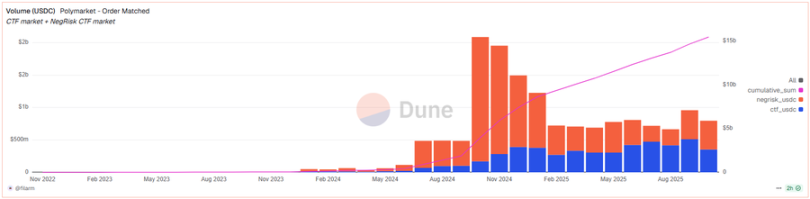
What’s fascinating is that users can profit using many advanced strategies, such as arbitrage, liquidity provision, discount capture, high-frequency trading, and more.
It is still an early and evolving market, now entering the regulatory phase, which means there are still plenty of opportunities.
But there is one method that remains largely underutilized: insider analysis.
Polymarket is an open platform, meaning anyone can create a market on anything. Some markets are entirely based on public information, such as “Who will win the next World Cup?”, while others involve events where a small group of people already know the answer, such as “Who will win the next Nobel Peace Prize?”
In the Nobel Prize market, the committee responsible for selecting the Nobel laureates obviously knows the result earlier than anyone else, and some of them may quietly use this information to trade on Polymarket.
If you can track the movements of these insiders, you can actually bet on the correct outcome with near certainty, because insiders know exactly what will happen.
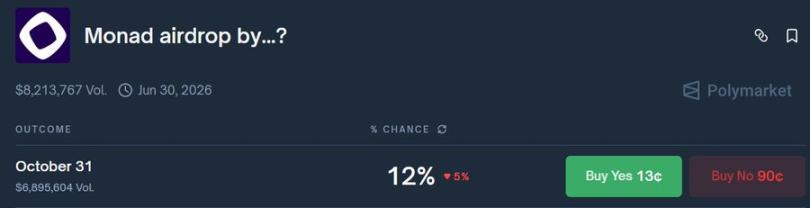
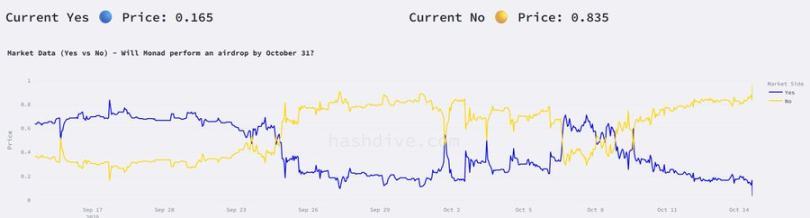
Another example is “Monad airdrop before October 31.”
The project team and people closely related to the project already know whether it will happen, so anyone who can track these wallets has a huge advantage.
There are several ways to detect potential insider activity.
The simplest method is to use Hashdive(dot)com, currently the best Polymarket analytics tool, which provides extensive metrics and data for each market.
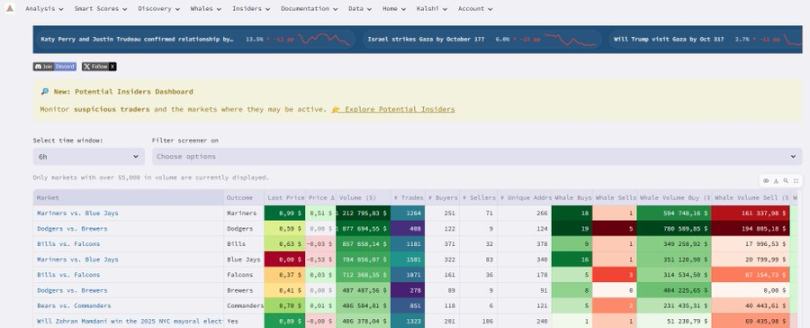
- First, select a market where insider activity may exist, such as the monad airdrop.
- Click into the market, and you’ll see a detailed page with analysis and metrics.
- Scroll down to the “Possible Insider Traders” section.
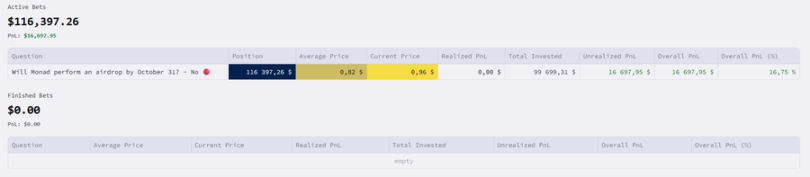
Let’s take the first trader on the list as an example:
He put in $100,000 betting “No,” and this is the only market he’s trading in.
This is suspicious—a new wallet, putting a large amount of money into a single market.
This person is very likely a member of the Monad team or closely related to them.
The goal is not to focus on a single trader, but to analyze the collective activity of the group.
Some may be genuine insiders, others may just be following the trend—the key is the overall pattern.
In this example, almost all the top traders are betting “No.”
The top eight wallets are all on the same side, each using a new wallet and holding large positions in only one or two markets.
This is a clear signal: insiders seem convinced there will be no Monad airdrop before October 30.
Currently, the “No” side is trading at about $0.83, meaning there is a potential guaranteed return of nearly 17% by October 30.
Some markets do not have a “Possible Insider Traders” section, which is normal.
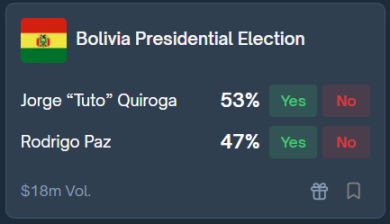
For example, in the “Bolivian Presidential Election,” there can’t really be insiders, because in a close race, no one truly knows how people will vote.
So the key is to choose markets where insider information may exist and track insider movements as early as possible.
The earlier you spot these movements, the higher your potential profit.
If you wait too long, more insiders will enter, prices will move, and your profit margin will shrink.
Your advantage depends entirely on how early you can spot them.
Nobel Prize Case Study
One of the best real-world examples of this strategy is the market:
“2025 Nobel Peace Prize Winner.”
Some traders clearly got the information 9 hours before the official announcement.
Within seconds, Maria Machado’s winning probability jumped from 3.6% to 70%, well before the result was made public.
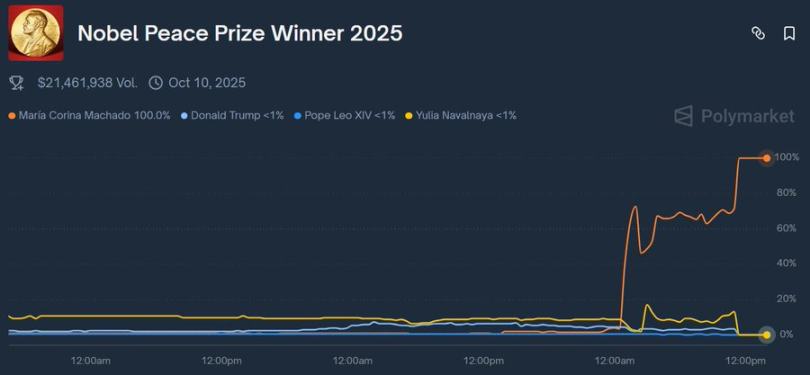
This was clearly the move of insiders—someone leaked the decision in advance.
Some traders made 20x returns, either by following the insider pattern or because they were insiders themselves:
Debased turned $2,500 into $75,000
CannonFodders turned $900 into $30,000
Gopfan2 turned $700 into $26,000
They all entered immediately when Maria Machado’s probability began to mysteriously soar.
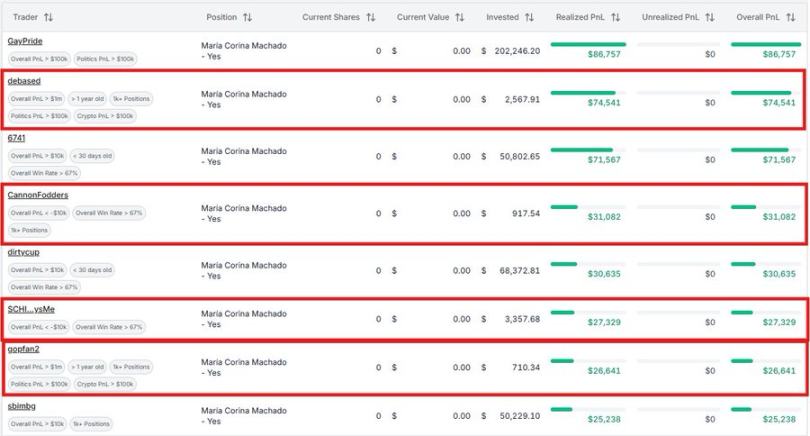
These people could be members of the Nobel committee, people closely related to the committee, or even investigative journalists who discovered the leak.
In any case, the facts are clear: some people had reliable information 9 hours before the official announcement.
When the probability on the Polymarket market jumps from 3% to 70% within minutes, it’s undeniable—insiders are in action.
Norwegian authorities even launched an insider trading investigation into this case.
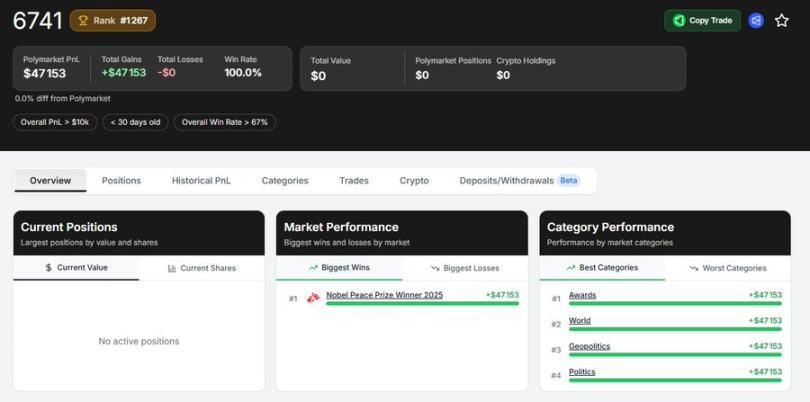
Reportedly, they focused on wallet “6741,” which bet $50,000 hours before the result was announced.
That wallet only traded once, and only in this market, which immediately drew attention.
Why Having Insiders Is Actually a Good Thing
At first, you might think insiders are bad for Polymarket, but in reality, they help it achieve its true purpose.
The real mission of Polymarket is not about making or losing money,
but about revealing the collective truth about future events.
The more insiders there are, the more accurate the prices become,
and the more reliable the information the market provides.
Take the Nobel Prize as an example.
I don’t need to wait for the official announcement—Polymarket already told me who the winner is.
In this sense, Polymarket beats all major media to the punch, which is exactly why it’s so powerful.
Insiders with reliable information help correct pricing errors and indirectly transmit this knowledge to everyone else through price movements.
This is an ultra-efficient information dissemination mechanism.
Without insiders, prices only reflect opinions and guesses.
With them, prices reflect hidden but real facts.
This is why some economists, such as the creators of the “prediction market” concept, believe that insider trading is beneficial in this context:
It narrows the gap between belief and reality.
It also creates a truth-incentive system:
If insiders trade based on real information, they profit.
If they are wrong or lie, they lose money.
There is no incentive to spread fake news, because they pay the price for being wrong.
Most importantly, the insiders here do not harm others.
This is not like the token market, where insiders dump tokens on retail traders.
Prediction markets are voluntary, and traders are aware of the risk of information asymmetry.
This is a probability game, not a long-term investment.
Therefore, as long as the rules are clear, insiders can improve the accuracy of predictions without causing systemic unfairness.

Tools to Track Them
Here are some of the most useful tools for analyzing Polymarket data.
This list is not exhaustive—new tools are constantly emerging.
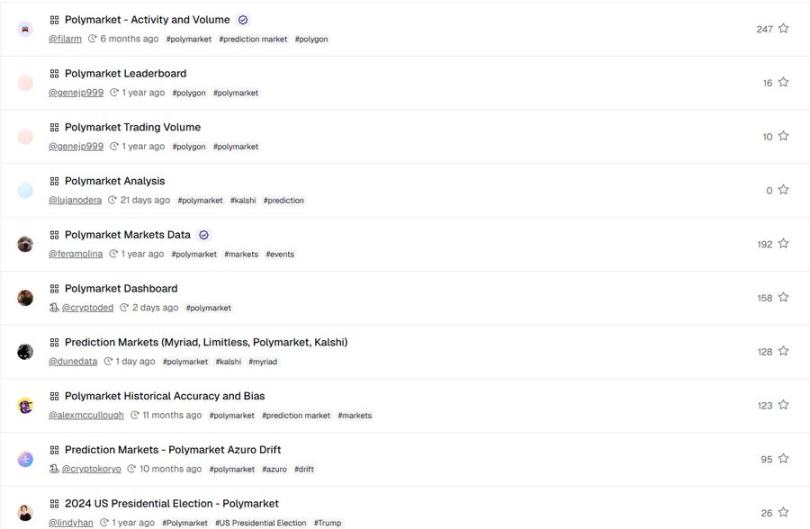
Dune Dashboards: Dozens of Polymarket dashboards, some global (trading volume, users, trades), others specialized (insiders, airdrop trackers, whales, etc.).
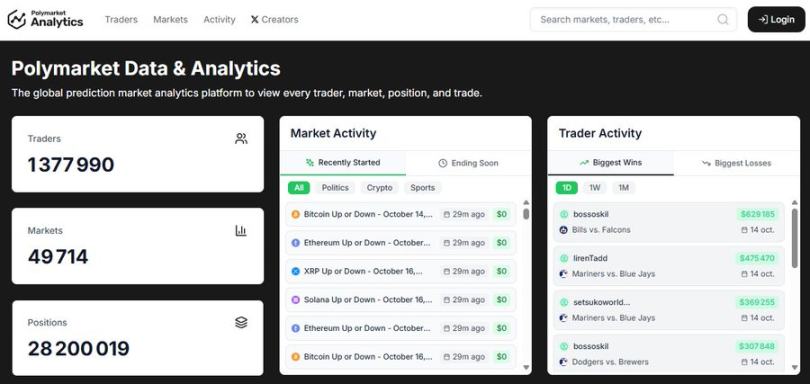
PolymarketAnalytics(dot)com: One of the most comprehensive tools. Allows you to track market traders in real time, discover top alerts, whales, smart money, and analyze performance.
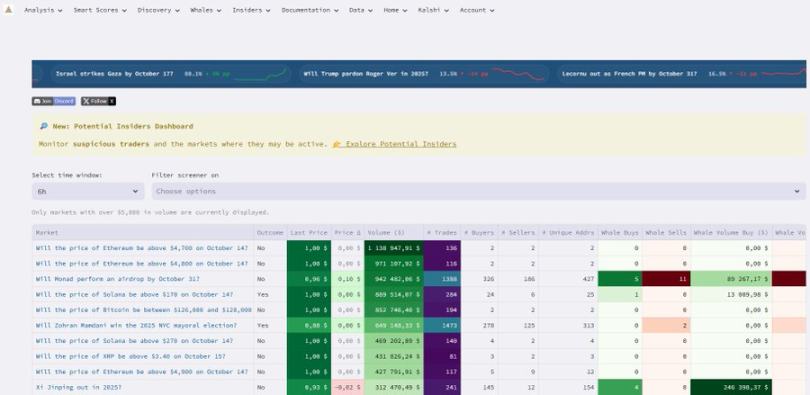
Hashdive(dot)com: Another powerful analytics platform. Each market page contains in-depth metrics, as well as a new “Insiders” section to help you identify potential insider traders.
Disclaimer: The content of this article solely reflects the author's opinion and does not represent the platform in any capacity. This article is not intended to serve as a reference for making investment decisions.
You may also like
Will the traditional Christmas rally still happen in the US stock market this year?
After a simultaneous technical and position-based recovery in the US stock market, Goldman Sachs, Morgan Stanley, and JPMorgan have successively signaled a year-end rebound. Extremely light positions, mean reversion of valuations, and seasonal support together create conditions for a short squeeze. However, global manufacturing import price inflation has annualized at around 24%, surpassing the pandemic peak, and the inflation bill will come due intensively in the first quarter of next year. Goldman Sachs warns that once the year-end rally materializes, it may exhaust future upside potential.

Anthropic IPO Roadshow: CEO Says "Doesn't Care About Market Conditions", Hopes to "Underpromise and Overdeliver"
As Anthropic gears up for its IPO, CEO Amodei remains deliberately low-key during the roadshow, emphasizing "under-promise and over-deliver," and appears calm regarding market volatility at the time of listing. In response to fluctuations in the AI sector and the Nvidia situation, Amodei stated he is not particularly concerned about the specific month of listing or market conditions, and frankly admits that allocation of computing power is "the most fundamental business challenge."
SpaceX (SPCX.US) Starship's 15th Test Flight: Booster recovery failed for unknown reasons; first orbital round-trip mission still awaits upper stage "tower catch" landing
On Friday local time, SpaceX conducted its 15th Starship flight mission in Texas.

Unlike Elon Musk’s “One Price” Approach: Anthropic (ANT.US) Roadshow Pricing Inquiry at $70-78, Institutional Investors Become the True Decision Makers in IPO Pricing
Anthropic will launch what is set to be the largest IPO in history next week, aiming to take this title from SpaceX. However, unlike Elon Musk’s conglomerate, large investors will have greater influence over its IPO pricing amid the ongoing turbulence in the artificial intelligence (AI) market.
Crypto prices
More


