
How can the network effect of cryptocurrencies become a valuation trap?

Written by: Santiago Roel Santos
Translated by: AididiaoJP, Foresight News
Original Title: The "Bankruptcy" of Metcalfe's Law: Why Are Cryptocurrencies Overvalued?
The Network Effect Dilemma of CryptocurrenciesMy previous view that "cryptocurrency trading prices far exceed their fundamentals" sparked heated debate. The strongest objections were not about usage or fees, but stemmed from ideological differences:
-
"Cryptocurrencies are not businesses"
-
"Blockchains follow Metcalfe's Law"
-
"The core value lies in network effects"
As someone who witnessed the rise of Facebook, Twitter, and Instagram, I am well aware that early internet products also faced valuation challenges. But the pattern became clear: as users' social circles joined, the product's value grew explosively. User retention increased, engagement deepened, and the flywheel effect was evident in the experience.
This is the true manifestation of network effects.
If one argues that "cryptocurrencies should be valued from a network rather than a business perspective," then let's analyze further.
Upon deeper investigation, an unavoidable issue emerges: Metcalfe's Law not only fails to support current valuations, but actually exposes their fragility.
The Misunderstood "Network Effect"
The so-called "network effects" in the crypto space are mostly negative effects:
-
User growth leads to a deteriorating experience
-
Transaction fees skyrocket
-
Network congestion intensifies
The deeper issues are:
-
Open-source nature leads to developer attrition
-
Liquidity is profit-seeking
-
Users migrate across chains based on incentives
-
Institutions switch platforms based on short-term interests
Successful networks have never operated this way; when Facebook added tens of millions of users, the experience never declined.
But New Blockchains Have Solved the Throughput Problem
This does alleviate congestion, but does not solve the essence of the network effect problem. Increasing throughput only removes friction; it does not create compounded value.
The fundamental contradictions remain:
-
Liquidity can leave
-
Developers can move
-
Users can leave
-
Code can be forked
-
Weak value capture capability
Scaling improves usability, not inevitability.
The Truth Revealed by Fees
If L1 blockchains truly had network effects, they should capture most of the value like iOS, Android, Facebook, or Visa. In reality:
-
L1s account for 90% of total market cap
-
Fee share plummeted from 60% to 12%
-
DeFi contributes 73% of fees
-
But valuation share is less than 10%
The market is still pricing according to the "fat protocol theory," but the data points to the opposite conclusion: L1s are overvalued, applications are undervalued, and ultimately value will aggregate at the user aggregation layer.
User Valuation Comparison
Using a general metric, market cap per user:
Meta (Facebook)
-
3.1 billion monthly active users
-
$1.5 trillion market cap
-
Per user value: $400-500
Cryptocurrencies (excluding bitcoin)
-
$1 trillion market cap
-
400 million general users → $2,500 per user
-
100 million active users → $9,000 per user
-
40 million on-chain users → $23,000 per user
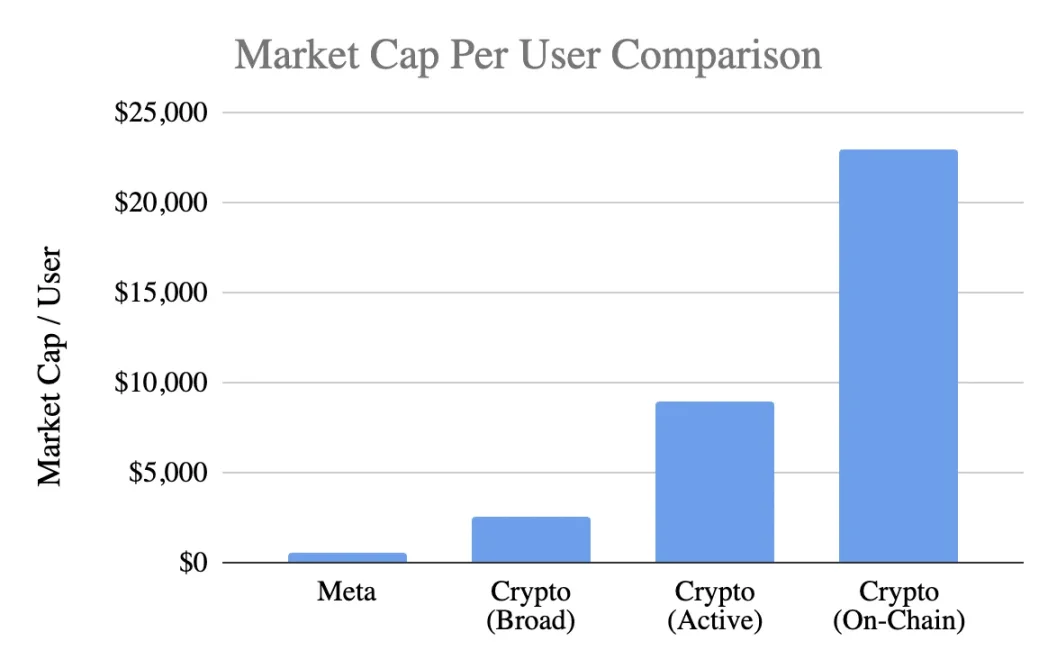
Valuation levels reach:
-
5x premium at the most optimistic estimate
-
20x premium under strict standards
-
50x premium based on real on-chain activity
And Meta is arguably the most efficient monetization engine in consumer tech.
On the Debate About Development Stages
The argument that "Facebook was the same in its early days" is debatable. Although Facebook also lacked revenue early on, its product had already built:
-
Daily usage habits
-
Social connections
-
Identity recognition
-
Community belonging
-
Value enhancement from user growth
In contrast, the core product of cryptocurrencies is still speculation, which leads to:
-
Rapid user influx
-
Even faster churn
-
Lack of stickiness
-
No habit formation
-
No improvement with scale
Unless cryptocurrencies become "invisible infrastructure," a backend service imperceptible to users, network effects will be hard to self-reinforce.
This is not a matter of maturity, but a fundamental product issue.
The Misuse of Metcalfe's Law
The law's description of value ≈ n² is appealing, but its assumptions are flawed:
-
Users need deep interaction (rare in reality)
-
The network should have stickiness (actually lacking)
-
Value should aggregate upward (actually dispersed)
-
There should be switching costs (actually very low)
-
Scale should build a moat (not yet apparent)
Most cryptocurrencies do not meet these prerequisites.
The Key Variable k Value's Revelation
In the V=k·n² model, the k value represents:
-
Monetization efficiency
-
Level of trust
-
Depth of participation
-
Retention ability
-
Switching costs
-
Ecosystem maturity
Facebook and Tencent's k values range from 10⁻⁹ to 10⁻⁷, tiny due to their massive network scale.
Cryptocurrency k value estimates (based on $1 trillion market cap):
-
400 million users → k ≈ 10⁻⁶
-
100 million users → k ≈ 10⁻⁵
-
40 million users → k ≈ 10⁻⁴
This means the market assumes each crypto user is worth far more than a Facebook user, despite lower retention, monetization, and stickiness. This is not early optimism, but excessive overextension into the future.
The Reality of Network Effects
Cryptocurrencies actually have:
-
Two-sided network effects (users ↔ developers ↔ liquidity)
-
Platform effects (standards, tools, composability)
These effects are real but fragile: easily forked, compounding slowly, and far from the n² flywheel effect of Facebook, WeChat, or Visa.
A Rational View on Future Prospects
The vision that "the internet will be built on crypto networks" is indeed attractive, but it must be made clear:
-
This future may come true
-
It has not yet arrived, and current economic models do not reflect it
Current value distribution shows:
-
Fees flow to the application layer, not L1
-
Users are controlled by exchanges and wallets
-
MEV captures value surplus
-
Forks weaken competitive barriers
-
L1s struggle to solidify created value
Value capture is migrating from the base layer → application layer → user aggregation layer, which benefits users, but should not command a premature premium.
Characteristics of Mature Network Effects
A healthy network should exhibit:
-
Stable liquidity
-
Concentrated developer ecosystem
-
Improved base layer fee capture
-
Continued retention of institutional users
-
Growth in cross-cycle retention rates
-
Composability defending against forks
Currently, Ethereum is showing early signs, Solana is gaining momentum, but most public chains are still far from this.
Conclusion: Valuation Judgments Based on Network Effect Logic
If crypto users:
-
Are less sticky
-
Are harder to monetize
-
Have higher churn rates
Their unit value should be lower than Facebook users, not 5-50 times higher. Current valuations have already priced in network effects that have not yet formed; the market is pricing as if strong effects already exist, but in reality, at least for now, they do not.
Disclaimer: The content of this article solely reflects the author's opinion and does not represent the platform in any capacity. This article is not intended to serve as a reference for making investment decisions.
You may also like
Nvidia acts as a "matchmaker": Anthropic and "AI Cloud" Lamda reach a $35 billion "computing power agreement"
Anthropic has signed two major computing power deals this year, totaling $80 billion. NVIDIA has evolved from being merely a chip supplier to a promoter of the "financialization of computing power infrastructure" in the ecosystem. By holding data center leases, NVIDIA provides credit endorsement and facilitates transactions for Anthropic, thereby extending its reach throughout the entire computing power supply chain. Emerging cloud providers are taking advantage of this to strongly challenge the market positions of giants like Amazon and Microsoft.
The US proposes a "debt relief plan" at the G20: Bessent and Walsh jointly call for "growth as the only way out of the predicament"
Against the backdrop of soaring global debt, the Iran war impacting energy markets, and rising trade tensions, U.S. Treasury Secretary Bessent and Federal Reserve Chair Walsh jointly introduced the "growth-driven debt resolution" narrative at the G20 finance ministers' meeting. Bessent stated clearly that "the only way out is growth" and called on G20 countries to implement deregulation policies. Walsh announced the end of the "era of secular stagnation," declaring that "growth is a choice."
Musk's tweet sends turbine blade leader tumbling! SpaceX (SPCX.US) announces in-house production of gas turbine blades, Howmet (HWM.US) suffers biggest drop in 16 months
Howmet Aerospace closed down 7.51% on Monday, with intraday losses reaching 9% and hitting a two-month low, marking its largest single-day drop since April 2025.

HYPE, XRP, and Solana face key support and resistance amid cooling momentum
Crypto prices
More


