
Market share dropped from 80% to 20%, what exactly happened to Hyperliquid?

The second half of the liquidity battle: In-depth analysis of Hyperliquid's "AWS-like" transformation and its path to breaking through within the ecosystem.
The Second Half of the Liquidity War: In-depth Analysis of Hyperliquid’s “AWS-ization” Transformation and the Path to Ecosystem Breakthrough.
Written by: esprit.hl
Translated by: AididiaoJP, Foresight News
In recent weeks, there has been growing concern within the industry about the future development of Hyperliquid. Loss of market share, the rapid rise of competitors, and an increasingly crowded derivatives track all point to a core question: what is really happening beneath the surface? Has Hyperliquid already peaked, or is the market’s current interpretation overlooking deeper structural signals?
This article will dissect the situation layer by layer for you.
Phase One: Comprehensive Leadership Period (Early 2023 – Mid 2025)
During this period, Hyperliquid’s key metrics repeatedly hit new highs and its market share continued to grow, mainly due to the following structural advantages:
- Points incentive system: Effectively attracted market liquidity.
- First-mover advantage in launching new contracts: For example, being the first to launch contracts like TRUMP and BERA, making it the platform with the most abundant liquidity for new trading pairs and the preferred choice for pre-market trading (such as PUMP, WLFI, XPL). Traders had to use Hyperliquid to capture emerging trends, pushing its competitive advantage to the peak.
- User experience: Top-tier interface and user experience among perpetual contract DEXs.
- Lower fees: More cost-effective compared to centralized exchanges.
- Launch of spot trading: Opened up new use cases.
- Ecosystem building tools: Including Builder Codes, HIP-2 proposals, and HyperEVM integration.
- Extremely high stability: Maintained zero service interruption even during major market fluctuations.
Thanks to these advantages, Hyperliquid’s market share grew continuously for over a year, reaching a peak of 80% in May 2025.
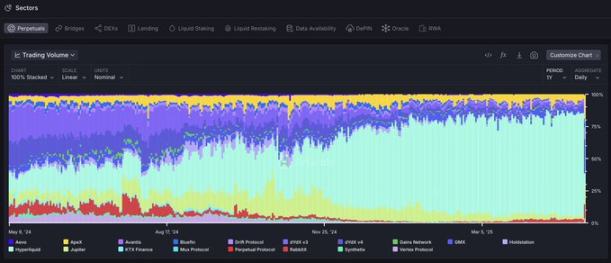
(Market share of perpetual contract trading volume according to @artemis data)
At that time, the Hyperliquid team was far ahead in both innovation and execution, and there was no truly competitive product in the entire ecosystem.
Phase Two: Period of Stagnant Growth: “Liquidity AWS” Strategy and Intensified Competition
Since May 2025, Hyperliquid’s market share has plummeted, dropping from about 80% to nearly 20% by early December.
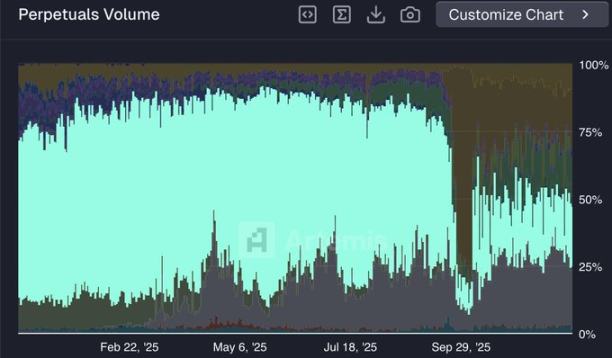
(Market share of @HyperliquidX according to @artemis data)
This relative loss of growth momentum is mainly attributed to the following points:
1. Strategic focus shifted from B2C to B2B
Hyperliquid did not continue to deepen the pure B2C model (such as launching its own mobile app or continuously rolling out new perpetual contract products), but instead shifted to a B2B strategy, aiming to become the “AWS of liquidity” (Amazon Web Services).
The core of this strategy is to build infrastructure for external developers to use, such as Builder Codes for front-end use and HIP-3 for launching new perpetual contract markets. However, this shift means handing over some product deployment rights to third parties.
In the short term, this strategy is not optimal for attracting and retaining liquidity. The infrastructure is still in its early stages, market adoption takes time, and external developers currently lack the user reach and trust that the Hyperliquid core team has built up over the long term.
2. Competitors seizing the opportunity to capture the market
Unlike Hyperliquid’s new strategy, competitors have maintained a fully vertically integrated model, allowing them to move much faster when launching new products.
By controlling the entire execution process, these platforms retain full control over product launches and can leverage established user trust to expand rapidly. This makes them far more competitive at this stage than in the first phase.
This directly translates into market share gains. Today, competitors not only offer the full suite of products available on Hyperliquid, but have also launched features that Hyperliquid has yet to roll out, such as Lighter’s spot market, perpetual stocks, and forex trading.
3. Lack of incentives and liquidity migration
Hyperliquid has not launched any official incentive campaigns for over a year, while its main competitors have. For example, Lighter, which currently leads in trading volume market share (about 25%), is still in the pre-token “points incentive season.”
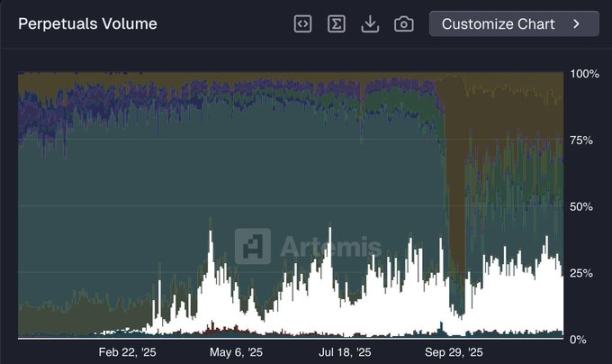
(Market share of @Lighter_xyz according to @artemis data)
In the DeFi world, liquidity is essentially profit-driven. A large portion of the trading volume flowing from Hyperliquid to Lighter (and other platforms) is likely motivated by incentives and potential airdrops. As with most perpetual contract DEXs running points incentives, Lighter’s market share is expected to decline after its token launch.
Phase Three: The Rise of HIP-3 and Builder Codes
As mentioned above, building the “AWS of liquidity” is not the optimal short-term strategy. But in the long run, it is precisely this strategic positioning that gives Hyperliquid the potential to become the core hub of global finance.
Although competitors have replicated most of Hyperliquid’s current features, the true source of innovation still lies within Hyperliquid.
Builders developing on Hyperliquid can focus on specific areas and develop more targeted product strategies on top of the evolving infrastructure.
In contrast, protocols that remain fully vertically integrated (such as Lighter) will face more limitations when trying to optimize multiple product lines simultaneously.
Although HIP-3 is still in its early stages, its long-term influence is already beginning to show. Major participants such as @tradexyz have launched perpetual stocks, and @hyenatrade has recently deployed a terminal for trading USDe. More experimental markets are emerging, such as @ventuals, which offers pre-IPO asset exposure, and @trovemarkets, which focuses on niche speculative markets like Pokémon or CS:GO assets.
It is expected that by 2026, HIP-3 market trading volume will account for a significant share of Hyperliquid’s total trading volume.
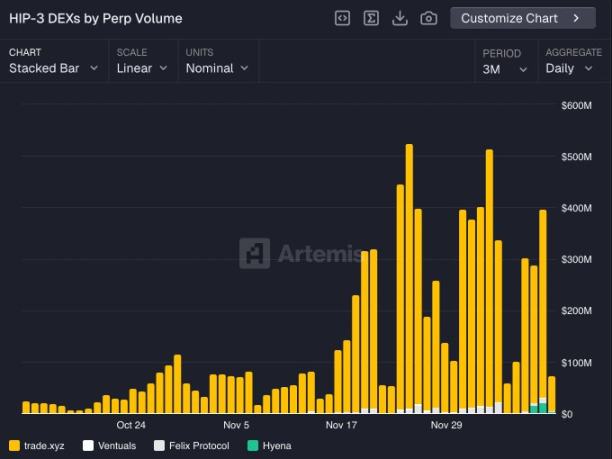
(HIP-3 market trading volume created by builders)
The ultimate key to Hyperliquid regaining dominance lies in the synergy between HIP-3 and Builder Codes.
Any front-end integrated with Hyperliquid can instantly access all HIP-3 markets, thus offering unique products to its users. Therefore, builders are highly motivated to create new markets through HIP-3, as these markets can be easily accessed by any compatible front-end (such as Phantom, MetaMask, etc.), thereby tapping into new sources of liquidity—a perfect growth flywheel.
The continued development of Builder Codes makes me increasingly optimistic about their potential for revenue generation and user growth.
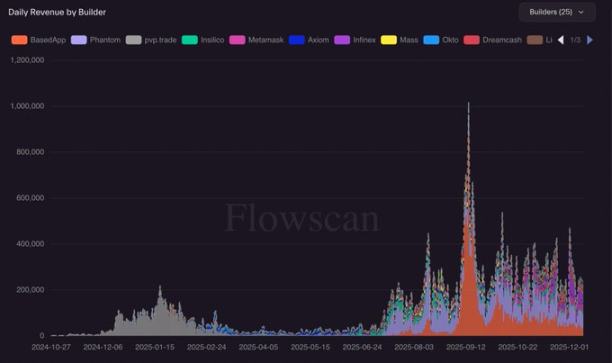
(Builder Codes revenue according to @hydromancerxyz data)
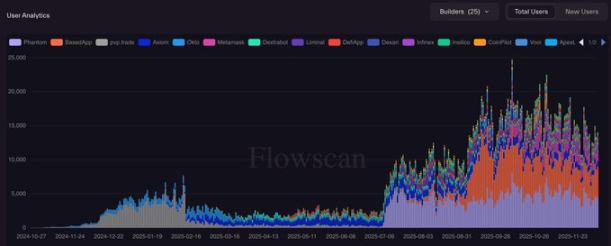
(Builder Codes daily active users according to @hydromancerxyz data)
Currently, the main users of Builder Codes are still crypto-native applications such as Phantom, MetaMask, and BasedApp. But I expect that in the future, a new type of “super app” built on Hyperliquid will emerge, aiming to attract a completely new user base that is not crypto-native at all.
This is very likely the path for Hyperliquid to enter its next phase of scale expansion.
Disclaimer: The content of this article solely reflects the author's opinion and does not represent the platform in any capacity. This article is not intended to serve as a reference for making investment decisions.
You may also like
Micron stock drops as Samsung accelerates next-generation AI chip production
Federal Reserve Governor Waller: The Crypto Boom Sparked by Trump May Be Fading
Lidar-maker Ouster buys vision company StereoLabs as sensor consolidation continues
Layer-2 Social Dominance – Linea and Starknet Lead the Pack as Ecosystem Activity Surges
Trending news
MoreCrypto prices
More





