

 cryptoticker.io
The year 2026 has already carved a permanent place in Monero’s history, characterized by a parabolic rally that briefly silenced skeptics, followed by a sharp deleveraging event that tested the network's structural resilience. As of February 17, 2026, Monero ($XMR) is navigating a complex landscape where technical "oversold" signals clash with mounting regulatory headwinds from major global jurisdictions.
Monero Price Action: The 2026 Rollercoaster
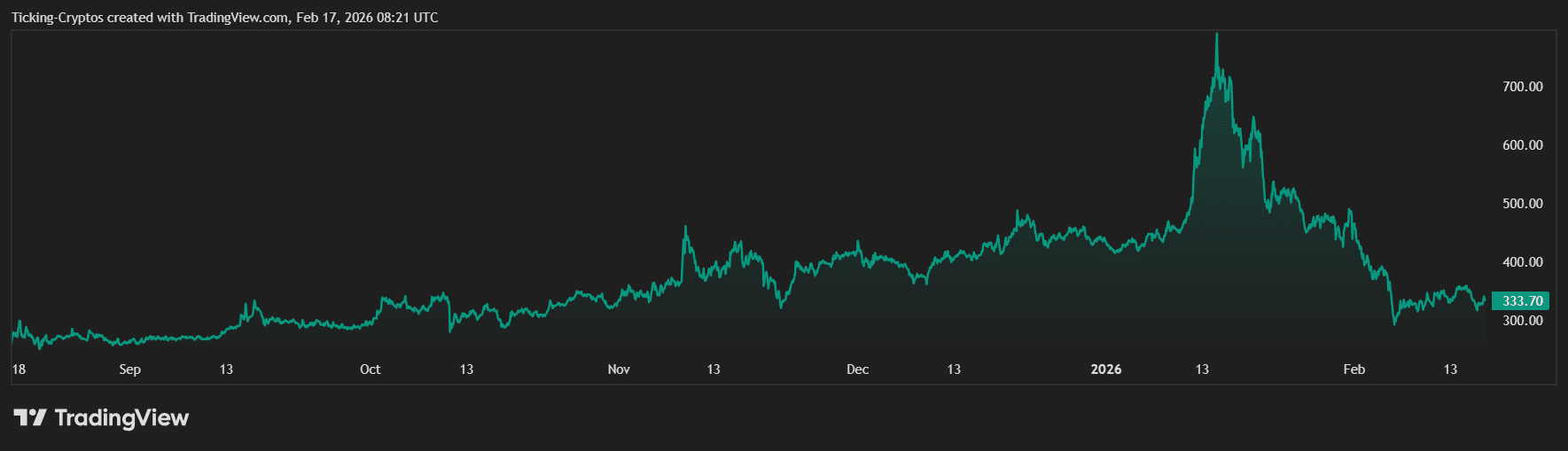
To understand where Monero is headed, we must analyze the two distinct phases that defined the first seven weeks of the year. The $XMR/USD price started 2026 with an aggressive "privacy premium" rally, fueled by institutional interest in non-transparent liquidity.
The Rise: January’s Parabolic Surge
In mid-January 2026, Monero reached a historic milestone, printing a local top near $799.89. This 195% increase from early 2025 lows was driven by:
- Political Tailwinds: Unexpected support from high-profile US policymakers who reframed privacy as a "constitutional right."
- Macro Uncertainty: Global economic shifts led investors toward "financial autonomy" assets.
- Technical Discovery: $XMR entered a price discovery phase after clearing multi-year resistance levels.
The Fall: The February Regulatory Squeeze
The descent was as rapid as the ascent. By early February, $XMR had retraced over 57% of its gains. The primary catalysts for this "deleveraging cascade" included:
- Exchange Delistings: Major platforms, including Binance, accelerated the removal of privacy-focused pairs to comply with the EU’s MiCA framework and the US CLARITY Act.
- Profit Taking: After the $800 peak, massive "long" liquidations (totaling nearly $240,000 in a single 24-hour window) accelerated the downward momentum.
- Systemic Pressures: A broader cooling of institutional appetite, evidenced by significant outflows from Bitcoin ETFs, dragged the entire altcoin market lower.
Monero Coin Analysis: Identifying the Floor
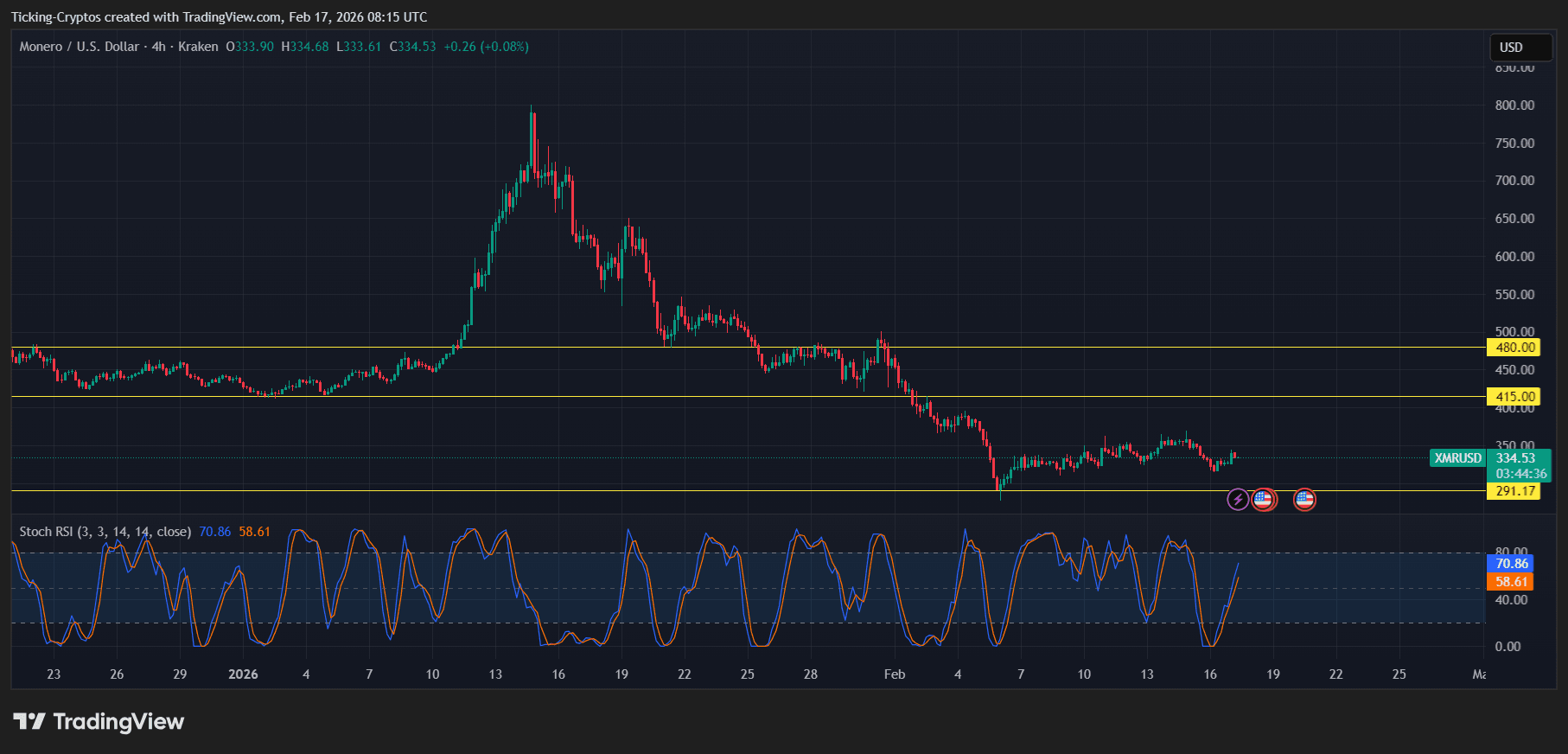
The chart for $XMR-USD currently shows a battle for survival at key Fibonacci retracement levels.
| Local High | $799.89 | All-time high / Psychological resistance |
| Immediate Resistance | $387 | 200-day EMA / Heavy overhead supply |
| Current Support | $302 | 78.6% Fibonacci level |
| Macro Floor | $231 | Major historical structural support |
Currently, the Relative Strength Index (RSI) is hovering near 33.69, indicating that Monero is approaching oversold territory. While the price remains below its 50-day and 200-day Exponential Moving Averages (EMAs), the $300 zone has emerged as a critical "buy the dip" region for long-term holders.
Fundamental Outlook: Privacy vs. Compliance
Despite the price volatility, Monero’s on-chain activity remains remarkably stable. According to recent data from Chainalysis, while exchange liquidity has thinned due to delistings, the use of $XMR in decentralized models and non-custodial swaps has reached new heights.
Upcoming Network Upgrades
The Monero community is preparing for several "hardening" upgrades later in 2026:
- FCMP++ (Full-Chain Membership Proofs): Aimed at mathematically increasing the anonymity set.
- Seraphis Implementation: A modernization of the address structure to improve wallet syncing and scalability.
These technological advancements suggest that while the "price kurs" may be under pressure, the network's utility as the gold standard for privacy remains unchallenged.
Monero Price Prediction 2026: What’s Next for $XMR?
For the remainder of Q1 and Q2 2026, analysts anticipate a period of consolidation. If Monero can maintain a daily close above the $300 support, a re-test of the $450-$500 range is plausible by the second half of the year. However, a decisive break below $300 could open the doors for a return to the $230 "macro floor."





