
The Magnificent 7 Trade Is Cracking - And The 'Great Valuation Rotation' Is Here

For much of the past three years, the trade on Wall Street felt almost mechanical: buy the biggest technology names and let compounding do the rest.
Investors piled into the so-called Magnificent Seven — NVIDIA Corp. (NASDAQ: NVDA), Microsoft Corp. (NYSE: MSFT), Apple Inc. (NASDAQ: AAPL), Alphabet Inc. (NASDAQ: GOOG, NASDAQ: GOOGL), Amazon Inc. (NASDAQ: AMZN), Meta Platforms Inc. (NASDAQ: META) and Tesla, Inc. (NASDAQ: TSLA) — and largely ignored the rest of the market.
The strategy delivered.
Between late 2023 and late 2025, the Roundhill Magnificent Seven ETF (NYSE: MAGS) surged roughly 130%.
Over the same period, the SPDR S&P 500 ETF Trust (NYSE: SPY) gained about 50%, while the Invesco S&P 500 Equal Weight ETF (NYSE: RSP) climbed just 28%.
Mega-cap concentration wasn't just rewarded — it was dominant. In terms of market size, the tech elite group reached over $22 trillion, representing 35% of the S&P 500.
But fast forward to early 2026, and the trade that defined the bull market on Wall Street is starting to fracture.
Magnificent 7 Momentum Breaks:
In mid-February, the Magnificent Seven cohort broke below its 200-day moving average — a level that is closely monitored by investors as a dividing line between structural uptrends and potential trend reversals.
For the Mag-7 trade, the 200-day moving average had acted as a dynamic floor for most of the past two years.
Pullbacks toward it were consistently met with aggressive buying. Each test reinforced the narrative that mega-cap tech weakness was an opportunity, not a warning.
Excluding the brief, tariff-driven volatility shock of 2025 — which proved temporary and quickly reversed — the group had not suffered a sustained technical fracture since 2023.
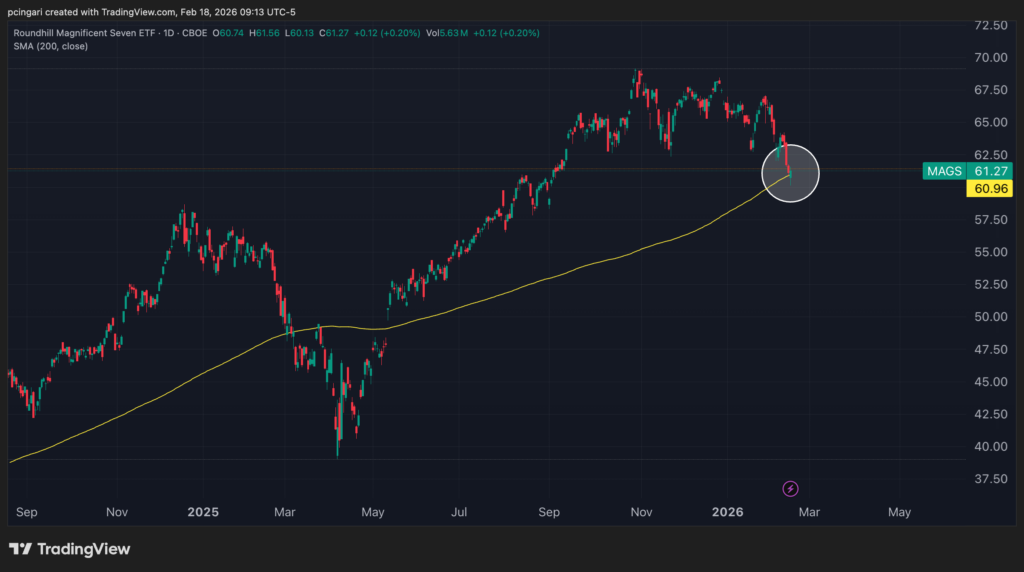
Year-to-date performance tells the story of shifting leadership:
- Magnificent Seven: –8%
- S&P 500: roughly flat
- RSP (Equal-weight S&P 500) : +5%
For a market that had been powered by a handful of hyperscalers, this divergence is striking. What was unthinkable just weeks ago — an out-of-tech rotation — is now unfolding in plain sight.
The question investors are now asking: Is this just a pause, or the beginning of a regime shift?
‘The Great Valuation Rotation’
According to veteran investor Ed Yardeni of Yardeni Research, the market may already be undergoing what he calls the "Great Valuation Rotation of the Roaring 2020s."
In a note to clients this week, Yardeni indicated that the global rebalancing trade that began late last year is likely to extend well into 2026.
At the core of the shift is a reassessment of the Magnificent Seven's earnings trajectory.
The hyperscalers' aggressive commitments to AI infrastructure spending — once viewed purely as a growth catalyst — are now being scrutinized for sustainability and margin pressure.
As doubts creep in, valuation multiples have compressed.
That compression hasn't happened in isolation. Capital has rotated toward areas of the market where earnings momentum is improving and multiples remain more reasonable — both within the U.S. and abroad.
"We continue to recommend underweighting the Magnificent-7, as we have since early December," Yardeni wrote, highlighting that his firm also downgraded Information Technology and Communication Services from overweight to market weight at that time.
Instead, Yardeni is leaning into what he calls the "old economy."
The expert is reiterating overweight positions in Industrials and Health Care, maintaining a bullish stance on precious and base metals, upgrading Materials, and favoring foreign equities — particularly emerging markets.
3 Reasons Investors Are Rotating Out Of The Mag 7
According to Adam Turnquist, chief technical analyst LPL Financial, three forces are driving the shift:
First, the AI euphoria is cooling. After enormous inflows throughout 2025, investors have started questioning whether hyperscalers can sustain their aggressive AI spending, putting pressure on stretched valuations.
Second, money is moving toward cheaper markets. With technology accounting for a large share of the S&P 500's gains, capital is rotating into value stocks, small caps and international equities after years of U.S. dominance.
Third, earnings growth is broadening. Rate cuts from the Federal Reserve and easing inflation are supporting stronger profit growth outside the Magnificent Seven, gradually loosening mega-cap tech's grip on market leadership.
Bottom Line
For years, the Magnificent Seven weren't just market leaders — they were the market. Concentration worked, momentum reinforced itself and every dip felt like an opportunity.
That dynamic is now being tested.
Valuations are compressing, technical leadership has cracked and earnings growth is broadening beyond mega-cap tech. Capital isn't fleeing equities — it's reallocating. The shift appears less like panic and more like discipline returning to asset allocation.
This doesn't necessarily signal the end of the Magnificent Seven's dominance. But it does suggest that the era of effortless outperformance driven by a handful of hyperscalers may be giving way to a more balanced market.
If the past three years were defined by concentration, 2026 may be defined by rotation.
Photo: Shutterstock
Disclaimer: The content of this article solely reflects the author's opinion and does not represent the platform in any capacity. This article is not intended to serve as a reference for making investment decisions.
You may also like
Jim Cramer Believes Crowdstrike (CRWD) Shouldn't Be Afraid of Anthropic

Jim Cramer Discusses Gartner (IT) Stock

Jim Cramer Discusses Salesforce (CRM) Stock

Jim Cramer Believes Adobe's (ADBE) In Trouble

Trending news
MoreCrypto prices
More





