
Trump-Linked USD1 Deflects ‘Coordinated Attack’ as World Liberty Financial Fights to Hold the Peg

World Liberty Financial (WLFI-USD), the crypto protocol famously connected to the Trump family, is currently under fire. On Monday afternoon, the project’s stablecoin, USD1, experienced a rare moment of weakness when its price wobbled away from its $1 anchor. The token dipped to a low of $0.994, a 0.6% drop, triggering immediate alarms across the crypto market. Developers were quick to label the volatility as a “coordinated attack” designed to manufacture panic and profit from the chaos.
World Liberty Financial Blasts the Coordinated Attack
The team behind the protocol gave a direct explanation for why the price slipped. According to a statement released on X, the attack was a multi-front assault involving hacked cofounder accounts, paid influencers spreading “FUD” (fear, uncertainty, and doubt), and traders opening massive short positions against the WLFI token.
The project’s leadership team addressed the situation head-on, stating: “It didn’t work.”
They credited the token’s survival to a rock-solid redemption feature. This mechanism allows any holder to swap their USD1 directly for a physical U.S. dollar, which acted as a safety net that prevented a total collapse. As of Monday evening, the token has mostly recovered, trading much closer to home at $0.998.
BitGo Reserves Provide a $5 Billion Shield
Despite the drama, USD1 remains one of the heavyweight players in the stablecoin world with a $5 billion market cap. The token is issued in partnership with BitGo, a major crypto custodian. To keep the price stable, BitGo maintains a reserve of short-term U.S. Treasuries and cash deposits that back every single token 1:1.
While USD1 is still smaller than giants like Tether (USDT) or Circle (USDC), this stress test proved that its internal systems are working. Developers emphasized that having direct convertibility, the ability to get real money out at any time, is the only thing that keeps a stablecoin resilient when the market turns toxic.
Key Takeaway
Essentially, someone tried to rob the bank, but the vault was too heavy to move. The attackers hoped to start a bank run where everyone sold their tokens at once; they tried to achieve this through hacking accounts and paying people to talk trash about USD1. However, most stayed calm because investors knew they could simply trade their tokens for real dollars at the source. While a 0.6% dip is a wobble in the crypto world, the fact that the coin bounced back shows that even in a digital war, having real cash in the bank is still the best defense.
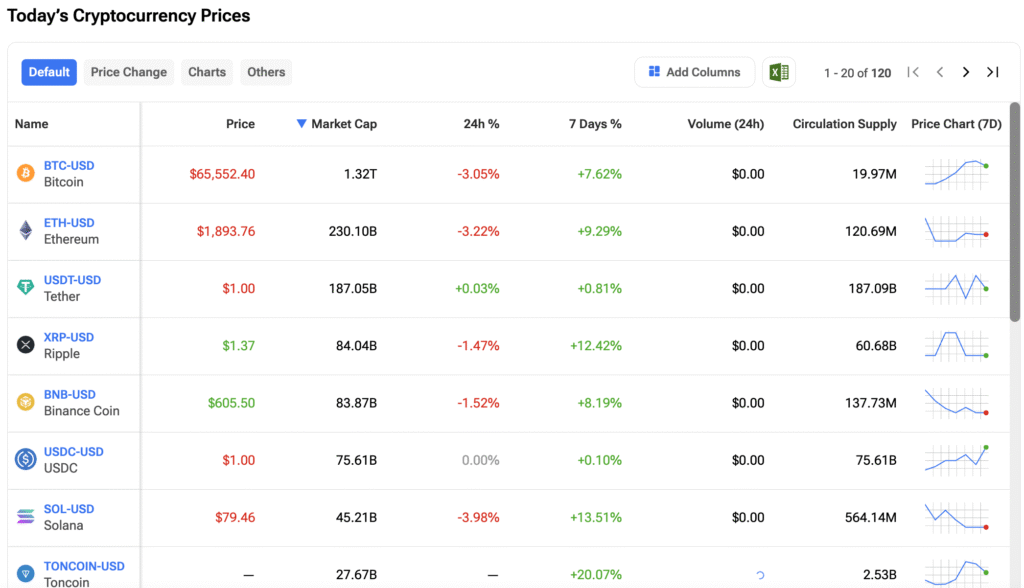
To get a detailed look at the wider digital asset sector including tokens like WLFI, we used the TipRanks Cryptocurrency to evaluate these prominent cryptos side-by-side.
Copyright © 2026, TipRanks. All rights reserved.
Disclaimer: The content of this article solely reflects the author's opinion and does not represent the platform in any capacity. This article is not intended to serve as a reference for making investment decisions.
You may also like
Dogecoin whales accumulate $48 million as price tests key support at $0.067
Goldman Sachs: The Next Main AI Trend Shifts from Computing Power to Humanoid Robots
Goldman Sachs believes that labor shortages and the demand for automation are providing long-term growth drivers for the humanoid robot industry. The valuations of the humanoid robot and automation sectors in Asia remain lower than those of similar assets in the United States, and capital is gradually rotating into core components and the automation industry chain. However, the industry as a whole is still in the early stages of commercialization. The scarcity of real-world data, insufficient general autonomous AI capabilities, and high costs remain the main bottlenecks restricting the large-scale implementation of humanoid robots.
SHIB Price Stays Under Pressure Despite 83M Token Burn

Tariff "boomerang" deals a heavy blow to finances! CBO confirms: Trump tariffs cause a $200 billion gap, US deficit to soar to $2.1 trillion in 2026
The U.S. federal government had originally relied on tariff revenue as a source of increased income, but this windfall is fading at a much faster rate than expected. The Congressional Budget Office (CBO) has admitted that the sharp decline in tariff income has created a $200 billion budget gap for this fiscal year.

Crypto prices
More


