
Circle Internet Group Q4 2025 Earnings Call Transcript

Circle Internet Group (NASDAQ:CRCL) reported fourth-quarter financial results on Wednesday. The transcript from the company’s earnings call has been provided below.
- Circle Internet Group shares are climbing with conviction. What’s driving CRCL stock higher?
Operator
Good morning ladies and gentlemen and thank you for standing by. My name is Kelvin and I will be your conference operator today. At this time I would like to welcome everyone to the Circle Internet Group’s fourth quarter and full year 2025 earnings call. All lines have been placed on mute to prevent any background noise. After the speaker’s remarks, there will be a question and answer session. If you would like to ask a question during this time, simply press Star followed by the number one on your telephone keypad. If you would like to withdraw your question, please press star one again. Thank you. I would now like to turn the call over to John Andrews, Vice President of Capital Markets and Investor Relations. Please go ahead.
John Andrews (Vice President of Capital Markets and Investor Relations)
Thank you operator. And good morning. I’d like to welcome you to Circle’s fourth quarter and full year 2025 earnings conference call. I’m joined by Jeremy Allaire, our co founder, Chief Executive Officer and Chairman and Jeremy Foxgeen, our Chief Financial Officer. Earlier this morning we posted our earnings press release and earnings presentation on the Circle investor relations website, investor.circle.com the transcript of this call will be posted on that website once available. I do need to remind everyone that our earnings press release presentation and this call contain statements that are forward looking. Because forward looking statements are inherently subject to risks and uncertainties, some of which cannot be predicted or quantified and some of which are beyond our control. You should not rely on these forward looking statements as predictions of future events. The events and circumstances reflected in our forward looking statements may not be achieved or occur and actual results could differ materially from those projected in the forward looking statements. Information concerning risks, uncertainties and other factors that could cause these results to differ is included in our SEC filings. We will also disclose non GAAP financial measures on this call today. Definitions of those non GAAP financial measures and reconciliations to the most comparable GAAP financial measures can be found in the earnings release and earnings presentation which are posted on Circle’s investor relations website. Investor.circle.com Non GAAP Financial measures should be considered in addition to, not as a substitute for, GAAP measures. Now I’d like to turn the call over to Jeremy Allaire. Jeremy?
Jeremy Allaire (Chief Executive Officer)
Thank you John and good morning everyone. I want to start this morning talking a little bit about what I’m seeing in terms of this extraordinary transformation that’s underway. I’m speaking not just about the changes we’re seeing from blockchains and stablecoins, but the broader backdrop of technology acceleration software, powered technology acceleration and artificial intelligence. I believe we are in the earliest Stages of a very deep and very fundamental transformation of the way the global economic system functions and works. Not only will our global economic system become more Internet native, but it’s also going to become dramatically more automated. We are entering a world where in my view, likely tens or hundreds of billions of AI agents will interact with and perform economic functions over the Internet. If we look at the past decades, we’ve seen this progression and this progression has been accelerating. This progression has been one where we build more and more software native infrastructure, more and more data and transactions on the Internet. The progression from the Internet of information into an Internet of software distribution, interactive media and commerce, all made possible through the adoption of web, cloud and mobile platforms, has created extraordinary value over time. Beginning around 2013, we began to see another transition, this time into the value era of the Internet where early blockchain platforms emerged. Later, through the innovation of fiat backed stablecoins, we saw the birth of a transformative Internet Internet native money layer. Now, as we’ve achieved regulatory clarity and as the technology has matured, we’re now seeing these developments directly colliding with another major platform shift, which is the adoption of AI platforms. This value era, this combination of economic operating systems and an Internet native money layer with artificial intelligence, agentic economic activity and automation seems likely to drive the greatest acceleration of economic activity we’ve ever seen in human history. And we’re really just at the beginning. Our aim at CIRCLE has always been to build a new Internet financial system to build the software infrastructure that powers it. And we’re more excited than ever to have that opportunity today. Let’s talk about our key highlights in Q4. Our stablecoin network continued to grow. We saw USDC end the year around $75 billion in circulation, up 72% year on year. Despite some of the declines that we saw in Q4 due to the crypto market correction, we also saw tremendous ongoing growth in the amount of transactions happening on our network. With on chain USDC volume hitting nearly $12 trillion, representing 247% year on year growth. This continues to reflect the growing velocity and utility of digital dollars on the Internet. Q4 delivered very strong financial results. We realized $770 million in total revenue and reserve income in the quarter, up 77% year on year. Adjusted EBITDA for the quarter was $167 million, up 412% year on year with an adjusted EBITDA margin of 54%. Overall for the quarter, we had very strong yearly growth across the board. Importantly, our platform continues to expand, we launched the testnet of ark, our Layer one blockchain network, and we’re on track to launch mainnet this year. Circle Payments Network continues to see very strong volume growth and participant development, design, engineering and deployment lifecycle and seeing very strong results. Our product velocity is accelerating and I anticipate that to continue alongside the exponential improvements we’re seeing from AI coding agents. Now. My own belief is that AI platforms, AI agents and blockchain based economic operating systems will support trustworthy, automated, transparent and hyper efficient infrastructures that are going to be the underpinnings of the future of the global economic system. And I believe that this is going to be one of the most accelerated periods of technology transformation in the history of the world. And it really is just thrilling to be here building core infrastructure that can help to underpin this new economic system. I’ve never been more excited about circle’s market position, platform stack and our growth opportunities. With that, let me turn it over to Jeremy Foxgeen, our CFO to take you through the financial results.
Jeremy Fox-Geen (Chief Financial Officer)
Thank you Jeremy and good morning everyone. I’m pleased to report we delivered strong financial results in the fourth quarter and full fiscal year, closing out an exceptional year of growth and momentum for Circle. I’ll start by reviewing the quarter and then provide our forward guidance. USDC in circulation was $75.3 billion at year end, up 72% year on year and notably grew faster than the overall fiat backed stablecoin market. USDC held within Circle’s platform infrastructure or on platform. USDC grew 5.6 times year on year to $12.5 billion at year end representing 17% of total circulation. The reserve return rate was 3.81% for the fourth quarter down 68 basis points year on year reflecting the decline in SOFA during this period. Total revenue and Reserve income increased 77% year on year to $770 million for the quarter as growth in average USDC in circulation and other revenue was partially offset by the lower reserve return rate. Total distribution transaction and other costs increased 52% year on year to $461 million. I do want to remind you that distribution costs in the fourth quarter of 2024 included the previously disclosed one time payments of $60 million to a large distribution partner. Revenue less distribution cost margin was 40.1% in the fourth quarter with a modest quarter on quarter increase of 0.6 percentage points, primarily reflecting the impact from growth in other revenue. Other revenue increased to $37 million in the fourth quarter. Subscription and services revenue was $24.7 million in the fourth quarter primarily from revenue associated with our blockchain network partnerships. Transaction revenue was $12.2 million primarily from blockchain rewards revenue where our revenues from running a Super Validator on the Canton Network increased substantially as Canton Coin began trading during the quarter. Total revenue and reserve income less distribution transaction and Other costs grew 136% year over year to $309 million in the fourth quarter. Adjusted operating expenses grew 32% year on year to $144 million for the quarter as we continue to invest in growing our platform and distribution at this pivotal time for our industry. Adjusted operating expenses include payroll taxes, including payroll taxes related to stock based compensation which were $8.4 million in the fourth quarter while we had no such expense in the prior year period. Beginning in the first quarter of 2026, we have amended the definition of adjusted operating expenses. First, to exclude stock based compensation payroll tax expense to align with our treatment of stock based compensation expense. Second, to exclude certain one time legal expenses, acquisition related costs and where relevant, restructuring expenses, all of which totaled $2.9 million in the fourth quarter as they reflect the same adjustments as in our adjusted EBITDA measure. Based on this amended definition, adjusted operating expenses would have been $133 million in the fourth quarter and would have grown 28% year on year. On a comparable basis, adjusted EBITDA grew 412% year on year to $167 million reflecting the operating leverage inherent in our model. The prior year adjusted EBITDA included the one time distribution payment that I previously mentioned adjusted ebitda margin was 54% in the fourth quarter. I want to take a moment to briefly recap our FY25 guidance and results. First, our guidance philosophy. We are building our business for long term success and moreover, several of our most impactful performance drivers are visible to the market in real time. As such, we do not give detailed quarterly or full financial guidance. We guide only on certain metrics to help our investors better understand our expected performance trajectory. We will update this guidance when we expect our performance to materially deviate from guidance USDC in circulation at year end grew 72% year on year. FY25 other revenue of $110 million exceeded our guidance of 90 to $100 million. Fourth quarter results came in better than expected, largely driven by a $7 million benefit as Canton Coin began trading. FY25RLDC margin of 39.4% exceeded our guidance of approximately 38%. Fourth quarter margin came in better than expected driven by the combination of other revenue outperformance as well as a sustained reserve margin. FY25 adjusted operating expenses of $508 million was in line with guidance. Let me conclude with comments on our guidance for FY2026. We do not give guidance on USDC circulation or growth. We are at the beginning of meaningful shifts in the global markets for money and we expect both long term growth and quarter on quarter variability. As previously noted, we would anticipate USDC to grow at a 40% CAGR over a multi year through cycle. We anticipate FY26 other revenue to be between 150 and $170 million. We anticipate the FY26 RLDC margin to be between 38 and 40%. We anticipate the FY26 adjusted operating expenses to be between 570 and $585 million reflecting growing investment in building our platform capabilities and global partnerships. As noted before, Beginning in the first quarter of 2026 adjusted operating expenses will exclude payroll tax expense related to stock based compensation which totaled $20.6 million in FY25 as well as certain one time legal expenses, acquisition related costs and where relevant restructuring expenses, all of which totaled $10 million in FY25. Our 2026 guided range reflects this definitional change as does the FY25 comparable figure on this slide of $478 million. Overall, we have delivered a strong close to a critical year for CIRCLE with meaningful growth and strong profitability. We are only just beginning to attack the opportunity before us and we remain excited about our future. I want to thank the team here at Circle for your continued hard work and thank our investors and analysts for your support and engagement with that operator. We can now start the Q and A portion of the call. Ladies and gentlemen, we will now begin the question and answer session. As we enter Q and A, we ask that you please limit your input to one question and one follow up.
Operator
As a reminder, to ask a question, please press the star button followed by the number one on your telephone keypad. If you would like to withdraw your question, please press star one again. One moment please for your first question.
Your first question comes from the line of Devin Ryan of Citizens Bank.
Please go ahead.
Citizens Bank Analyst
Good morning. Thanks for taking the questions here. Want to start on kind of this agentic evolution. I think it’s a compelling case and just want to get a sense of how you think from a timing perspective this plays out. And does it start with trading liquidity and then progressing to payments and borrowing in lending, or how do you see that and then how do you make sure that USDC is in the middle of that and can ARC perform relative to other layer ones technically to support this? Thanks.
Jeremy Allaire (Chief Executive Officer)
Thank you. It’s a great question and it’s something that we are spending a lot of time on. You know, when we designed ARC and announced and rolled out the testnet, we talked specifically about this agentic economic activity as a fundamental design center for how we’ve saw autonomous software, autonomous agents and others conducting economic activity on the Internet. And you know, it kind of speaks to the bigger backdrop of the early vision of the company, which is programmable money and what that allows and machine intermediated money and what that allows. And we’re really seeing this convergence happen as we speak. And so we started our journey not just in the design of ahrq, but with USDC by making sure that we’re participating in all of the key standards for agentic payments and value movement, helping contribute to what’s called the X402 standard, the agentic payment standard from Google. We’re part of the AI Agent consortium, so we’ve been engaged and involved. But something happened really a month ago which is these, you know, this turning point with Claude, Claude, code, what’s now called Open Claw. And we really saw this kind of incredible leap in the ability for the average person but also sophisticated developers to spin up agents to do an incredibly wide array of tasks. And obviously we’re all seeing that out in the market. And what’s been interesting to see is that there’s been this direct and immediate pickup where AI agents are realizing, and the developers of those AI agents are realizing that agent to agent transactions need a reliable, low cost, trusted medium of exchange. And so virtually all of the AI payments infrastructure that we’re seeing, the agent agent type activity, is happening with blockchain, blockchains is happening with usdc. So that’s been very, very encouraging and we’re doubling down on that in a pretty significant way. Now I think to other parts of your question, what’s the ramp on this? I mean, I think this is one of the great known unknowns or however you might want to put it, which is what is the. Are we having a kind of takeoff moment? The Collison brothers yesterday talked about. We, you know, Q1 26 might be the takeoff moment for the Singularity. We may look back at that and I think the technology shifts that we’ve been experiencing are indicative of a kind of takeoff and that leads to the uses, which is, you know, AI agents consuming work from other AI agents, the kind of collaboration amongst AI agents, AI agents distributing out work to humans, humans consuming from AI agents, All of these are happening. We’ve seen AI agent marketplaces launch just in the past weeks where AI agents can employ human workers to conduct tasks and be compensated in USDC as the medium of Exchange. We’re seeing AI job boards where AIs can hire each other and use USDC as the way to make those payments. So this is happening very organically and I think from our perspective as businesses and startups build products around agentic economic activity, the natural place that they’re going to do that is with stablecoins and on blockchains. Which leads to part of your other question, which is really around ark. ARK is purpose built for this moment. ARK is built with a validation and consensus model that can support scale. ARC is built with an economic model where we can drive the cost of transactions in high performance kind of channels down to 1 1,000th of a penny. And in fact we just went in testnet last week with a feature that is designed for autonomous agents called Circle Gateway, which is a feature that would allow autonomous agents to hold a balance and spend not just on ARC but on other networks and have a transaction cost of 1/1,000th of a penny and get that value moved in less than a second to all these other apps and services that are out…on these networks. So we’re building the primitives, we’re building it at the operating system level, the infrastructure level. We’re building the tooling. And we’re really engaged in actually marketing to agents that are autonomously out there and want to build. So a lot more to come from us here and we’re really pleased. And I think again we talk about money velocity and how effectively networks and infrastructure like what we’ve built will lead to higher and higher amounts of money velocity. And my own view, which is in my opening comments as well, is in a world of tens or even hundreds of billions of AI agents, the velocity of money is just going to be multiple orders of magnitude higher than it is today in the existing economic system. And so we’re building a new economic infrastructure, we’re building a new Internet financial system. And I think we’re very optimistic that CIRCLE can play a really key role in this convergence between AI and stablecoins and blockchains.
Truist Securities Analyst
Yeah, thank you, Jeremy. A great, great response. And it would be fascinating to follow this evolution. Maybe this is a faster follow up. But on just ARK Token, any UPD on kind of the considerations there, how that’s evolving and then any sense of timing of when you might make a decision on whether you would launch a token for ark.
Jeremy Allaire (Chief Executive Officer)
Yeah, a couple of things I could say. I think we’re continuing to explore the ARK token. It’s I think, a very good exploration where we’re getting a very good understanding of how a token can play a key role in providing stakeholder incentives, governance, security, utility and other things on the ARC network. And so that exploration continues. We, you know, we aren’t communicating about any specific timeline or other because we’re still in that exploration. But as noted, we’re making tremendous progress with ARC and we’re making very strong progress towards ARC mainnet. And we’re very excited to see that come into play. And we expect to see some amazing companies participating in running the ARC infrastructure, deploying apps on the ARC infrastructure and also providing foundational infrastructure to asset issuers and AI agents. A wide array of use cases on it. So we’re pleased with the progress and of course, as we have more to say about that, we’ll share that publicly.
Operator
Okay, excellent. Thanks so much. Your next question comes from the line of Joseph Baffi of Canaccord Genuity.
Operator
Please go ahead.
Canaccord Genuity Analyst
Hey guys, great progress. Just maybe we’ll just talk regulatory backdrop a little bit. Jeremy. And Jeremy, Genius has been in place now for a couple quarters. Just wondering what kind of tangible signs of progress you’ve seen directly from Genius. And then, you know, the follow up would be on clarity. You know, where we sit now. Your views on it. You know, you know, clearly the stablecoins are kind of in the middle of the compromise and discussion there. So your comments and thoughts there. Thanks.
Jeremy Allaire (Chief Executive Officer)
Sure. So first on Genius. Genius has absolutely continued to be a tailwind for our business and I think the sector as a whole, it has created this legal foundation for major institutions to come into this market. We’ve seen follow on guidance from the likes of the SEC and the CFTC as they’re clarifying how effectively what would be genius compliance stablecoins can be used as collateral on CFTC markets. The recent SEC guidance in terms of the haircut treatment on stablecoins for broker dealers, which is a big breakthrough in terms of how stablecoins can be used in capital markets. And I would just say broadly, banks, payments companies, tech firms, large enterprises around the world are leaning in and wanting to weave stablecoins into their product strategies. And so it’s also spilling over into international markets where international regulators are also saying, ok, well, we now need to acknowledge genius compliance stablecoins as the sort of good stable coins that could be allowed in their markets. And that’s really strong from our perspective. So we think it’s been very positive and will continue to be positive as it goes. Effective. And as some of these OCC licenses start to come through as well, which will impact large issuers like Circle on Clarity. Clarity is very close to the finish line right now. I know we’re very close to the issues. There’s a lot that’s been reported. I think the most recent reporting seems accurate, which is that the crypto industry and the banking industry are working day over day, week over week at a staff level and with the White House to come up with some compromise language around the different kinds of rewards that people can get for holding stablecoins or using stablecoins and how they use them. And my sense is that everybody wants to figure this out. There’s a lot in this for banks, capital markets, asset managers, the crypto industry as well. And so right now I’m cautiously optimistic about it. But obviously D.C. is D.C. and, and all the dynamics of the spring and everything else. You know, it’s not my job to handicap. There are probably analysts at some of your firms that can do that better. But we’re, we’re, we’re cautiously optimistic and we do think that with Clarity act, if it does come to pass on a bipartisan basis, is another significant unlock for building in this space. And we can certainly talk about that in the future. But we think it’s a very Very significant unlock for the development of this market and the use of blockchains in a far broader range of applications as well.
Canaccord Genuity Analyst
Sure. Thanks very much, Jeremy.
Operator
You’re welcome. Your next question comes from the line of John Todaro of Needham. Please go ahead.
Needham Analyst
Hey, thanks for taking my question. I guess just going back to Ark and then maybe CCTP in there as well. You know, it seems like the evolution of these could long term become kind of asset agnostic. Ark could be just a broad asset tokenization platform for assurance of equity. Some of the other assets, I guess just. Jeremy, where are your thoughts on kind of that evolution long term? If we could just drill a little bit more into the long term vision. Park.
Jeremy Allaire (Co-founder, Chief Executive Officer and Chairman)
Yeah, absolutely. So, you know, the conceptual model for ARC for us is this is an economic operating system. It is a distributed economic operating system. That distributed economic operating system is going to be operated by a collection of known leading financial infrastructure companies, including Circle, that will run the infrastructure to support the compute the transactions and the like and the data on these networks. And it’s designed for prudentially sound financial activity and economic activity. We think that’s necessary to build the real world economy on the Internet. Within that though, we want to make sure that as a safe and sound and secure foundation that it has several things that are important to financial system actors. We want to make sure that it has the single best, most capital efficient liquidity for digital dollars in the world. And so marrying what we do with USDC to what we’re able to do with the technology in Ark, we believe we can create the most capital efficient and fast digital dollar liquidity model in the world. The second, which relates to another part of it is we really think about ARK as a liquidity and distribution hub for other asset issuers. And so we’re building technology and this technology builds on the incredible distribution we’ve already created with cctp. We’re building technology that would allow an asset issuer, whether it’s a tokenized equity, a tokenized fund, a tokenized bank deposit, other stablecoin issuers, and any kind of asset that can be imagined that can be tokenized, to be able to be issued on ARK and then be able to turn on liquidity and distribution on other blockchain networks. So if I’m issuing a tokenized stock, and I want that tokenized stock to be able to run on Robinhood’s L2 and on Coinbase’s, on Chain Exchange and on some other tokenized environment that supports these assets, the people who are issuing Assets really need to know that they can do it in a safe way, in a liquid way and have that kind
Disclaimer: The content of this article solely reflects the author's opinion and does not represent the platform in any capacity. This article is not intended to serve as a reference for making investment decisions.
You may also like
NexPoint (NREF) Matches Q4 Earnings Expectations
TriMas (TRS) Falls Short of Q4 Earnings Expectations
D-Wave Quantum Inc. (QBTS) Posts Fourth Quarter Loss, Falls Short of Revenue Expectations
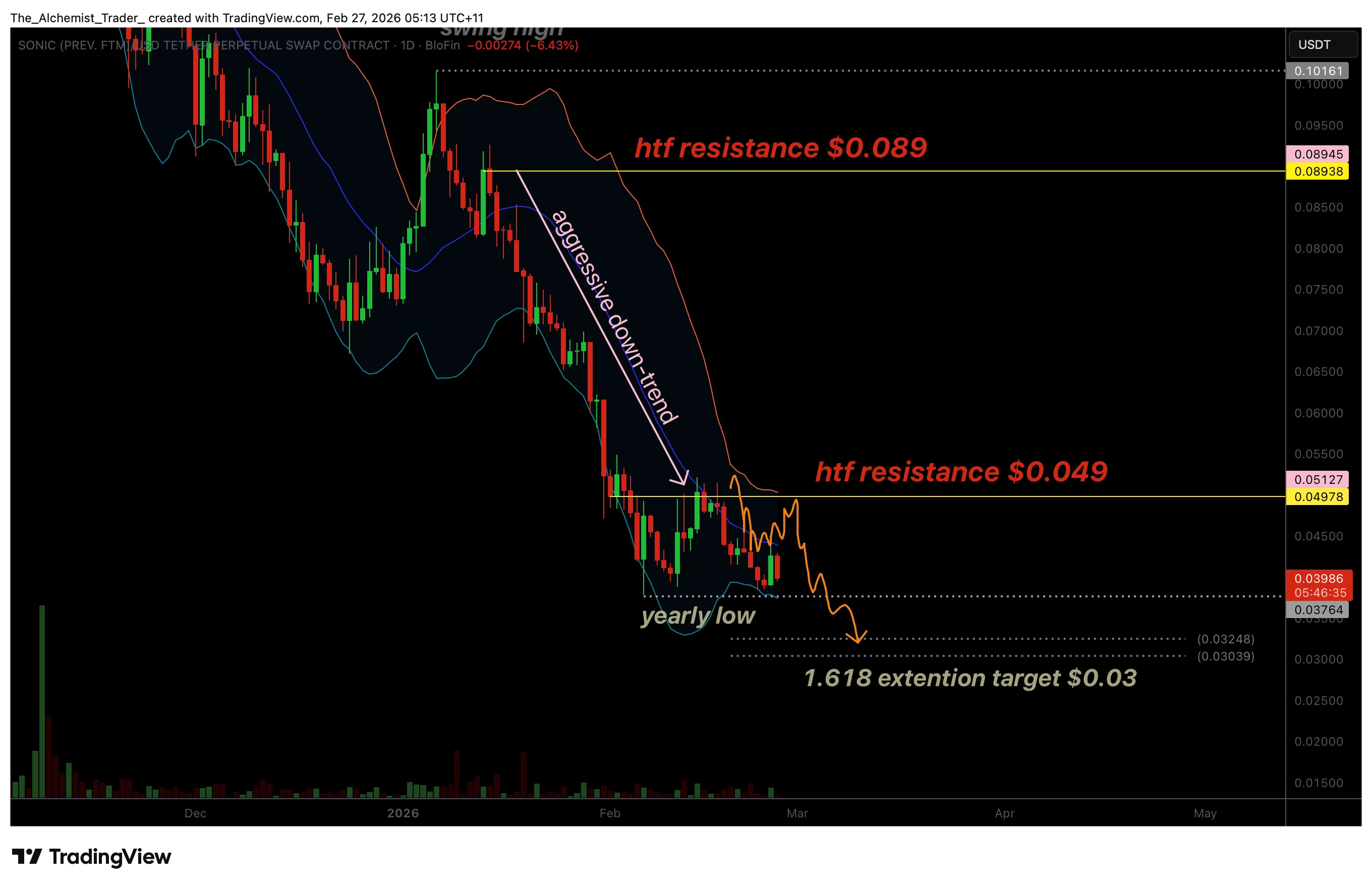
Sonic price eyes new yearly lows as aggressive downtrend continues
Trending news
MoreCrypto prices
More





