
The Argument for Bitcoin's Strength Lies Within the Aftermath of the $1 Trillion Collapse

Bitcoin’s Price Plunge Tests Market Foundations
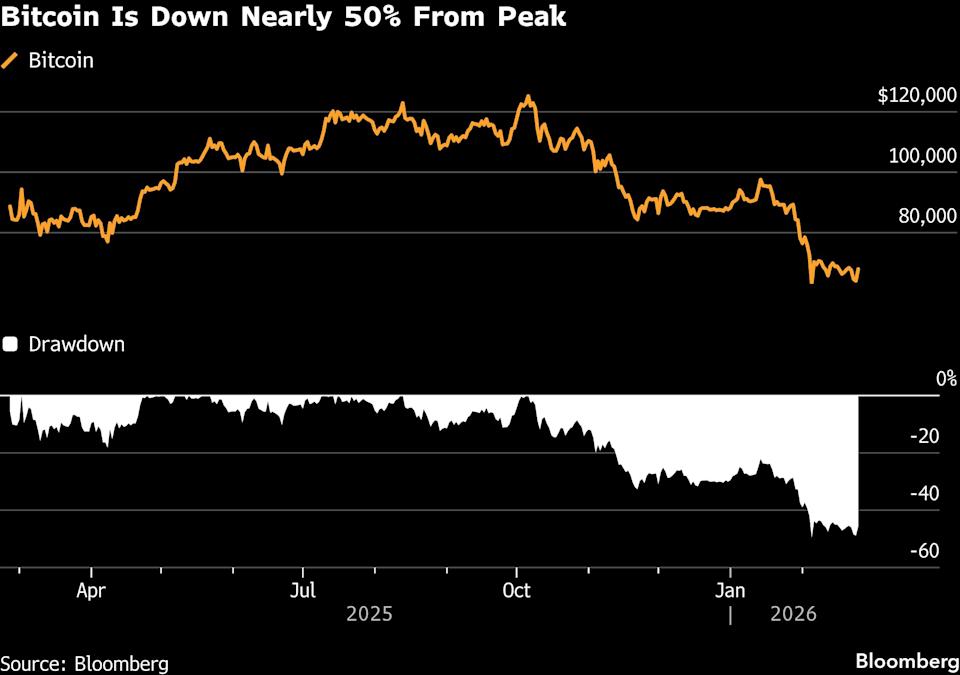
(Bloomberg) Bitcoin’s value has tumbled nearly 50% from its October peak, marking its steepest decline since the FTX collapse. Yet, despite the dramatic drop, the institutional framework established during the previous boom remains largely intact.
Exchange-traded fund (ETF) investments have mostly held steady, and major financial players are still involved. While some short-term traders have exited, long-term investors have shown resilience. This gap between price action and market stability is fueling a contrarian optimism that is being overshadowed by the current downturn.
Top Stories from Bloomberg
The bearish narrative is clear: Even after a recent rebound, Bitcoin remains below $70,000, far from its October high above $126,000, erasing $1 trillion in market value. Nearly 45% of coins are now worth less than their purchase price. Options traders are seeking downside protection, and confidence in institutional support has faded amid weeks of ETF outflows, leading many to believe the mainstream adoption experiment is faltering.
However, skeptics of the bearish view argue that ETF outflows need perspective. Brett Munster of Blockforce Capital notes that since spot Bitcoin ETFs launched in January 2024, net inflows have totaled tens of billions of dollars, with recent outflows representing only about 6% of that sum.
Munster describes this as “clear evidence of consolidation rather than capitulation,” highlighting that 17 of the 25 largest Bitcoin ETF holders increased their positions in the fourth quarter.
On Wednesday, Bitcoin surged over 8% to around $69,500 as equities rose and risk appetite improved ahead of Nvidia’s earnings. Whether this rally will persist or fade, as previous ones have, remains a key question dividing investors.
Bulls point to the aftermath of the 2022 crash for context. Back then, the market’s infrastructure collapsed—major players like FTX, Celsius, BlockFi, and Three Arrows Capital failed, taking with them crucial custodians, lenders, and exchanges, and destroying market confidence.
This time, the core infrastructure remains robust. Exchanges are operational, custodians are solvent, and banks are not only staying in the market but expanding their crypto offerings. According to River, a Bitcoin financial services firm, over half of the largest U.S. banks are developing or have announced crypto-related products.
“The current Bitcoin price action is a mere crisis of confidence. Nothing broke, no skeletons will show up,” says Gautam Chhugani, senior analyst at Bernstein. He believes the bearish case for Bitcoin is weaker than ever and predicts the token could reach $150,000 by 2026.
Some critics argue that Wall Street’s interest is more about blockchain technology than Bitcoin itself. For example, JPMorgan’s tokenized money market fund operates on Ethereum, and the stablecoin market could thrive regardless of Bitcoin’s price. Digital infrastructure can expand even if Bitcoin doesn’t recover.
Bulls counter that every new crypto product or service from banks and brokerages increases the pool of potential Bitcoin buyers. When financial advisors are authorized to recommend crypto, it doesn’t move the price immediately, but it sets the stage for a much larger wave of demand in future cycles. While infrastructure may be indifferent to price, it is not indifferent to access—and wider access has historically fueled Bitcoin’s recoveries.
Fidelity Digital Assets emphasizes this point, noting that public companies and spot ETFs now hold nearly 12% of Bitcoin’s circulating supply. Despite challenges to the accumulation model, these entities have consistently increased their holdings since early 2020, creating a demand floor that didn’t exist in previous cycles. This pool of long-term holders is less likely to sell during downturns.
Recent filings show that university endowments like Harvard and Dartmouth continue to hold crypto ETFs. Overseas, Hong Kong’s Laurore Ltd. recently boosted its BlackRock Bitcoin ETF holdings by 8 million shares, marking a significant institutional move.
On the supply side, Bitcoin’s fourth halving in April 2024 reduced new issuance by half. With more coins locked up and fewer being mined, the amount available for trading is shrinking—even as prices fall. If this supply squeeze persists, any rebound could be sharper than expected.
Still, there’s no guarantee the market has bottomed. The bullish case faces a skeptical market, while the bearish narrative dominates sentiment and price action.
Yet, the infrastructure that failed in the last downturn is not only intact but expanding. Whether this matters more than price, or if price will eventually undermine the infrastructure, is the central question for contrarian investors. For now, they remain in the minority, but underlying market dynamics suggest that could change.
“All the reasons Bitcoin has generally rallied over the past 15 years are still true,” says Matthew Hougan, chief investment officer at Bitwise Asset Management. “The world is becoming more digital, concerns about fiat currencies are rising, regulations and access are improving, and the generation that grew up with Bitcoin is getting older and wealthier.”
Most Popular from Bloomberg Businessweek
©2026 Bloomberg L.P.
Disclaimer: The content of this article solely reflects the author's opinion and does not represent the platform in any capacity. This article is not intended to serve as a reference for making investment decisions.
You may also like
Netflix's 5.97% Surge Propels It to 14th-Most-Traded as WBD Bidding War Intensifies
Farmers face challenges as tariffs negatively impact the soybean industry

Trending news
MoreCrypto prices
More





