
How much gold could you purchase with $1 million during various periods in history?

The Evolution of Gold Prices
For much of the 20th century, gold prices remained largely unchanged. However, shifts in economic policy, global events, and inflation eventually propelled gold’s value upward. Since the 1970s, the price of gold has surged dramatically. Early investors in gold have seen significant returns. Let’s explore how gold’s value has evolved over the years—and what $1 million invested in gold in the past would be worth today.
Highlights
- Gold prices were stable for decades, but major economic changes and inflation led to sharp increases.
- According to the National Mining Association, gold rose from $1,250 per ounce in 2016 to $5,185 per ounce in 2026.
- In 1900, $1 million could buy nearly 53,000 ounces of gold. At current prices, that gold would be valued at approximately $273 million.
How Much Is $1 Million in Gold Worth Over Time?
| Year | Gold Price per Ounce | Ounces Purchased with $1 Million | Value in 2026 |
|---|---|---|---|
| 1900 | $19 | 52,743 | $273.4 million |
| 1910 | $19 | 52,854 | $274 million |
| 1920 | $20.68 | 48,355 | $250 million |
| 1930 | $20.65 | 48,426 | $251 million |
| 1940 | $33.85 | 29,542 | $153.2 million |
| 1950 | $34.72 | 28,801 | $149.3 million |
| 1960 | $35.27 | 28,352 | $147 million |
| 1970 | $36.02 | 27,762 | $143.9 million |
| 1980 | $615 | 1,626 | $8.4 million |
| 1990 | $383.51 | 2,607 | $13.5 million |
| 2000 | $279.11 | 3,582 | $18.6 million |
| 2010 | $1,224.53 | 816 | $4.2 million |
| 2020 | $1,769.61 | 565 | $2.9 million |
| 2026 | $5,185 | 192.8 | $1 million |
*Data sourced from the National Mining Association
**2026 values reflect gold spot prices as of February 27, 2026
What Drives Changes in Gold Prices?
Gold’s value is influenced by more than just demand from jewelry makers or collectors. Several other factors play a role in its price movements:
Inflation
Gold is often seen as a safe haven during periods of high inflation. When the U.S. dollar loses value, investors flock to gold to protect their purchasing power. Historically, gold’s largest price jumps have occurred during times of significant inflation.
For instance, during the late 1970s and early 1980s, inflation soared into double digits, according to the Federal Reserve Bank of Minneapolis. This period saw gold prices leap from $36.02 per ounce in 1970 to $615 per ounce by 1980.
Federal Debt Concerns
When the U.S. government increases its borrowing, investor anxiety rises, often leading to increased gold purchases. Worries about national debt, government financial stability, and global tensions can all impact gold’s value.
Consumer Demand
Gold is not just an investment asset—it’s also popular among consumers, not only for jewelry but also for coins and bars. Retailers like Costco have made it easier to buy physical gold, and online platforms have expanded access to gold products. Social media trends, such as TikTok videos of gold bar unboxings, have further fueled demand.
Gold Price Trends Through the Years
Looking back, investing in gold at the turn of the 20th century could have resulted in extraordinary gains. For example, $1 million invested in gold in 1900 would have bought over 53,000 ounces, now worth around $273 million.
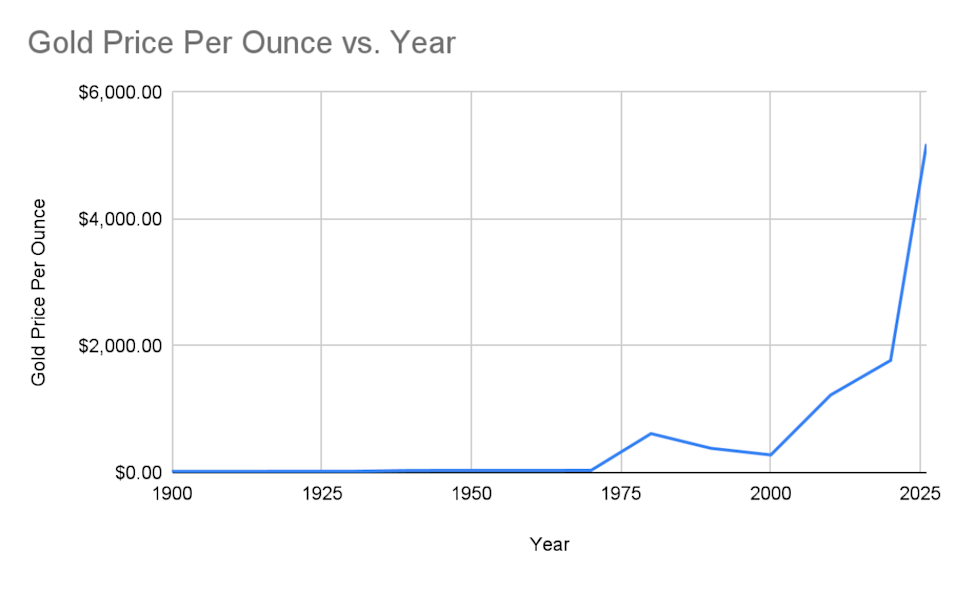
Gold’s most significant price surges occurred in 1980, 2010, and 2025. Here’s a look at the events that shaped these milestones:
Source: National Mining Association
The 1980s
During the 1970s, gold remained affordable, typically below $40 per ounce. By 1980, however, prices soared to $615 per ounce. This dramatic shift followed the end of the gold standard, when President Nixon stopped the dollar’s convertibility to gold in 1971. Once government controls were lifted, gold began trading freely, leading to rapid price increases.
The 2010s
Gold was priced at $279.11 per ounce in 2000. The financial crisis of 2008 destabilized markets, prompting central banks to lower interest rates and introduce new economic measures. Investor concerns about inflation and the stock market led to increased gold purchases, pushing prices to $1,224.53 per ounce by 2010.
The 2020s
The 2020s have been marked by global disruptions, including pandemics and geopolitical conflicts. These uncertainties have driven investors toward gold, which reached a record $5,185 per ounce in 2026. At today’s prices, $1 million would buy just under 193 ounces of gold.
Should You Buy Gold?
If you’re considering adding gold coins or bullion to your portfolio, it’s important to weigh your options carefully—especially in relation to the stock market.
While gold’s long-term gains are impressive, they don’t match the returns of the stock market. For example, $1 million invested in gold in 1980 would be worth $8.4 million today. The same amount invested in the S&P 500 would have grown to $189 million.
Gold can be a valuable part of a diversified investment strategy, but it’s generally not recommended as your primary investment. Diversification helps manage risk and adapt to market changes.
If you’re unsure how gold fits into your financial plan, consider consulting a certified financial planner (CFP) for tailored advice.
Frequently Asked Questions
If I invested $1,000 in gold 10 years ago, what would it be worth now?
In 2016, gold was priced at $1,250.74 per ounce. A $10,000 investment would have bought about eight ounces, which would now be valued at $41,480.
How much gold can I purchase with $10,000 today?
At current prices, $10,000 would buy approximately 1.9 ounces of gold.
What is the current value of one ounce of gold?
As of February 27, 2026, one ounce of gold is valued at around $5,185. For more details on gold’s price history, Yahoo Finance provides historical gold price data dating back to 2000.
Disclaimer: The content of this article solely reflects the author's opinion and does not represent the platform in any capacity. This article is not intended to serve as a reference for making investment decisions.
You may also like
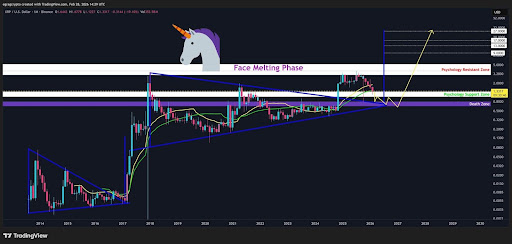
XRP Price About To Enter ‘Face-Melting Phase’, And The Target Is $27
Keep An Eye on These 4 Bank Stocks With Recent Dividend Hikes
Keep An Eye on These 4 Bank Stocks With Recent Dividend Hikes
Pfizer Stock: Buy, Sell or Hold After Its 11% Rally So Far in 2026?
Trending news
MoreCrypto prices
More





