
Stocks decline while oil prices soar amid escalating conflict with Iran

Market Turmoil as Middle East Tensions Escalate
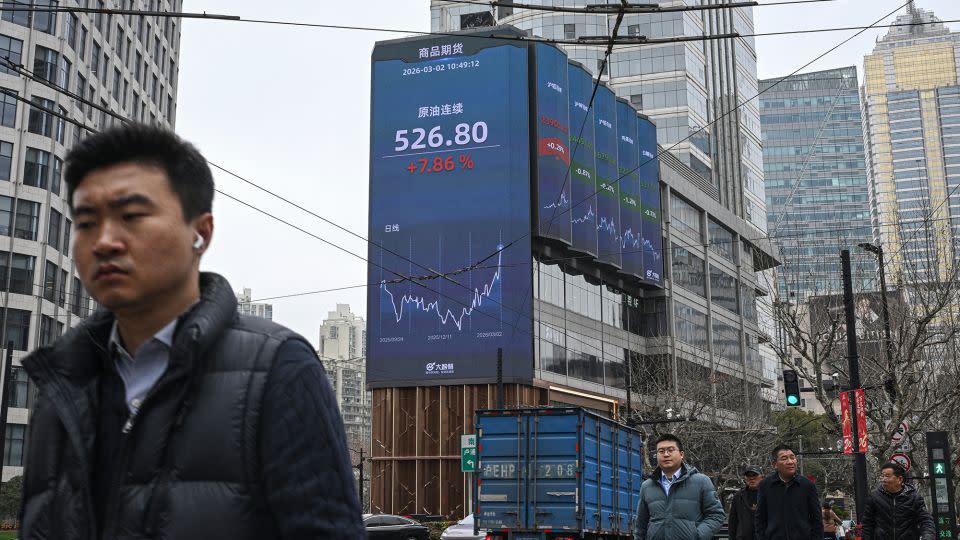
A display in Shanghai’s Jing’an district on March 2, 2026, highlights the latest crude oil futures amid global market volatility.
Oil Prices Soar, Stocks Slide, and Gold Climbs
Monday saw a dramatic spike in oil prices, a global sell-off in equities, and a rally in gold as investors reacted to the growing risk of a wider conflict involving Iran. The uncertainty in the Middle East has triggered expectations of heightened turbulence in energy markets, though the swings so far have largely matched forecasts. Wall Street remains alert for any further shocks to oil and gas prices.
Safe-Haven Assets in Demand
Rising tensions between the United States and Iran have driven investors toward traditional safe havens, including gold and the US dollar, as they seek stability during the ongoing unrest. Here’s a summary of the latest market responses:
- Oil: Brent crude, the global benchmark, surged nearly 9% to $79.33 per barrel—its highest price since January of the previous year, surpassing levels seen during US strikes on Iranian nuclear sites in June. West Texas Intermediate crude, the US standard, jumped almost 8% to $72.39 per barrel, a peak not seen since June. Oil prices briefly soared as much as 13% on Sunday night before retreating, as hopes linger for limited long-term market disruption.
- Stocks: Equity markets around the world declined. The Dow Jones Industrial Average dropped 483 points (1%) shortly after opening, while the S&P 500 and Nasdaq both fell about 0.7%. Europe’s Stoxx 600 lost 1.88%, and Japan’s Nikkei 225 slipped 1.35%.
- Volatility: Wall Street anticipates a turbulent but possibly brief conflict. Historically, markets often recover from geopolitical shocks once tensions ease. The extent of oil price increases will be a key factor in determining the impact on stocks.
- Other Concerns: In addition to geopolitical risks, investors are also wary of ongoing weakness in technology and AI stocks, questions about the health of private credit, high stock valuations, and potential complacency in the markets.
- VIX: The market’s volatility index, known as the VIX, jumped 18%, reaching its highest point in three months.
- Diesel: Diesel prices surged, outpacing crude oil gains and hitting a two-year high. European gasoil futures climbed nearly 20%, while US diesel futures rose 15%.
- Natural Gas: European natural gas futures skyrocketed 46% as the region braces for further energy market instability amid the Middle East conflict. QatarEnergy, the state-owned energy company, halted liquefied natural gas production at its Ras Laffan facility following an Iranian attack. US natural gas futures increased by 4%.
Gold, Dollar, and Bonds React
- Gold: The price of gold jumped 2.5%, reaching a one-month high and briefly surpassing $5,400 per troy ounce. The precious metal, which had seen volatile trading recently, benefited from renewed safe-haven demand as the US-Iran conflict fueled fresh market uncertainty.
- US Dollar: The dollar strengthened against major currencies, as investors sought safety. The US dollar index rose 0.9%, erasing its losses for the year and hitting a five-week high. Prolonged uncertainty over oil prices and US-Iran relations could prompt the Federal Reserve to keep interest rates steady, further supporting the dollar.
- US Government Bonds: Treasury bonds fell on Monday after an initial rally on Sunday. Yields, which move inversely to prices, dropped to 3.96% on the 10-year note Sunday—its lowest since November—before rising to 4.01% Monday.
- Bitcoin: The cryptocurrency hovered just below $66,000, showing little movement and failing to attract safe-haven flows. Bitcoin has declined nearly 50% since its record high in early October.
Sector Highlights: Defense and Airlines
- Defense Stocks: Shares in defense companies saw notable gains. Northrop Grumman rose 3%, RTX Corporation climbed 4%, and Lockheed Martin advanced 4.6%.
- Airlines: Airline stocks fell as the conflict’s proximity to major hubs like Dubai raised concerns. American Airlines dropped 7.1%, Delta Air Lines fell 4.4%, and United Airlines slid 6.5%. European carriers were also hit, with Air France down 7.5% and Lufthansa off 5.5%.
“Given the circumstances, markets are holding up reasonably well,” commented Krishna Guha, vice chairman at Evercore ISI, in a note on Monday.
Guha suggested that if oil remains near $80 per barrel and the conflict is short-lived, the global economic impact would be limited. However, a sustained rise above $100 per barrel could trigger much larger economic shocks worldwide.
Disclaimer: The content of this article solely reflects the author's opinion and does not represent the platform in any capacity. This article is not intended to serve as a reference for making investment decisions.
You may also like
Chewy's Tech Conference: A Narrative Play Ahead of March 25th Earnings
Shiba Inu bulls seek out a selling opportunity: Is THIS it?
Gates Capital Commits $150M to TIC: Major Investor Move or Savvy Market Indicator?
Trending news
MoreCrypto prices
More





