
Q4 Financial Peaks And Valleys: Unity (NYSE:U) Compared To Other Design Software Companies

Q4 Review: Design Software Industry Standouts and Laggards
With the fourth quarter earnings season wrapping up, it's an ideal moment to evaluate which companies in the design software sector, including Unity and its competitors, excelled or struggled.
The appetite for immersive 2D, 3D, VR, and AR experiences continues to rise. While the concept of the metaverse remains largely theoretical, the need for advanced tools to build interactive games, virtual tours, and digital films is very real and growing.
Across the seven design software companies monitored, Q4 results were robust. Collectively, these firms surpassed revenue forecasts by 3.1%, and their outlook for the next quarter aligns with expectations.
Despite some outperforming their peers, the group as a whole has seen share prices fall, with an average decline of 4.4% since their latest earnings announcements.
Unity (NYSE:U): Q4’s Weakest Performer
Unity, a platform that powers more than half of the world’s mobile games and is expanding into sectors like automotive and architecture, offers developers the tools to build, deploy, and monetize interactive 2D and 3D content on various platforms.
In Q4, Unity posted $503.1 million in revenue, marking a 10.1% increase year-over-year and beating analyst projections by 2.1%. However, the quarter was mixed: while Unity exceeded EBITDA estimates, its guidance for the next quarter’s EBITDA fell well short of expectations.
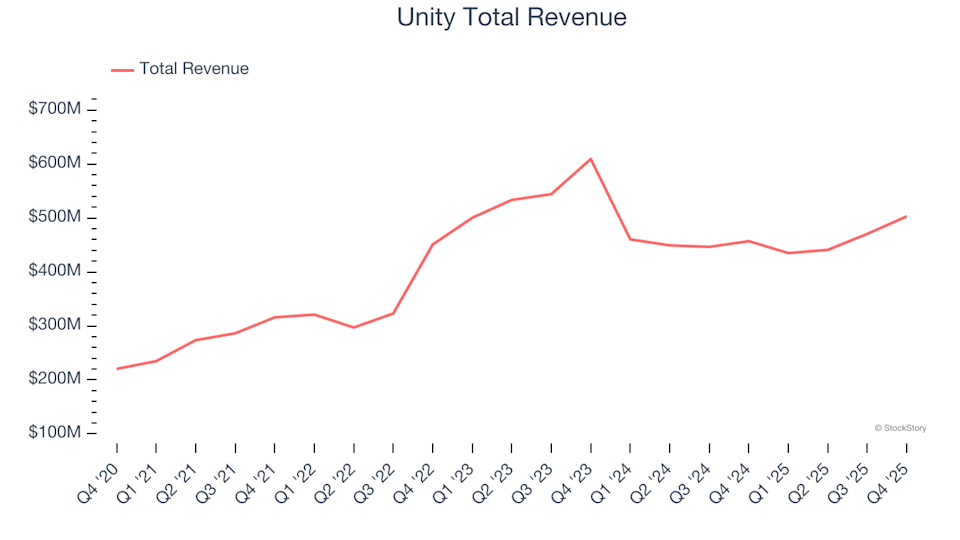
Following the report, Unity’s stock has dropped 37.5% and is currently trading at $18.17.
Autodesk (NASDAQ:ADSK): Q4’s Top Performer
Autodesk, which began with AutoCAD in the 1980s, has evolved into a leading provider of design software for industries such as architecture, engineering, construction, manufacturing, and entertainment, supporting project design, simulation, and visualization.
The company reported $1.96 billion in revenue for Q4, a 19.4% year-over-year increase, surpassing analyst estimates by 2.1%. Autodesk delivered an outstanding quarter, beating billings forecasts and providing next quarter EPS guidance above expectations.
The market responded positively, with Autodesk shares rising 5% since the earnings release, now trading at $245.17.
Adobe (NASDAQ:ADBE)
Named after the creek behind co-founder John Warnock’s home, Adobe is renowned for its suite of software for digital content creation, document management, and marketing, serving users across desktop, mobile, and cloud platforms.
Adobe’s Q4 Performance
Adobe generated $6.19 billion in revenue for the quarter, up 10.5% from the previous year and exceeding forecasts by 1.4%. Although Adobe’s quarter was the weakest among its peers, it still delivered solid results, including EPS guidance and billings that topped analyst expectations.
Since the earnings announcement, Adobe’s stock has declined 23.8% and is now priced at $261.61.
Procore Technologies (NYSE:PCOR)
Procore Technologies is dedicated to developing cloud-based solutions that help owners, contractors, and stakeholders collaborate and manage construction projects from any device, aiming to support those who build the world.
For Q4, Procore reported $349.1 million in revenue, a 15.6% increase year-over-year and 2.4% above analyst expectations. The company also outperformed on billings and saw accelerating customer growth.
Procore added 227 new customers, bringing its total to 17,850. Its stock has climbed 11.1% since the report and is currently valued at $53.18.
Cadence Design Systems (NASDAQ:CDNS)
For over three decades, Cadence Design Systems has provided critical software, hardware, and intellectual property that engineers rely on to design and verify advanced electronics and semiconductors, powering everything from smartphones to AI accelerators.
Cadence reported $1.44 billion in revenue for Q4, up 6.2% year-over-year and 1% above analyst estimates. The company also delivered EPS guidance and EBITDA results that surpassed expectations.
Despite having the weakest performance relative to analyst estimates and the softest full-year guidance among its peers, Cadence’s stock has risen 5.9% since the report, now trading at $300.15.
Market Overview
Following the Federal Reserve’s rate hikes in 2022 and 2023, inflation has steadily declined toward the 2% target. Remarkably, these tighter policies did not trigger a recession, allowing for a cautiously optimistic outlook. Recent rate cuts—a half-point in September 2024 and a quarter-point in November—have further boosted the markets, especially after Trump’s November victory pushed major indices to record highs. Still, investors face uncertainties around tariffs, corporate tax changes, and the economic outlook for 2025.
About StockStory’s Analyst Team
StockStory’s team of experienced professional investors leverages quantitative analysis and automation to deliver timely, high-quality market insights that consistently outperform the market.
Disclaimer: The content of this article solely reflects the author's opinion and does not represent the platform in any capacity. This article is not intended to serve as a reference for making investment decisions.
You may also like
A Review of Q4 Earnings for HR Software Stocks: Comparing Paycom (NYSE:PAYC) with Its Competitors
Wedbush's Sector Split: The Expectation Arbitrage in AppLovin, Unity, and Playtika
Q4 Financial Results: Comparing Baxter (NYSE:BAX) With Other Diversified Medical Devices & Supplies Stocks
Trending news
MoreCrypto prices
More





