Bitcoin slipped to $66,833 over the past 24 hours, testing new lows that echoed throughout the altcoin landscape. Despite Friday’s wave of sell-offs, markets avoided deeper declines over the weekend, offering some relief to nervous traders. Yet, with regional conflicts persisting and key support levels at risk, the atmosphere remains charged with uncertainty.
Geopolitical Tensions Weigh on Bitcoin
Iranian officials informed the United Nations that more than 1,300 civilians have been killed and thousands injured in recent attacks. Meanwhile, following the death of Supreme Leader Khamenei, Iran’s Assembly of Experts has yet to appoint a new leader, deepening the nation’s power vacuum. Former U.S. President Donald Trump, commenting on the region’s future, hinted that the regime may endure if the new leadership maintains good relations with his administration. Strategically, Iran is poorly suited to ground operations, and the United States remains cautious about engaging in a new conflict reminiscent of the Iraq war. Trump’s previous electoral surge was largely fueled by his promise to bring American soldiers home—an agenda that still influences U.S. foreign policy.
Cryptocurrency Market Update
OKB Coin, which counts ICE—the parent company of the New York Stock Exchange—among its investors, led the weekly rally with gains surpassing 30%, trading firmly above the $100 mark. PI Coin also surged 22%, while H Coin saw an 18% rise, ranking third among the top 100 cryptocurrencies by growth. The total cryptocurrency market capitalization hovered just below $2.3 trillion, with the Fear Index at 18—reflecting persistent market apprehension. As usual for the weekend, trading volumes remained subdued.
Iranian President Masoud Pezeshkian announced that missile operations targeting neighboring countries will end, provided those nations do not launch attacks against Iran. This development could help stabilize oil prices, which had recently surged following concerns that energy facilities could become targets. Over the weekend, hostilities concentrated primarily between Iran and Israel. In retaliation for an assault on a refinery in Tehran, Iran’s Revolutionary Guard reported missile strikes on an Israeli refinery in Haifa and the vicinity of Ben Gurion Airport in Tel Aviv.
Despite initial anxieties following the cancellation of certain customs tariffs, a feared climate of chaos failed to materialize. Instead, China and the European Union refrained from escalating tensions, sidestepping an opportunity to pressure Trump. Notably, the timing of Iran’s military response coincided with this trade policy shake-up; had the two events not aligned, Trump might have issued far harsher measures against countries challenging U.S. tariff decisions.
For Bitcoin, two major sources of uncertainty—trade tariffs and the Iran crisis—have now become tangible market realities. As these risks transform from speculation into fact, the emergence of negotiation headlines about Iran could rapidly reverse the recent negative sentiment. It’s worth noting that the 15% tariffs debated for the past five months were already agreed upon last year and are unlikely to cause fresh disputes among the involved parties. Meanwhile, declining employment data in the U.S. continues to support expectations of interest rate cuts in the latter half of the year. Though Bitcoin’s price may remain volatile in the short term, the period of mounting downward pressure appears to be ending, suggesting that charts may soon recover as selling abates.
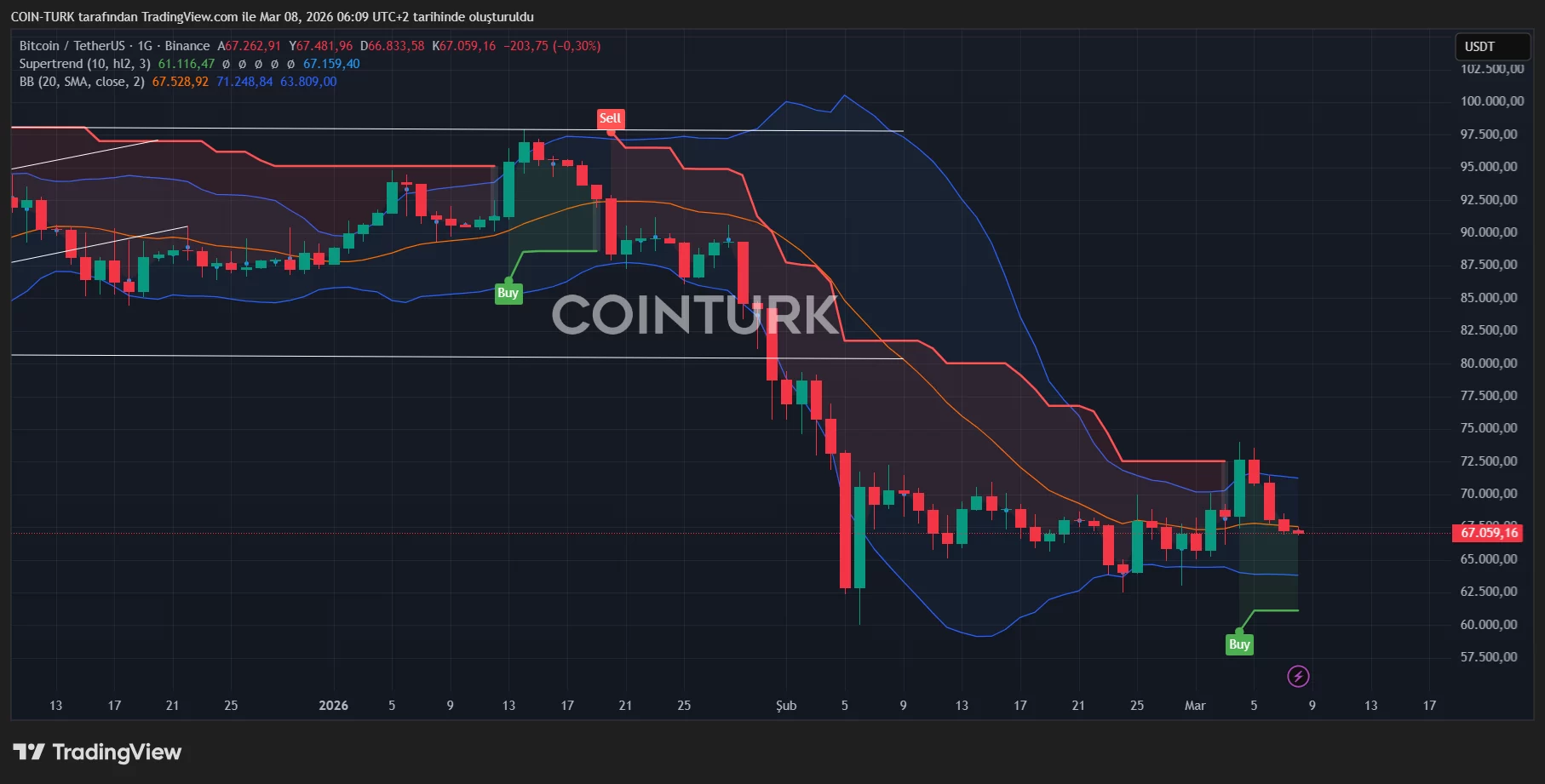
For an entire month, Bitcoin has managed to stay above the $66,000 threshold, though it continues to test this key support. The consolidation phase seems poised to continue for a while longer; after all, the previous period of market stagnation lasted 78 days, so greater volatility could still be a ways off. A decisive breakout is expected if Bitcoin can achieve consecutive closes above $75,000, with $81,300 being the next critical target.
The week’s biggest losers were PIPPIN and STABLE, suffering declines of 40% and 20% respectively. TRUMP Coin dropped 16%, with losses at WLFI closely following. Altcoin markets thus mirrored the broader caution seen in the crypto space.