
Goldman Raises Weatherford Price Target to $107, Citing Superior Performance Amid Flat Energy Market

Goldman Sachs Raises Weatherford Price Target: A Quality Play in a Flat Sector
Goldman Sachs recently increased its price target for Weatherford International from $83 to $107, suggesting an approximate 11.45% potential upside from current levels. Despite this upward revision, the firm maintained a "neutral" rating, signaling that the move is more about Weatherford’s relative strength within its sector than expectations for rapid growth.
According to Goldman, the stock’s momentum is being driven by factors that appeal more to institutional investors than to individuals. These include relative sector appeal, growing international optimism, and potential upside from Venezuelan operations, rather than a broad surge in North American activity. This reflects a strategy focused on identifying operational excellence in a sector where revenue growth is rare.
Looking ahead, Goldman anticipates that U.S. activity will remain largely unchanged, with only a slight uptick internationally expected in late 2026 or 2027. For portfolio managers, this means there are few immediate catalysts for earnings growth. As a result, Weatherford’s value proposition lies in its ability to deliver strong execution, maintain a healthy balance sheet, and preserve margins—qualities already demonstrated by its recent earnings performance.
Ultimately, this is a sector rotation strategy. In a market where energy services are viewed as a defensive, low-volatility choice, Weatherford stands out for its operational discipline and prudent capital management. The raised price target reflects confidence in the company’s quality, rather than in the sector’s growth potential, aligning with a broader institutional preference for risk-adjusted returns in a market with limited upside.
Financial Strength and Competitive Edge
Weatherford’s financials highlight its disciplined approach in a sluggish sector. The company’s fourth-quarter results showed a sequential improvement in adjusted EBITDA margin to 22.6%, though this was still 173 basis points lower than the previous year. While margin compression is a sector-wide challenge, Weatherford’s ability to sustain margins in the mid-20% range, even as competitors struggle, underscores its operational resilience.
For the full year, Weatherford reported net income of $431 million, representing an 8.8% margin—a 15% decrease from the prior year. This drop in profitability, alongside an 11% decline in revenue, highlights the stringent cost controls needed to protect earnings in a stagnant market. For institutional investors, this is the essence of the quality thesis: Weatherford is proving it can generate returns on capital even when revenue growth is limited.
The company operates across three main segments: Drilling and Evaluation (DRE), Well Construction and Completions (WCC), and Production and Intervention (PRI). While detailed segment results are not provided, DRE is identified as a primary growth engine, with a focus on advanced, technology-driven services that typically yield higher margins and create a stronger competitive moat. In a sector where volume growth is hard to achieve, this emphasis on premium services supports Weatherford’s quality advantage.
From a capital management perspective, Weatherford is strengthening its balance sheet. The company generated $466 million in adjusted free cash flow for the year and returned $173 million to shareholders, including a 10% increase in its quarterly dividend. This disciplined approach to liquidity is vital for maintaining credit quality during downturns and reinforces the stock’s defensive appeal.
In summary, Weatherford’s financial health is defined by its ability to withstand sector stagnation. Its focus on cost control, maintaining robust margins, and returning capital to shareholders provides a clear quality premium—precisely what Goldman Sachs is backing as a preferred choice for institutional investors seeking stability in a challenging industry.
Sector Landscape and Portfolio Strategy
The case for Weatherford among institutional investors is rooted in a realistic view of the sector’s limitations. The North American oilfield services market is expected to grow at a modest 6.2% compound annual rate, with 2026 activity constrained by oil prices in the $50-60 range—below the breakeven for many new wells. This environment favors capital discipline over expansion.
Recent data illustrates this stagnation: service rig operating hours have increased by just 3.2%, rig counts are down, and operators are keeping capital budgets flat or slightly reduced. For portfolio construction, this means sector growth is not the main attraction. Instead, the real opportunity lies in the ongoing need for maintenance, upgrades, and technical reinvestment in aging oil infrastructure worldwide.
Within this context, Weatherford is positioned as a quality-focused investment, capitalizing on essential, non-discretionary spending. Its operational strength and prudent capital management enable it to benefit from the maintenance cycle, even as overall revenue growth remains muted. The recent price target increase from Goldman Sachs reflects confidence in this quality premium, rather than in a broad sector rebound.
For institutional portfolios, Weatherford offers a way to rotate into a defensive, low-volatility segment of the energy market. Its financial stability and focus on high-value services make it an attractive option for targeted oil exposure, providing diversification and inflation protection without the risks associated with cyclical volume growth. This is a conviction play on quality, not a bet on a sector-wide recovery.
Valuation, Potential Triggers, and Risks
Weatherford’s current valuation reflects expectations for a modest, quality-driven improvement. The stock is trading above its 200-day simple moving average, indicating that the market has already priced in the anticipated international uptick expected in late 2026 or 2027. This sets a high bar, and any delays or disappointments in international growth could put pressure on the stock’s valuation.
The main catalyst for further upside is the anticipated recovery in international markets, which is seen as key to unlocking earnings growth in the face of a stagnant North American market. While oil prices constrain sector growth, increased international activity could improve utilization and margins for Weatherford, given its operational discipline. For institutional investors, this is the most immediate opportunity for the quality premium to be realized.
However, the biggest risk remains the lack of growth in North America. With activity expected to stay flat, top-line expansion will be limited, supporting the "neutral" ratings from firms like Goldman Sachs. This ongoing challenge means Weatherford’s ability to deliver returns will depend on continued cost management rather than revenue growth—a risk that is already reflected in the current share price, but one that also limits near-term upside.
Insider transactions provide additional context. CEO Girish Saligram recently sold 100,000 shares at an average price of $105.50, a notable personal sale. While such moves can be for various reasons, they serve as a reminder that insider conviction may not fully match the stock’s recent rally. With insiders collectively holding about 1.6% of the company, concentrated ownership is limited, which can sometimes indicate lower institutional confidence.
For portfolio managers, the key is careful positioning. Weatherford offers a quality-focused approach to sector rotation, but its valuation already reflects expectations for a specific catalyst. If the international recovery is delayed or weaker than anticipated, the stock could be vulnerable to ongoing stagnation in North America. As such, Weatherford represents a high-conviction, low-volatility holding that requires patience as the international cycle unfolds.
Disclaimer: The content of this article solely reflects the author's opinion and does not represent the platform in any capacity. This article is not intended to serve as a reference for making investment decisions.
You may also like
ARIA (Aria.AI) fluctuated by 49.4% in 24 hours: Trading volume surged by 796%, driving intense price volatility
DeFi Withdrawals Underscore Changing Investor Attitudes and Infrastructure Issues
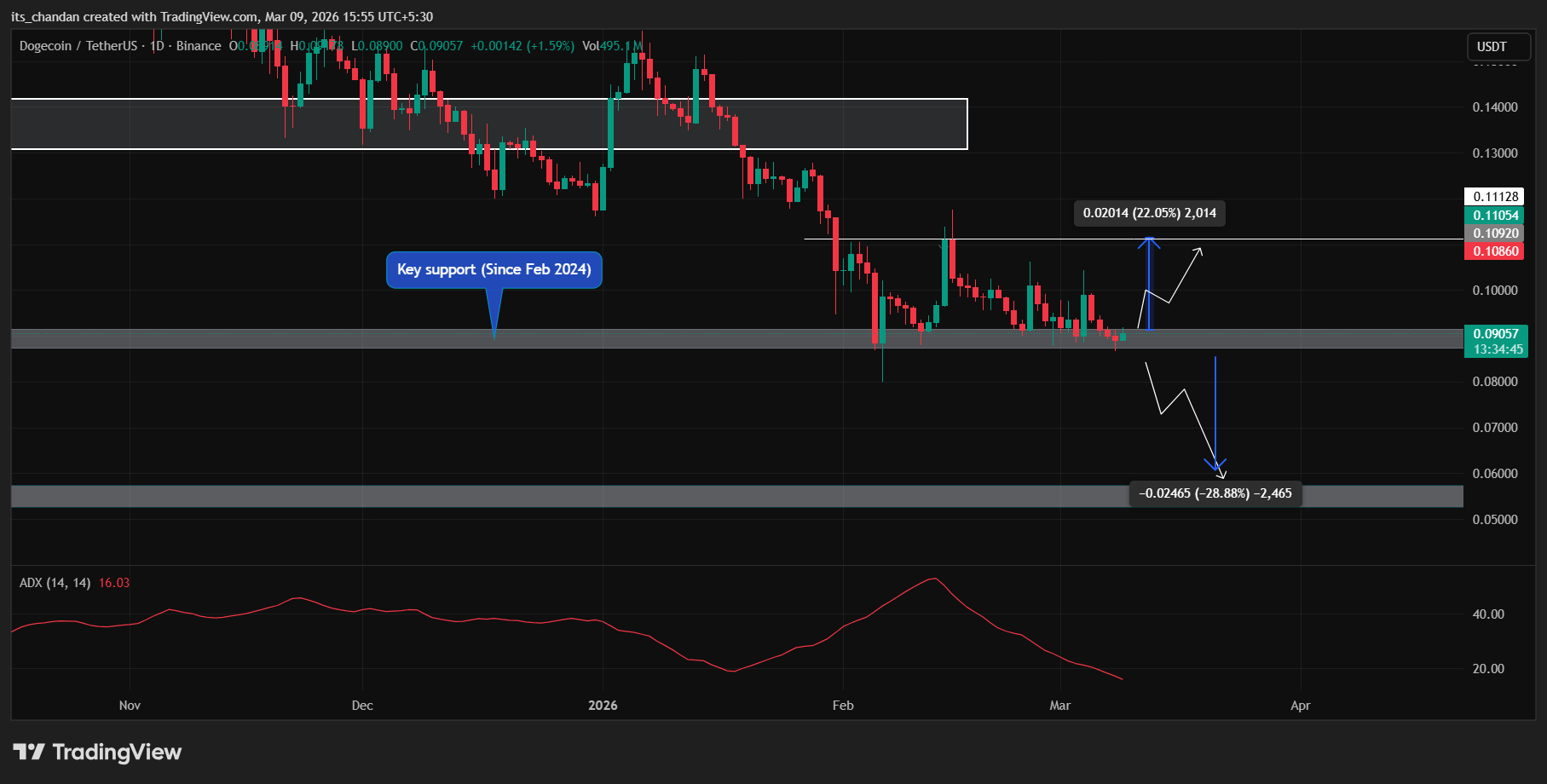
Dogecoin eyes $0.111 after $0.0872 retest – But DOGE’s move holds IF…
Workers Cling to Their Positions Amid Sluggish Hiring and Increasing Layoffs
Trending news
MoreCrypto prices
More





