
Stagflation Strategies Dominate Markets Amid Trump’s Indications of Escalating Conflict

Global Markets Rattle as Middle East Conflict Deepens
Financial markets are quickly losing hope for a swift end to the turmoil in the Middle East, with investor sentiment shifting from cautious optimism to heightened concern. The escalating crisis has triggered a significant selloff, wiping out approximately $6 trillion from global equities since the onset of hostilities involving Iran.
Key Headlines
Although some losses in equities were pared and oil prices retreated slightly after reports that G7 nations may coordinate a release from petroleum reserves, the overall market reaction on Monday was dramatic.
The situation intensified following President Donald Trump’s remarks that certain regions of Iran had not yet been targeted and that $100 oil was a “small price” for “Safety and Peace,” diminishing hopes for a limited conflict.
As oil prices surged toward $120 per barrel, it became apparent to traders that the market was no longer positioned for a brief confrontation. Brent crude saw an intraday spike of up to 29%—the largest in nearly six years—while volatility in equities soared and trading volumes across Asian markets far exceeded monthly norms. The trading activity reflected panic rather than caution.
“The mood is shifting toward panic,” said Danny Wong, CEO of Areca Capital. “There’s a rush to reduce exposure to all types of risk assets.”
Market Turmoil Spreads Globally
As trading began across different regions on Monday, major support levels in stocks, bonds, and currencies were breached in rapid succession. The US dollar strengthened as investors sought safety, and energy stocks climbed. At one stage, Asian stock markets plunged by about 5.6%, marking their sharpest drop since April. The Bloomberg Dollar Spot Index continued to rise.
“Investors are now assigning a higher probability to the worst-case scenario,” commented Rajeev de Mello, global macro portfolio manager at Gama Asset Management. “The stagflationary nature of this shock is particularly challenging.”
News of renewed attacks on energy infrastructure by both sides fueled fears of a prolonged supply disruption. In a bold move, Iran appointed the son of the late Ayatollah Ali Khamenei as its new supreme leader.
Investor Anxiety and Market Reactions
“I thought I’d get some rest this week, but that’s no longer possible,” said Matthew Haupt, hedge fund manager at Wilson Asset Management. “Investors are preparing for a prolonged downturn, with risks clearly skewed to the downside and no end in sight.”
In Japan, among the first markets to open, some trading desks reported their internal communication systems were overwhelmed by a surge in client inquiries.
“There’s a palpable sense of tension on the trading floor,” noted Katsuji Azuma, head of equity sales at Mitsubishi UFJ Morgan Stanley Securities.
According to Bloomberg data, foreign investors withdrew $14.2 billion from emerging Asian equities (excluding China) last week—the largest outflow since at least 2009. The selloff has been most pronounced in South Korea and Taiwan, both major hubs for global AI investment.
Volatility indices linked to Japan’s Nikkei 225 and India’s NSE Nifty 50 soared by as much as 62% and 23%, respectively, reaching their highest levels since mid-2024. South Korea even experienced a temporary trading halt due to the sharp decline.
“When a black swan event hits, everything can drop simultaneously,” observed Anna Wu, cross-asset strategist at Van Eck Associates in Sydney. “Today we’re seeing widespread selling across stocks, bonds, and currencies—except for oil and the dollar.”
The MSCI Asia Pacific Index is now within about 1% of a technical correction, while the MSCI Emerging Markets Index is approaching a similar threshold, highlighting the severity of the global risk-off sentiment.
Asia’s Vulnerability and Policy Responses
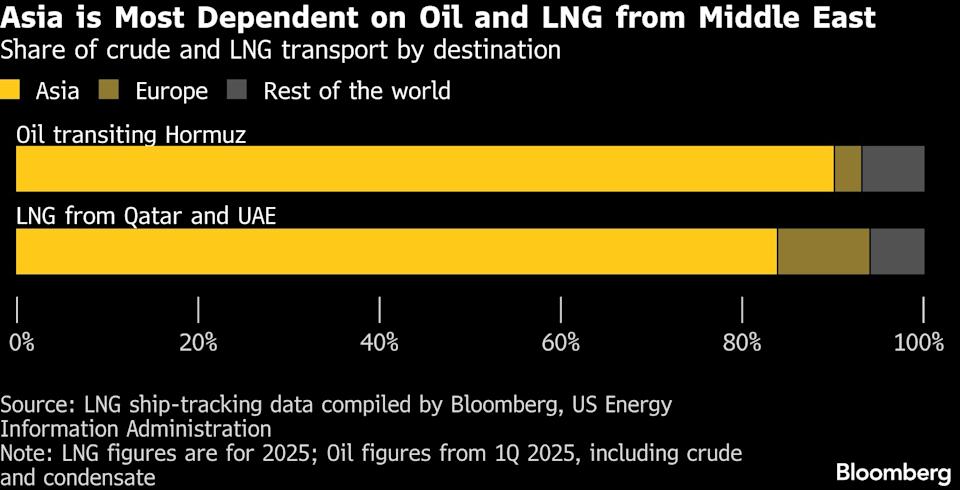
Part of the recent downturn reflects how far markets had previously climbed. South Korea and Taiwan had reached multi-year highs on strong demand for AI chips, leaving valuations stretched. The oil shock has added to the pressure, exposing Asia’s particular vulnerability to disruptions in Middle Eastern energy supplies.
A significant portion of the region’s crude oil and LNG imports passes through the Strait of Hormuz, now a flashpoint in the conflict. China, India, and Indonesia are among the world’s largest oil importers, while South Korea and Taiwan—heavily reliant on gas-fired power and Gulf supply chains—are especially at risk.
“I’m increasing cash holdings because if the Middle East crisis drags on, the likelihood of recession or stagflation rises,” said Hironori Akizawa, fund manager at Tokio Marine Asset Management.
Governments in the region are scrambling to mitigate the fallout. South Korea and Taiwan are considering market stabilization measures to curb equity losses and looking for ways to cap domestic fuel prices as energy costs soar.
Shifting Expectations for US Monetary Policy
Amid mounting global inflation concerns, traders are scaling back expectations for US interest rate cuts, with some now betting that the Federal Reserve may not lower rates at all this year. The anticipated timing for the next quarter-point cut has been pushed to September, whereas a move had been fully priced in for July before the conflict erupted.
Read more: Yardeni Raises Odds of US Market Meltdown to 35% on Iran War
AI Investment Cycle Faces Uncertainty
The geopolitical shock is coinciding with growing doubts about whether the artificial intelligence investment boom is peaking. Investors are closely watching signals from major tech firms about the sustainability of AI infrastructure spending as the broader economic outlook darkens.
“Investors are turning defensive,” said Jun Bei Liu, co-founder and lead portfolio manager at Ten Cap Investment Management. “Markets are now trying to gauge how long this conflict could last and what persistent high oil prices might mean for global growth.”
With contributions from Gabrielle Ng, Ruth Carson, Marcus Wong, and Momoka Yokoyama.
Trending in Bloomberg Businessweek
©2026 Bloomberg L.P.
Disclaimer: The content of this article solely reflects the author's opinion and does not represent the platform in any capacity. This article is not intended to serve as a reference for making investment decisions.
You may also like
Oil concerns and tensions with Iran send Asian markets tumbling, as Korea’s KOSPI suffers the steepest decline
TRX Gold Reports 2026 Annual Meeting Voting Results

From startup seedling to cannabis powerhouse, Verano has navigated the industry’s ups and downs
Reflecting on the fourth quarter earnings of property and casualty insurance stocks: Mercury General (NYSE:MCY)
Trending news
MoreCrypto prices
More





