
Rigetti’s Cepheus Delay Masks a Critical Fidelity Gamble: Will Achieving 99.5% Fidelity Spark Widespread Commercial Use?

Rigetti Computing: Building the Foundation for Quantum Computing
Rigetti Computing is focused on developing the essential hardware for the next era of quantum technology, but the company is still in the early, capital-intensive stage of industry growth. Their approach centers on complete vertical integration—controlling every aspect from design and manufacturing to deployment. This strategy, anchored by their proprietary Fab-1 facility, is intended to speed up innovation cycles and safeguard intellectual property as they move toward systems with over 100 qubits. The core belief is that this level of control will give Rigetti a meaningful advantage during the pre-mass adoption phase, where small gains in yield and reliability can accumulate significantly over time.
Recent performance data shows Rigetti is achieving important reliability benchmarks, though it still lags behind industry leaders in terms of error rates. The company recently reported a 99% median two-qubit gate fidelity on its 108-qubit Cepheus-1-108Q prototype. Even more notably, another prototype reached 99.9% two-qubit gate fidelity at a gate speed of 28 nanoseconds, which is said to be 1,000 times faster than leading alternatives. However, compared to IBM and Google’s latest systems, Rigetti’s 82/84-qubit device still has higher error rates, with two-qubit errors of 1% (iSWAP) or 0.5% (fSIM). In contrast, IBM’s 156-qubit Heron R2 achieves 0.371%, and Google’s 105-qubit Willow reaches 0.14%, placing Rigetti earlier on the adoption curve.
Modular Architecture and Scaling Challenges
To address scalability, Rigetti employs a modular chiplet design rather than relying on single, monolithic chips. Their 108-qubit system is built from twelve 9-qubit modules, a solution that overcomes the physical constraints of manufacturing larger chips and is crucial for building bigger, more dependable quantum computers. The recent postponement of the Cepheus-1-108Q launch for further refinement highlights the complexity of this engineering phase. Rigetti is choosing to prioritize system performance, aiming for 99.5% fidelity before release, rather than sticking to a rigid schedule.
In summary, Rigetti is laying the groundwork for the next generation of computing. Their vertically integrated and modular approach aligns with the infrastructure demands of future quantum systems. However, current error rates indicate they are still trailing in the hardware race. Achieving practical quantum advantage will require not just more qubits, but dramatically improved reliability. Rigetti is making progress, but remains in a costly, execution-intensive phase where disciplined management will be critical to reaching the next stage of growth.
Financial Strength: Supporting Long-Term Innovation
Rigetti’s robust financial position is a key asset as it navigates the high-cost development curve of quantum hardware. Entering 2026, the company boasts a substantial cash reserve, providing several years of operational visibility—an advantage over competitors who must frequently seek new funding. At the end of 2025, liquidity exceeded $600 million, significantly reducing the risk of near-term dilution and enabling the company to pursue its ambitious plans without compromising on timing. This financial strength is largely due to warrant exercises completed in late 2025, which bolstered the balance sheet ahead of the next phase of expansion.
Strategy Backtest: MACD Crossover Long-Only for RIGQ
- Entry: Buy when the 12-day EMA crosses above the 26-day EMA and the MACD (12,26,9) line moves above the signal line.
- Exit: Sell when the MACD line drops below the signal line, after 20 trading days, or if a take-profit of +8% or stop-loss of -4% is reached.
- Backtest Period: Last 2 years
Backtest Results
- Total Return: -1.18%
- Annualized Return: -0.55%
- Maximum Drawdown: 3.97%
- Profit-Loss Ratio: 0.66
Trade Statistics
- Total Trades: 2
- Winning Trades: 1
- Losing Trades: 1
- Win Rate: 50%
- Average Holding Period: 9.5 days
- Max Consecutive Losses: 1
- Average Gain per Win: 2.4%
- Average Loss per Loss: 3.5%
- Largest Single Gain: 2.4%
- Largest Single Loss: 3.5%
Revenue and Commercialization Outlook
Despite this financial strength, Rigetti’s revenue base remains small. In 2025, the company generated just $7.1 million in sales, highlighting that widespread commercial adoption is still in its early stages. Most of Rigetti’s business is concentrated among government agencies, national laboratories, and research organizations. While recent contracts—such as an $8.4 million order from India’s C-DAC for a 108-qubit system—demonstrate long-term relevance, they do little to smooth out the inherent volatility of large, infrequent deployments. As a result, Rigetti’s financial runway is built on future potential rather than current sales.
Ongoing investment is essential to achieve the company’s ambitious goals: deploying a 150+ qubit system by 2026 and surpassing 1,000 qubits by 2027. Each milestone requires significant R&D spending, manufacturing expansion at Fab-1, and ongoing system optimization, as seen with the delayed Cepheus-1-108Q. Rigetti’s financial flexibility is especially valuable given the unpredictable nature of its revenue and the frequent delays common in this sector. The company’s strong balance sheet acts as a buffer, allowing it to weather postponed deployments or customer-specific adjustments without needing to seek outside funding.
Ultimately, Rigetti’s financial resources position it to pursue its vertically integrated strategy through the challenging, expensive stages of quantum development. While the journey to commercialization is far from over, this financial strength reduces a major risk and gives the company the time and capital needed to close the performance gap and reach a pivotal turning point.
Key Drivers, Risks, and the Road to Widespread Adoption
Rigetti’s progress toward broad adoption depends on several near-term milestones that will test its technical and commercial capabilities. The most significant upcoming event is the delayed launch of its 108-qubit Cepheus-1-108Q system, now expected around the end of Q1 2026. This delay, prompted by a new chip iteration to enhance tunable couplers, reflects a deliberate choice to prioritize performance over speed. Achieving the target of 99.5% median two-qubit gate fidelity is crucial for real-world utility. Success here would validate Rigetti’s modular design and integrated approach, potentially accelerating customer transitions from research to early commercial use.
However, this opportunity is tempered by a significant ongoing risk: the company’s revenue is heavily dependent on government and research clients. This reliance slows the pace of commercial feedback and product iteration, as these customers have lengthy procurement cycles and unique requirements. Unlike consumer technology, where rapid user feedback drives quick improvements, Rigetti’s primary clients move slowly, making revenue streams unpredictable. While the company’s financial cushion helps, it does not fundamentally change the challenge of relying on a narrow, slow-moving customer base for commercial validation.
The dramatic rise in Rigetti’s stock price—up 5,700% over the past year—illustrates the tension between speculative enthusiasm and actual business progress. Such volatility is typical in the early stages of disruptive technology, where market excitement can outpace commercial reality. Any setbacks in product launches or delays in securing commercial deals could lead to sharp corrections, as seen in the sector’s recent consolidation.
The industry’s strategic direction is also shifting. The recent $1.8 billion acquisition of SkyWater by IonQ signals a move toward vertical integration, echoing Rigetti’s own approach. By bringing manufacturing in-house, IonQ aims to speed up development and control scaling, setting a new competitive standard. For Rigetti, its Fab-1 facility is not just a production site but a critical asset for navigating the quantum adoption curve. The company’s ability to match or exceed IonQ’s pace of innovation, while advancing its modular systems, will be key to realizing the benefits of its infrastructure-focused strategy.
In conclusion, Rigetti stands at a crucial crossroads. The upcoming Cepheus system launch could be a decisive moment, shifting perceptions from technical promise to commercial viability. Yet, the challenge of slow-moving, government-driven feedback remains. The sector’s volatile stock performance underscores the speculative nature of this journey. Ultimately, success will go to the company that can deliver the most scalable, reliable quantum hardware. Rigetti’s integrated approach offers a potential advantage, but now it must prove it can translate this into widespread adoption and industry leadership.
Disclaimer: The content of this article solely reflects the author's opinion and does not represent the platform in any capacity. This article is not intended to serve as a reference for making investment decisions.
You may also like
ARIA (Aria.AI) fluctuated by 49.4% in 24 hours: Trading volume surged by 796%, driving intense price volatility
DeFi Withdrawals Underscore Changing Investor Attitudes and Infrastructure Issues
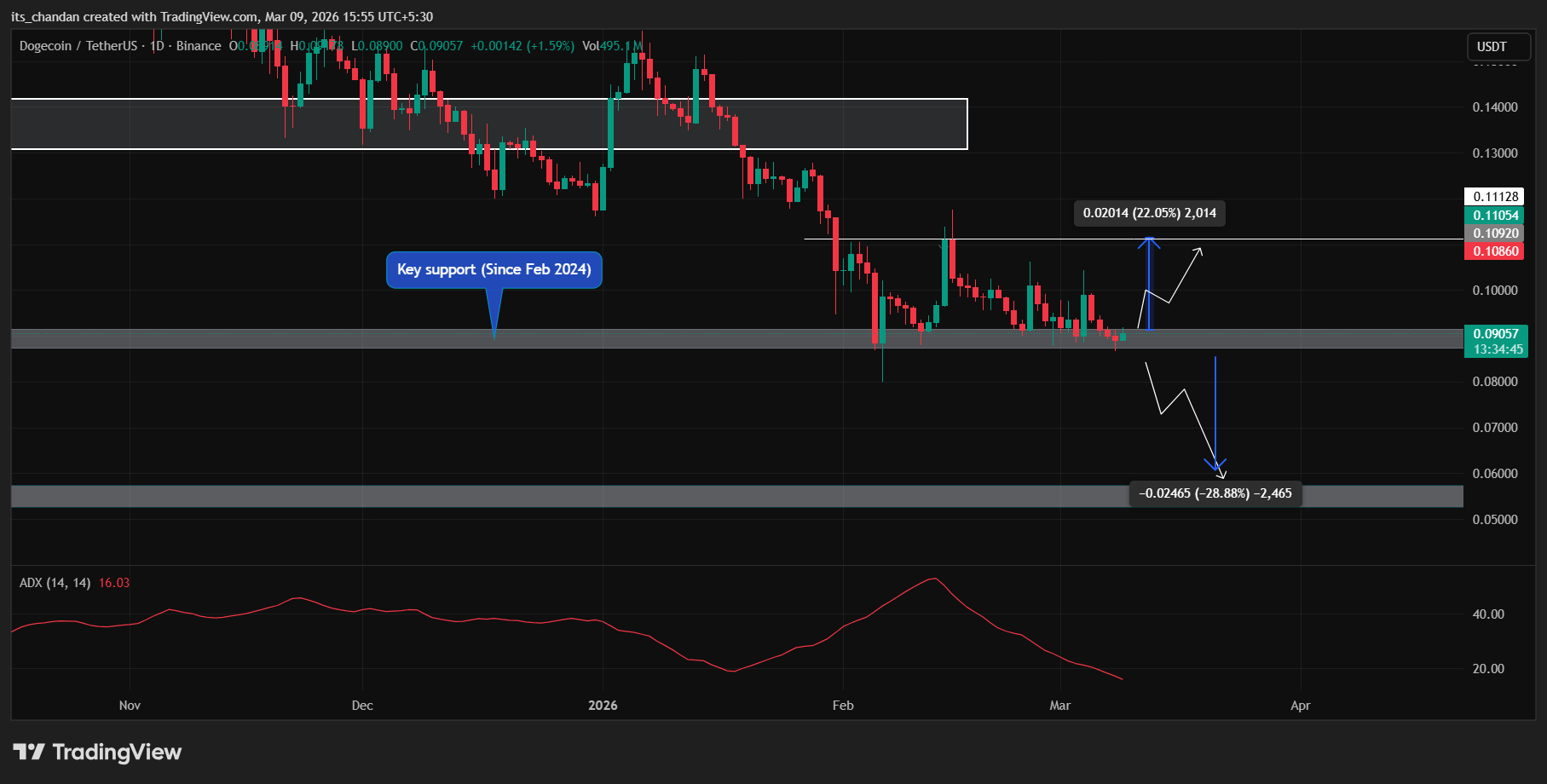
Dogecoin eyes $0.111 after $0.0872 retest – But DOGE’s move holds IF…
Workers Cling to Their Positions Amid Sluggish Hiring and Increasing Layoffs
Trending news
MoreCrypto prices
More





