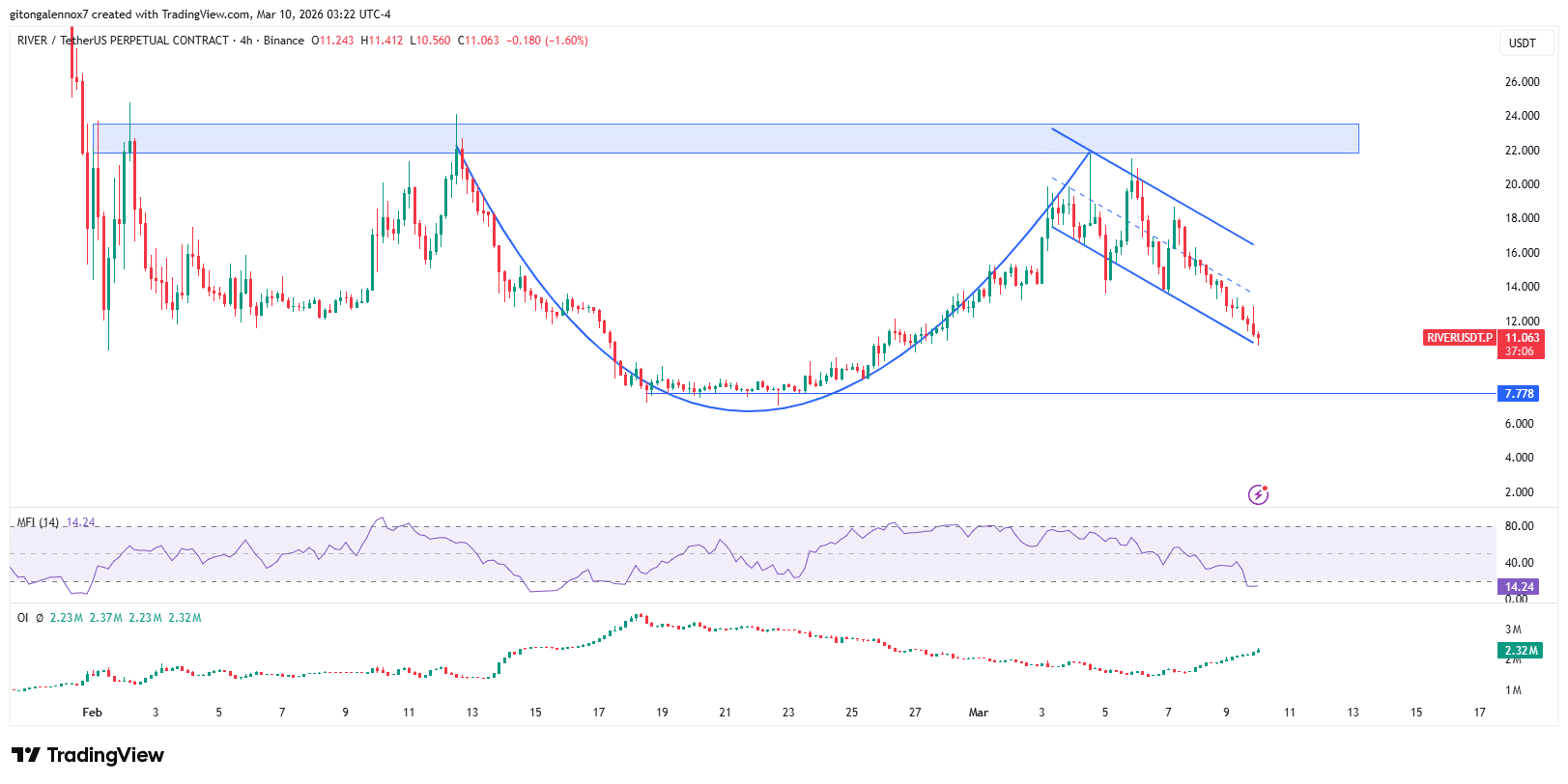
River [RIVER] appears to be invalidating a potential cup‑and‑handle breakout. Over the past 24 hours, RIVER has dropped 17%, at press time, with its price now well below January’s peak of $87.
The altcoin continues to decline, despite earlier signs of potential invalidation of the head-and-shoulder pattern on the daily chart.
RIVER is now on its sixth consecutive red day, suggesting the pattern is firmly in play. The key questions are how much further the altcoin could drop and what factors are driving the decline.
RIVER prices are heading toward…
The price chart was trading within the handle pattern, with more decline anticipated in line with the head-and-shoulder pattern.
RIVER was headed toward the $7.72 zone as capital outflows hit oversold levels. At press time, the Money Flow Index (MFI) was at 14.24, indicating the sell pressure was at extreme levels.
Moreover, Open Interest (OI) has been rising even as price declines, highlighting a clear divergence. Over the past five days, OI nearly doubled from $1.46 million to $2.33 millioin.
This surge indicates traders are favoring shorts over longs and using leverage to strengthen those positions.
Source: RIVER/USDT on TradingView
According to price action, the $7.72 level may serve as a pause in the downtrend. Historical data on the 4‑hour chart shows bulls previously defending this level with a week‑long consolidation above it.
Such a pause could open the door for a rebound toward $20, the range’s resistance.
The OI-Weighted Funding Rate was also in the red with a reading of 0.0086%. This reading indicated sellers were paying longer to keep their short positions open. Hence, long liquidations were increasing.
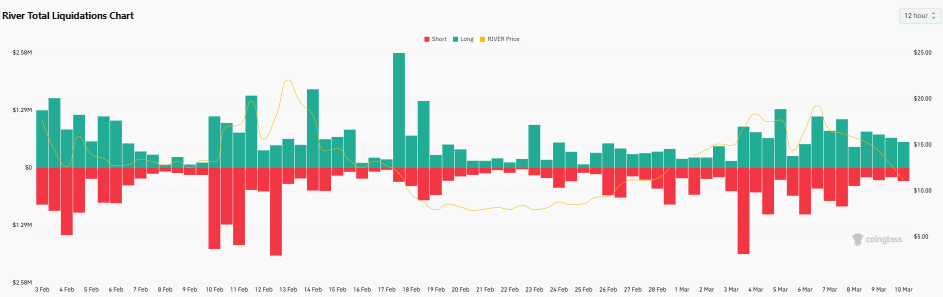
Long liquidations dominate RIVER crypto
CoinGlass data shows that long liquidations have dominated over the past four days. At the time of writing, long liquidations totaled $564K, nearly double the $291K recorded for shorts.
Source: CoinGlass
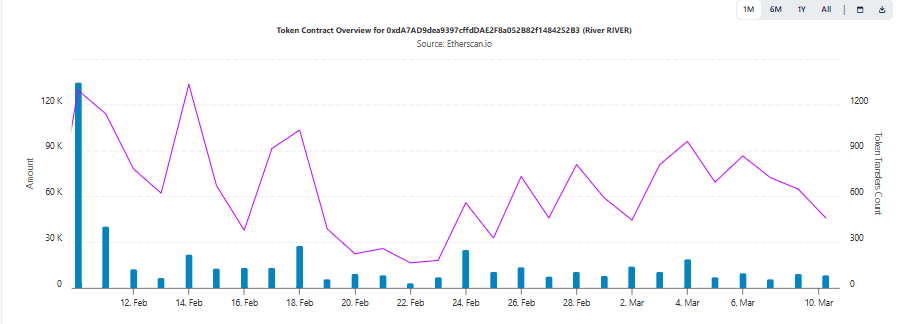
These liquidations triggered a long squeeze, intensifying selling pressure. At the same time, network activity mirrored the price weakness, with fewer transactions occurring as prices declined.
Weak network activity
Since the beginning of March, the transfer amount has dropped from 18,631 RIVER tokens to 8,413 tokens. Moreover, the transfer count fell from 962 to 460.
Source: Etherscan
While strong network activity doesn’t always translate into price strength, weak activity tends to worsen bearish conditions. In this case, the slowdown in network usage contributed to the decline in price action.
Final Summary
- RIVER crypto fell 17% in 24 hours amid increasing long liquidations and weak network activity.
- RIVER price action was invalidating bullish patterns as it obeyed previous bear patterns like the head-and-shoulder.