
Airline Closure: An Examination of the $15 Million Revenue Loss and the $285 Million Per Day Economic Consequences

Immediate Disruptions in Air Travel Operations
Cash flow within the aviation sector is facing significant challenges. With 50,000 TSA employees working without compensation, airport security checkpoints are experiencing severe congestion, slowing down passenger movement and causing operational setbacks. This situation is further aggravated by the FAA’s mandate to reduce capacity by 10% at 40 major airports, resulting in thousands of flights being cut each day. The combined effect is a swift and widespread breakdown in the system’s flow.
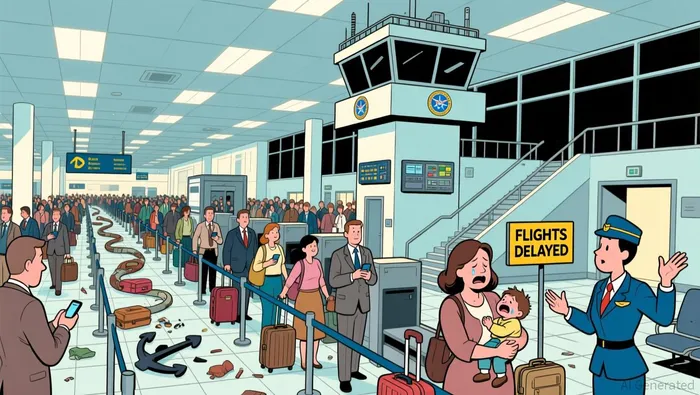
The operational impact is dramatic. In just three weeks, flight cancellations due to staffing shortages skyrocketed from 11 in late October to 4,162 by early November. This surge is directly linked to the FAA’s flight reduction policy, which has become the main reason for cancellations. The economic fallout is both immediate and substantial, with the FAA estimating that the daily cost to the U.S. economy from these flight reductions alone ranges between $285 million and $580 million.
The aviation network is now operating under intense pressure and reduced capacity. Travelers are dealing with extended wait times and unpredictable schedules, while airlines are forced to rebook large numbers of disrupted passengers. This creates a costly cycle involving refunds, crew scheduling challenges, and lost income, all originating from the initial shock of unpaid personnel and enforced flight reductions.
The Financial Toll: Revenue Losses and Rising Costs
Airlines are already feeling the financial strain, having suffered an estimated $10–$15 million in lost revenue due to the shutdown, primarily from canceled flights and operational interruptions. This marks the first clear sign of financial disruption impacting the bottom line.
Expenses are mounting as well. The loss in revenue from cancellations is being compounded by the additional costs of rebooking passengers and issuing refunds. The main factor behind these losses remains the FAA’s 10% capacity cut at 40 airports, which alone is estimated to cost the U.S. economy $285 million to $580 million per day.
Operational challenges are intensifying. Staffing shortages among air traffic controllers are now the leading cause of delays, accounting for 61% of all delay minutes in the National Airspace System in early November. This has triggered a costly chain reaction of crew scheduling issues, aircraft misplacement, and longer tarmac waits, all stemming from the initial disruption of unpaid workers and mandated flight reductions.
Strategy Backtest: Absolute Momentum Long-only (AMZN)
- Entry Criteria: Buy AMZN when the 252-day rate of change is positive and the closing price is above the 200-day simple moving average (SMA).
- Exit Criteria: Sell when the closing price falls below the 200-day SMA, after 20 trading days, or if a take-profit of +8% or a stop-loss of −4% is reached.
- Risk Management: Take-profit at 8%, stop-loss at 4%, maximum holding period of 20 days.
Backtest Results
- Total Return: -11.73%
- Annualized Return: -4.82%
- Maximum Drawdown: 13.6%
- Profit-Loss Ratio: 1.07
Trade Statistics
| Total Trades | 15 |
| Winning Trades | 6 |
| Losing Trades | 9 |
| Win Rate | 40% |
| Average Hold Days | 11.4 |
| Max Consecutive Losses | 3 |
| Profit-Loss Ratio | 1.07 |
| Average Win Return | 5.38% |
| Average Loss Return | 4.7% |
| Max Single Return | 9.99% |
| Max Single Loss Return | 7.53% |
Key Drivers and Market Response
Congress now holds the key to resolving the crisis. Top airline executives have come together to urge the passage of the Aviation Funding Solvency and Stability Acts, which would ensure that air traffic controllers and TSA staff continue to receive pay regardless of government funding status. Their recent letter frames the shutdown as a recurring political problem that must be addressed to restore normal operations and compensate workers who have gone unpaid for over a month.
The upcoming Thanksgiving travel season, just three weeks away, will be a crucial test for the already strained system. Airlines must navigate ongoing staff shortages and reduced flight schedules while accommodating peak holiday demand. The results will show whether the current 10% capacity cut is a temporary adjustment or a deeper issue that could lead to widespread delays and cancellations during the busiest travel period of the year.
Despite the turmoil, investor sentiment remains relatively steady. Past experience suggests that markets may not be overly alarmed. During the previous shutdown, a major airline stock index climbed nearly 15%, with Southwest Airlines surging almost 20%. This pattern indicates that investors view the disruptions as temporary, expecting that demand for air travel will persist even amid operational challenges.
Disclaimer: The content of this article solely reflects the author's opinion and does not represent the platform in any capacity. This article is not intended to serve as a reference for making investment decisions.
You may also like
1 Stock Worth Investigating for Potential Gains and 2 We Challenge
Innovation Beverage Group Limited Announces Closing of $6 Million Public Offering

Take-Two's established series encounter challenges while the industry anticipates the release of GTA 6
Next Crypto to Explode: DeepSnitch AI Set for 300x Potential as Launch Nears While TRUMP and Solana Struggle for Catalysts

Trending news
MoreCrypto prices
More





