
Fed Chair Powell's Court Victory Could Compel Trump to Overhaul the Fed Through Force

Federal Judge Blocks DOJ Subpoenas Targeting Fed Chair Powell
The administration has suffered a significant legal defeat after a federal judge invalidated grand jury subpoenas issued to the Federal Reserve. Chief Judge James Boasberg determined that these subpoenas were primarily intended to pressure Chairman Jerome Powell, rather than to investigate any criminal activity. According to the judge, the main goal was to coerce Powell into supporting lower interest rates or stepping down, rather than pursuing legitimate legal concerns. While this outcome reinforces the Federal Reserve's autonomy, it does little to ease the ongoing political tensions surrounding the central bank.
The controversy revolves around Powell's testimony before Congress regarding a multi-billion-dollar office renovation, an issue fraught with political implications. President Trump has consistently urged the Fed to cut rates, and this investigation appears to be the latest escalation in that campaign. The judge's recent order emphasized the lack of substantial evidence for any criminal conduct, noting that the government presented "essentially zero evidence" aside from Powell's actions displeasing the President.
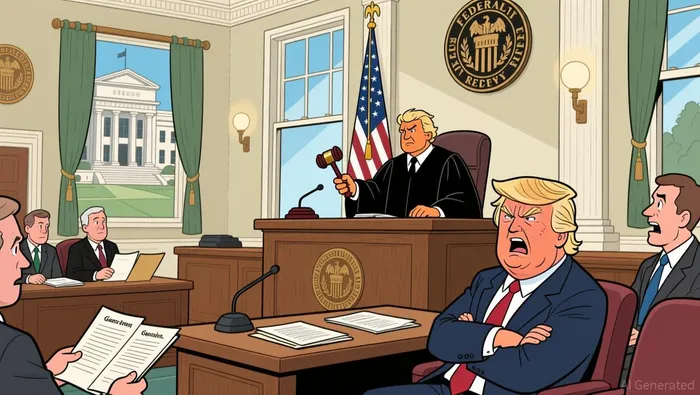
Despite the court's intervention, political maneuvering continues. President Trump has already put forward Kevin Warsh as his choice to succeed Powell, signaling a clear intention to reshape the Federal Reserve's leadership. Ironically, the judge's decision may undermine the administration's justification for the investigation, potentially leading to a more direct political confrontation. The struggle between judicial independence and political influence is now front and center, with Powell caught in the crossfire.
The Dynamics Behind the Power Struggle
The court's decision represents a clear setback for the Justice Department's investigation, which was found to lack credible evidence against Powell. The judge concluded that the subpoenas were merely a tool to exert pressure, not to uncover wrongdoing. Although this legal defeat may embolden the White House to push harder for Powell's replacement, it also frames the situation as a defense of the Fed's independence.
Time is now a critical factor. Powell's term as Federal Reserve Chair ends in May 2026, giving the administration a limited window to act. President Trump has already nominated Kevin Warsh, indicating a desire to appoint a more dovish leader. However, the judge's ruling could complicate the administration's narrative, making it more difficult to justify the probe and potentially forcing a more open confrontation.
Institutional dynamics are also at play. Senate Banking Committee Democrats are blocking Warsh's nomination, insisting that all criminal investigations targeting Powell and other Fed officials be dropped first. This standoff could result in Powell remaining as chair beyond his current term, especially if figures like Stephen Miran, who are more aligned with the administration but less influential, depart the board. By highlighting the weakness of the DOJ's case, the judge's decision may have inadvertently bolstered the case for keeping Powell in his role.
Key Developments and Potential Outcomes
The next steps will be shaped by two immediate developments that will test both the administration's determination and the Federal Reserve's independence. First, the upcoming Federal Open Market Committee meeting will be closely watched for Powell's public statements and voting behavior, which will signal whether he retains influence or is preparing to exit.
Second, the battle over Kevin Warsh's nomination has become the focal point of the political struggle. Senate Democrats are refusing to proceed with hearings until the criminal investigations against Fed officials are dropped. This gives them leverage to force a compromise. If the administration yields, it may have to abandon the probe, allowing Powell to remain. If it stands firm, the nomination process could stall, leaving Powell in place even after his term expires.
The main risk is that political pressure will intensify following the judge's ruling. With the DOJ's legal efforts blocked, the administration might resort to more aggressive tactics, such as attempting to force Powell's resignation before May. However, this could backfire. By nominating Warsh, the White House may have inadvertently strengthened the case for Powell to stay, especially since Warsh's confirmation now depends on the probe being dropped. This situation could result in Powell remaining as chair, while more loyal but less influential figures, like Stephen Miran, exit the board. Ultimately, the judge's decision has exposed the weakness of the DOJ's case and may reinforce arguments for maintaining Powell's leadership at the Fed.
Disclaimer: The content of this article solely reflects the author's opinion and does not represent the platform in any capacity. This article is not intended to serve as a reference for making investment decisions.
You may also like
OPAL Fuels' 2026 EBITDA Outlook: Will Upcoming RNG Initiatives Counteract Fluctuating Credit Prices?

Northern Right Sells 790,000 NCLH Shares Valued at $19.5 Million
This biotechnology company's shares jumped by 75% in the last quarter and secured a fresh $9 million in funding.
SoFi's 1M Member Milestone: A Flow Analysis of Revenue Catalysts
Trending news
MoreCrypto prices
More





