
NVIDIA’s CUDA Advantage Under Scrutiny: Will It Maintain Its 90% AI Market Dominance by 2026?

Lessons from the Baron Opportunity Fund: Identifying a True Compounder
The Baron Opportunity Fund stands as a compelling example of how to spot a genuine compounding investment. Over a quarter-century, the fund achieved an impressive annualized return of 13%, far surpassing the S&P 500's 6.8% annualized performance during the same timeframe. This consistent outperformance is rooted in a disciplined, long-term approach. Michael Lippert, the fund's manager, is celebrated as an Elite Investor among the world's leading equity managers, underscoring his ability to identify high-potential companies.
A pivotal moment in the fund's history was its early investment in NVIDIA in 2018. This decision became a cornerstone of the fund's extraordinary returns. While the exact multiple is not specified, commentary suggests this was a 30-fold gain, highlighting the value of patience and conviction. Lippert's strategy centers on identifying businesses with enduring growth, robust competitive advantages, and the capacity to convert revenue into profit over many years. NVIDIA, viewed as a company progressing through multiple growth phases, fit this profile perfectly.
This success prompts a crucial question for investors today: does NVIDIA's current valuation provide a similar margin of safety for those looking to hold long-term? The fund's journey—from backing a gaming chip manufacturer to supporting a leader in artificial intelligence—illustrates the challenge of foreseeing pivotal moments. The lesson for value investors is clear: margin of safety is not just about buying at a low price, but about the resilience of the business model and the strength of its competitive moat over decades. While the fund's 30x return is remarkable, the real challenge is determining if NVIDIA's present valuation leaves room for comparable future growth.
Examining NVIDIA's Moat: CUDA, Ecosystem, and the 10x Potential
NVIDIA's potential for outsized returns is anchored in two main factors: its formidable competitive moat and its ability to reinvest profits aggressively. The company's advantage extends beyond hardware; its software ecosystem built around proprietary architecture is a major differentiator. For enterprise clients, switching away from NVIDIA's CUDA platform is costly and risky, creating strong customer retention and turning hardware sales into ongoing relationships. In a fast-moving tech landscape, this ecosystem effect gives NVIDIA a lasting edge that is difficult for rivals to match.
From a financial perspective, NVIDIA is compounding at an exceptional rate. Its third-quarter fiscal 2026 revenue hit $57.0 billion, marking a 62% year-over-year surge. This growth is not a one-off event but part of a sustained trend, especially in the data center segment, which reached $115.19 billion in fiscal 2025—a 142% increase from the previous year. This financial strength enables continued innovation and expansion.
NVDA ATR Volatility Breakout Strategy Backtest
- Strategy Overview: Long-only volatility breakout for NVDA. Entry when the closing price exceeds the 20-day Donchian high plus 1.5 times ATR(14). Exit when the closing price falls below the 20-day Donchian low, after 20 trading days, or at take-profit (+8%) or stop-loss (−4%).
- Backtest Results:
- Strategy Return: 27.43%
- Annualized Return: 12.67%
- Maximum Drawdown: 4.52%
- Win Rate: 100%
- Total Trades: 3
- Winning Trades: 3
- Losing Trades: 0
- Average Hold Days: 12.33
- Average Win Return: 8.42%
- Max Single Return: 10.11%
- Max Single Loss Return: 7.14%
Strategic Partnerships: Fueling NVIDIA's Growth
A major driver of NVIDIA's continued momentum is its strategic alliance with Meta. This multiyear partnership aims to bolster large-scale AI infrastructure, representing a significant endorsement from one of the world's largest technology spenders. The agreement secures a substantial portion of Meta's future capital investment for NVIDIA's hardware, offering rare visibility and stability in the tech sector. It also affirms NVIDIA's platform as a cornerstone for the next generation of AI computing.
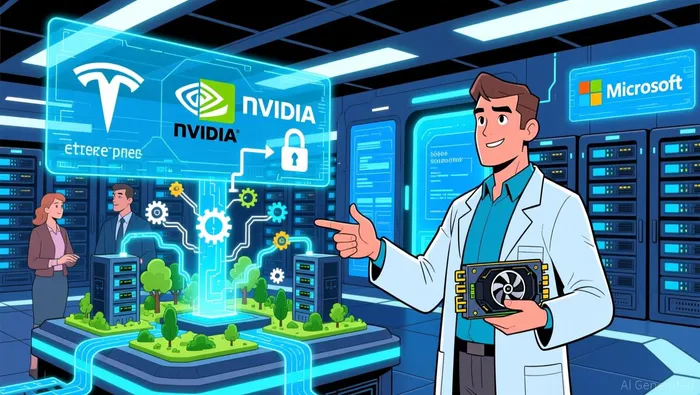
Collectively, these factors underpin the long-term investment thesis. NVIDIA's moat positions it to capture outsized value in the AI era, its financial results confirm the model's scalability, and partnerships like Meta's provide clear, multi-year demand signals. For value investors, this is the blueprint for a compounding business: a company with a robust, defensible moat generating substantial cash flows that can be reinvested to strengthen its position. The key question is whether the current price offers enough margin of safety for another decade of exponential growth.
Valuation and Margin of Safety: Is NVIDIA Still a 10x Opportunity?
The Baron Opportunity Fund's historical success was rooted in acquiring companies with strong moats at attractive prices. Investors today must determine if NVIDIA still fits this mold. Current figures suggest that expectations are already high. Wall Street analysts' price targets for 2026 range from $185 to $300, reflecting considerable uncertainty. Recent trading shows NVIDIA shares hovering around $188.52, remaining flat despite record-breaking revenue, which signals the market is factoring in execution risks rather than pure growth potential.
For value investors, margin of safety is determined by the relationship between price and the resilience of future cash flows. The main valuation risk is the transition from the Blackwell platform to the upcoming Vera Rubin architecture—a typical challenge in technology cycles. Any delays or increased competition could threaten the growth trajectory assumed in current valuations. The wide range of analyst targets highlights concerns about the sustainability of hyperscaler spending and the smoothness of platform transitions.
Ultimately, the period of easy gains may be over. Flat stock performance amid explosive revenue growth indicates the market is already pricing in known risks. For NVIDIA to embark on another 10x journey, it must successfully manage this transition and defend against rising competition. The Baron Opportunity Fund invested when NVIDIA was an emerging player; today's investors are buying into a company that has already delivered a 30x return. The margin of safety is now slimmer and depends on NVIDIA's ability to maintain and expand its competitive moat through the next wave of technological change.

Key Catalysts, Risks, and Considerations for Long-Term Investors
For those holding NVIDIA for the long haul, several critical factors will shape the future. The upcoming quarterly earnings report will reveal how 2026 spending plans are unfolding. As one analyst notes, NVIDIA's stock has remained flat this year, indicating the market is waiting for more clarity. The report will show whether major players like Amazon, Alphabet, and Meta are committing to multi-year orders for NVIDIA's hardware and will provide insight into the transition from Blackwell to Vera Rubin architecture—a pivotal technical milestone.
The biggest risk is a slowdown in capital spending by leading cloud providers. While their plans are ambitious, they remain projections. Any hesitation—whether due to economic challenges or shifting AI priorities—could directly impact NVIDIA's growth and profitability. This uncertainty is reflected in the broad range of Wall Street analyst price targets for 2026. NVIDIA's ability to sustain pricing power and volume growth depends on these customers following through with their infrastructure build-outs.
Looking further ahead, investors should monitor two key competitive dynamics. First, the strength of NVIDIA's software ecosystem, particularly CUDA, must be maintained through ongoing innovation to keep developers and enterprises engaged. Second, competition is intensifying—not only from AMD but also from custom silicon chips developed by hyperscalers, which pose a structural threat to NVIDIA's market share. The company's projected dominance relies on its ability to fend off these challenges and retain its estimated 90%+ share of the AI accelerator market.
- Watch for spending commitments and platform transition updates in the next earnings report.
- Monitor capital expenditure plans from major cloud providers for signs of sustained demand.
- Track the evolution of NVIDIA's software ecosystem and the competitive landscape over the coming years.
For value investors, these are the signals that will determine whether NVIDIA's current valuation still provides a margin of safety for the next phase of its compounding journey.
Disclaimer: The content of this article solely reflects the author's opinion and does not represent the platform in any capacity. This article is not intended to serve as a reference for making investment decisions.
You may also like
MSTR Drops 5.5% as Preferred Equity Rises and Bitcoin Acquisition Approach Changes

Equatorial Resources Drops More Than 4.6%: Unpacking the Reasons for a Sharp Decline in a Major Energy Company

Trending news
MoreCrypto prices
More





