
Nvidia’s transformation of AI factories sparks a $6.7 trillion surge in data center growth—Here’s why this marks the next industrial wave that investors are overlooking

Nvidia's Role in the AI Industrial Revolution
Nvidia stands at the forefront of a sweeping transformation powered by artificial intelligence. Far from being just a semiconductor manufacturer, the company is laying the groundwork for a new era in industry. CEO Jensen Huang describes this moment as the beginning of the largest infrastructure overhaul humanity has ever seen, driven by the surging demand for AI. This shift is not simply a technological update—it represents a fundamental redesign of the global economic landscape, encompassing data centers, chip production facilities, and what Huang refers to as "AI factories."
Unprecedented Scale of Investment
The magnitude of this expansion eclipses all previous industrial booms. Initial investments are expected to reach $700 billion, a sum greater than the combined GDPs of major brands like Disney, Nike, and Target, and surpassing the economies of countries such as Sweden, Israel, or Argentina. This is only the beginning; analysts predict that global spending on data centers could soar to $6.7 trillion by 2030, marking the start of a multi-trillion-dollar journey.
Transforming Labor and Productivity
This revolution extends far beyond technology. It demands a complete overhaul of workforce and productivity models. According to Huang, skilled trades—electricians, plumbers, pipefitters, steelworkers, network technicians, installers, and operators—are in high demand, with shortages already evident. The rise of AI is creating new opportunities in manufacturing and construction, blending digital innovation with physical labor. The shift is moving from an information-based economy to one driven by computational power, with foundational infrastructure being established today.
Exponential Growth: From Data Centers to AI Factories
The adoption of AI computing is accelerating at an unprecedented rate. The transition from training large models to deploying them for real-time inference is fueling this rapid growth. Currently, over 40% of Nvidia's revenue is generated from inference. Looking ahead, Huang projects that inference workloads will increase by a billion times, underscoring the scale of the next industrial revolution.
This transformation is not limited to expanding existing cloud infrastructure. It involves redefining the very nature of computing facilities. The concept of "AI factories" is emerging—specialized centers built specifically to run AI models continuously, integrating power, cooling, and networking from the ground up. This move from flexible cloud solutions to dedicated, high-performance industrial computing is what enables the explosive growth in inference demand.
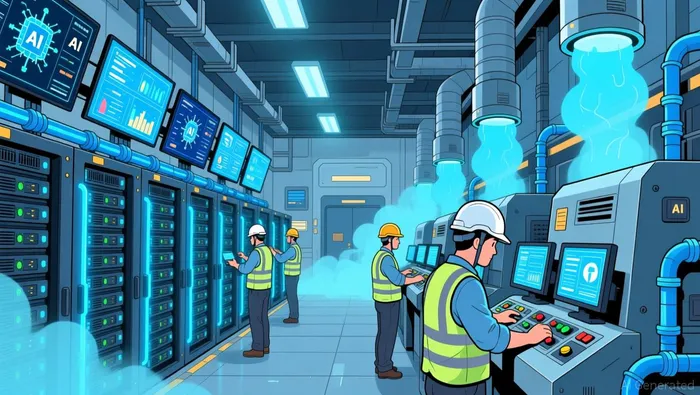
The financial commitment to this infrastructure spans decades. The initial $700 billion investment is just the starting point, with projections suggesting global data center spending could reach $6.7 trillion by 2030. For Nvidia, this represents a long-term growth curve, as the company provides the essential backbone for a new industrial ecosystem. The exponential adoption curve is only beginning its steep ascent.
Challenges in Execution: Navigating Rapid Expansion
While the growth story is compelling, it hinges on flawless execution. Nvidia operates under intense pressure, with CEO Jensen Huang describing the journey as "a million times harder than expected." This mindset, shaped by early near-failures, drives a culture of relentless effort and constant vigilance. Huang's philosophy of being "30 days from going out of business" fuels his work ethic, but also creates a high-stress environment where mistakes can have cascading consequences.
Geopolitical challenges further complicate Nvidia's expansion. Deals with countries like Saudi Arabia and the UAE involve navigating complex political landscapes and U.S. export controls. The recent ban on H20 chip sales to China highlights how regulatory changes can abruptly restrict access to entire markets. This forces Nvidia to produce different, often less advanced, chips for various regions, complicating supply chains and potentially weakening its technological advantage. Huang warns that U.S. chip policies could undermine America's leadership in technology and Nvidia's own position.
Infrastructure Buildout: A Marathon, Not a Sprint
The journey to build this new infrastructure is a long-term endeavor. The initial $700 billion investment is merely the opening phase. Success requires exceptional execution and the ability to navigate both internal pressures and external geopolitical risks. These challenges could slow the exponential growth curve, turning a billion-fold expansion into a more modest outcome. For now, Nvidia's operational intensity reflects the high stakes involved.
Key Signals and Risks: What Investors Should Watch
The thesis of exponential infrastructure growth is underway, but its progress depends on several critical indicators. Investors should focus on metrics that demonstrate sustained revenue growth and the emergence of new industrial applications.
- Inference Revenue Growth: Continued increases in inference revenue, which currently accounts for over 40% of Nvidia's earnings, will confirm the shift from model training to real-time AI operations. Huang has stated that inference workloads are poised for a billion-fold increase.
- Global Data Center Investment: Analyst forecasts of data center spending reaching $6.7 trillion by 2030 serve as a key indicator of the market's long-term trajectory. Any slowdown in this growth would signal a deceleration in AI adoption.
- Expansion of AI Factories: The spread of specialized AI infrastructure into industries like robotics, manufacturing, and transportation is a crucial catalyst. Nvidia's comprehensive approach, including software solutions like Dynamo, aims to secure these new customers and validate the paradigm shift.
- Geopolitical and Competitive Risks: Regulatory actions, such as the ban on H20 sales to China, and complex international deals can fragment the market and force Nvidia to adapt its products for different regions. These factors may slow global adoption and impact America's technological leadership.
Ultimately, the thesis is not just about Nvidia's stock performance, but about the pace and scale of the AI-driven industrial revolution. The main drivers are clear: inference revenue growth, the proliferation of AI factories, and global investment trends. The risks are equally apparent—geopolitical friction and the relentless execution needed to build the infrastructure for a billion-fold future. Monitoring these signals will distinguish genuine exponential growth from mere hype.
Disclaimer: The content of this article solely reflects the author's opinion and does not represent the platform in any capacity. This article is not intended to serve as a reference for making investment decisions.
You may also like


Ethereum Foundation’s 3,400 ETH Morpho Move Signals Strategy Shift
Forum Energy Stock Jumps 192.5% Over the Year: Should You Stay Invested or Cash Out?
Trending news
MoreCrypto prices
More





