
Oil’s Stagflation Jolt: How a 47% Jump in WTI Points to a Supply Crunch Opportunity

Stagflation Risks Intensify Amid Global Supply Shock
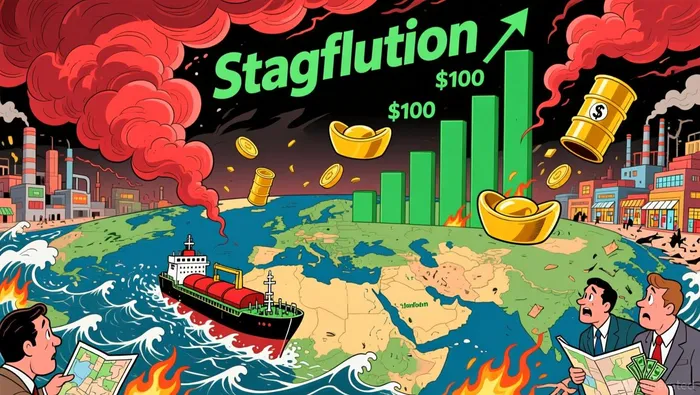
Global markets are currently grappling with a textbook case of stagflation, triggered by an unprecedented supply shock. The ongoing conflict in the Middle East has severely disrupted energy supplies, with attacks on shipping and infrastructure causing a sharp decline in traffic through the Strait of Hormuz. This is not merely a temporary price jump—it's a significant breakdown in the world's energy distribution system, with far-reaching consequences for the global economy.
The immediate effect on prices has been dramatic. Since hostilities began, WTI crude has climbed by over 47%. Last week, Brent crude futures finished above $100 per barrel for the second day in a row. Despite coordinated actions by the U.S. and its partners—including a record-setting IEA release of 400 million barrels and temporary shipping waivers—prices have continued their upward trajectory, signaling that the market expects the supply crunch to persist.
This situation has created a perilous feedback loop. Elevated energy costs are directly weighing on global growth by pushing up production and transportation expenses—a classic negative supply shock. Simultaneously, these higher costs are fueling inflation, raising the risk of a prolonged period of rising prices. The result is a stagflation scenario: markets are now factoring in persistent inflation alongside weakening economic momentum. This was evident in recent trading, as U.S. stocks broadly declined, with both the S&P 500 and Dow Jones dropping more than 1.6% as investors struggled to balance these opposing forces.
Geopolitical considerations add further complexity. While the conflict is pushing energy prices higher, the resulting economic strain could ultimately influence how long the disruption lasts. As some analysts point out, rising U.S. gasoline prices could increase political pressure, and the economic toll on Iran may limit its ability to maintain the blockade. While this could eventually lead to de-escalation, for now, the global economic cycle is being reshaped by this acute shock.
Safe Havens and Cyclical Assets: A Market Split
The current macro shock is causing a clear divide in asset performance, separating traditional safe havens from more cyclical investments. While equities have generally retreated, commodities and currencies have shown a marked shift toward perceived stability.
Energy commodities and gold have emerged as the main refuges. Even as most sectors declined, energy stocks rose 2.16% last week, propelled by surging oil prices. This is not a typical cyclical rally, but rather a defensive move into essential resources. The price action was particularly striking, with WTI crude jumping 22.8% in a single week, supporting energy equities even as the broader market sold off. Gold, though slightly lower, maintained its role as a store of value amid heightened risk aversion. This divergence underscores how the supply shock is redefining what investors consider "safe" assets.
Cyclical sectors suffered heavy losses. Financial stocks led the downturn, dropping 3.38% for the week and deepening their year-to-date decline to over 10%. This reflects mounting worries about credit quality and shrinking net interest margins as growth slows. Industrials and consumer discretionary sectors also fell sharply, as higher energy costs dampen capital investment and consumer spending.
Emerging markets, which had previously benefited from strong earnings, experienced a swift reversal. Asian economies reliant on Gulf oil imports saw their stock markets tumble. South Korea's Kospi index dropped nearly 6%, while Japan's Nikkei fell 5.2% in a single session. This sharp downturn highlights how the stagflation shock is hitting the most vulnerable economies first, erasing previous gains.
Amid the volatility, the U.S. dollar strengthened, and Bitcoin remained stable. The dollar's rise reflects a classic flight to safety, as investors seek the security of the world's reserve currency. Bitcoin, often viewed as a speculative asset, showed resilience by holding steady near a 1% gain. This suggests that even in risk-averse conditions, some investors are turning to alternative stores of value, though traditional safe havens like energy and the dollar remain dominant.
WTI Oil Price Snapshot

Policy Actions and Potential Price Trajectories
Market participants have made it clear that official interventions have not curbed the rise in energy prices. Despite the U.S. and its allies deploying significant measures—including a record IEA release of 400 million barrels and a 30-day waiver for India to purchase Russian oil—prices continue to climb. This indicates that traders view the supply disruption as both severe and enduring, beyond what current policy responses can quickly resolve. While these measures may have temporarily slowed the surge, they have not changed the underlying trend driven by the ongoing blockade of the Strait of Hormuz.
Goldman Sachs has outlined a scenario for how this shock might play out. According to their analysis, a two-month closure of the Strait of Hormuz could lift the fourth-quarter average Brent price from $71 to $93 per barrel. This would represent a substantial, though not permanent, premium. The bank also anticipates a gradual return to the low $70s later in the year, depending on how long the conflict lasts. This projection suggests a period of sustained high prices, followed by a slow normalization if tensions ease.
The historical comparison is striking. The initial shock has already quadrupled oil prices from pre-conflict levels, echoing the oil crisis of the 1970s. That period serves as a warning of how supply shocks can lead to persistent stagflation. Today’s market is reflecting similar risks, with the possibility that ongoing disruptions could embed higher energy costs into the global economy for an extended period.
In summary, while policy actions may have prevented an even sharper spike, they have not addressed the root cause. The future path for prices now depends on how the conflict unfolds. A rapid resolution could see prices fall back toward the low $70s by year-end, as Goldman predicts. However, a prolonged standoff would likely keep prices elevated, increasing the risk of entrenched inflation. For now, the macroeconomic outlook is being shaped by the supply shock, not by policy interventions.
Key Triggers and Ongoing Risks
The most immediate factor for markets is the political resolution of the Middle East conflict. The U.S. is preparing to form a coalition to escort ships through the Strait of Hormuz, which could help restore confidence. However, details are limited, and some reports suggest these efforts may not commence until active hostilities subside. This creates a tense timeline. As some analysts observe, Tehran appears determined to maintain its leverage, and officials expect the conflict could continue for weeks or longer. A drawn-out confrontation would keep energy supplies constrained and prices high, increasing inflationary pressures and slowing global growth.
Another pressing concern is the Federal Reserve’s response. Soaring oil prices complicate the central bank’s efforts to manage inflation, making a soft landing more difficult. As a result, markets have scaled back expectations for near-term rate cuts ahead of the upcoming FOMC meeting. The feedback loop is intensifying: higher oil prices drive inflation, which limits the Fed’s ability to loosen monetary policy, amplifying the economic drag from the supply shock. This was evident last week as Treasury yields climbed amid ongoing geopolitical uncertainty, reflecting a shift toward more hawkish expectations.
The resilience of global growth, especially in regions dependent on energy imports, will be crucial. The impact is not uniform—equity markets in Europe and Asia have underperformed the U.S. This divergence highlights regional vulnerabilities, as these economies rely heavily on Gulf energy imports, while the U.S. benefits from stronger domestic supply. Persistently high oil prices will test consumer spending and corporate profits in these regions, potentially leading to a sharper slowdown. Ultimately, the path forward for the global economy will depend on both the timeline for reopening the Strait of Hormuz and the policy responses to the stagflationary pressures now in play.
Disclaimer: The content of this article solely reflects the author's opinion and does not represent the platform in any capacity. This article is not intended to serve as a reference for making investment decisions.
You may also like
DLTH Breaks Out—But No News, Just Questions

Is Schwab Small-Cap Equity (SWSCX) Currently a Top Choice Among Mutual Funds?
Bank Rate remains at 3.75% - March 2026 Monetary Policy Overview and Meeting Minutes
Stablecoin Growth Threatens Bank Margins, Says Delphi Digital
Trending news
MoreCrypto prices
More





