
Rio Tinto Governance Crossroads: Shareholder Push to Revisit DLC Model Tests Board Credibility

The institutional agenda for Rio TintoRIO-2.36% is set. The company has announced that its 2026 Annual General Meetings for both Rio Tinto Limited and Rio Tinto plc will take place on May 6, 2026, with a nomination deadline of March 2, 2026. This marks the standard, concurrent gathering for its dual-listed structure. Yet, the timing frames a pivotal moment. The board has already undergone a significant, deliberate overhaul, completing a Board restructuring process effective from 23 October 2025 that downsized the body from a peak of 14 members to a more streamlined composition. This governance shift is not an isolated administrative change. It is a deliberate parallel to the operational consolidation announced in August 2025, where Rio Tinto restructured its business into three core units: Iron Ore, Copper, and Aluminium & Lithium.
The bottom line for institutional investors is a company in a state of controlled transformation. The board downsizing, which included the departure of key figures like Simon Henry and Martina Merz, was framed as concluding a transitional phase to achieve a more streamlined composition designed to enhance operational efficiency. This realignment aims to create sharper focus and accountability, mirroring the new business unit model. From a portfolio construction standpoint, this signals a move toward a more agile, capital-efficient operator with a clearer strategic narrative. The setup is one of operational continuity and governance discipline, with the new board composition intended to support the execution of that three-unit strategy. However, this very consolidation introduces a key governance risk on the horizon. The pending review of the dual-listed structure itself-a topic that will inevitably surface at these May meetings-represents a potential source of friction and uncertainty that could disrupt the otherwise smooth operational and governance trajectory.
The Catalyst: A Shareholder-Driven Review of the DLC Model
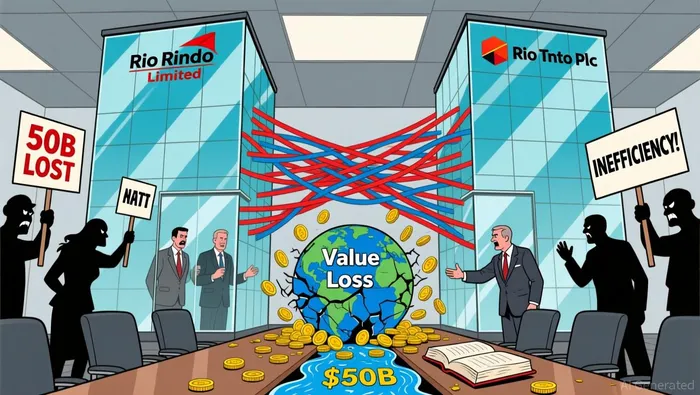
The institutional agenda just got more complex. A formal resolution to review Rio Tinto's dual-listed company (DLC) structure is now on the table, introduced by activist investor Palliser Capital and backed by over 100 other shareholders. This is not a theoretical debate. The proposal cites a stark potential value loss of about $50 billion due to the current setup, framing the DLC model as a persistent drag on shareholder returns. For portfolio managers, this introduces a direct challenge to the company's foundational governance, testing whether the operational efficiencies from the recent restructuring are being undermined by corporate structure.
The core of the resolution is a call for transparency and evaluation. It seeks to determine whether maintaining the dual-listed structure is preferable to unification, a move that would require the board to provide independent information to shareholders. This is a significant shift from the status quo. The activist's initial push, which questioned the rationale for the UK-listed entity's existence, highlighted several concrete inefficiencies: the London entity's inability to support dividends independently, its minimal UK-based employees, and its limited contribution to the group's EBITDA. These are not minor administrative quirks; they point to a structural capital allocation friction. Resources are being deployed to maintain a corporate layer that adds little operational value while incurring costs and creating a persistent trading discount.
For institutional investors, the upcoming AGMs on May 6 provide the first formal forum to gauge sentiment on this foundational model. The resolution's potential to pass would not immediately force a change but would compel the board to justify its position in detail. This creates a period of uncertainty that can affect risk-adjusted returns. Even the threat of a contentious vote can introduce volatility and distract management from execution. More broadly, a successful review could catalyze a structural simplification, potentially unlocking the estimated $50 billion in value and streamlining capital allocation. Yet, the process itself carries execution risk and could delay strategic initiatives.
The bottom line is that this resolution transforms a governance footnote into a central investment consideration. It forces a re-evaluation of the company's quality factor. A DLC structure, if deemed inefficient, represents a persistent quality discount. The board's ability to convincingly defend its rationale will be a key test of its strategic credibility in the eyes of the institutional community. For now, the debate introduces a material uncertainty that portfolio managers must weigh against the company's operational strengths.
Portfolio Construction Implications: Quality Factor vs. Governance Risk
Rio Tinto's institutional appeal rests on a classic quality factor profile. The company boasts a strong financial health score of "GOOD", underpinned by a 14-year consecutive dividend growth streak and a robust yield. This stability, combined with its operational scale and capital discipline, has traditionally made it a core holding for investors seeking reliable income and defensive exposure. The recent board streamlining was designed to reinforce this quality by sharpening strategic focus and accountability.
Yet, the pending governance review introduces a significant risk premium that challenges this narrative. The activist resolution, citing a potential $50 billion in lost value from the dual-listed structure, questions the efficiency of the very corporate model that supports Rio Tinto's global footprint. For portfolio managers, this creates a tension between a high-quality operator and a governance overhang. The risk is not just theoretical; it represents a persistent capital allocation friction. Resources are deployed to maintain a legal and administrative layer that adds little operational value, while the structure itself creates a trading discount and complicates investor access.
This dynamic directly impacts the risk-adjusted return calculus. A company with a strong quality factor should command a lower cost of capital, but the uncertainty around the DLC model could widen its risk premium relative to peers. Even if the review process is lengthy, the distraction and potential for a contentious vote can introduce volatility and divert management attention from execution. The bottom line is that the governance risk acts as a persistent quality discount, forcing investors to weigh the stability of the current model against the potential for a structural simplification that could unlock value.
From a portfolio construction standpoint, this sets up a classic "quality vs. value" dilemma. Rio Tinto remains a high-quality operator, but its governance structure may be preventing it from being a pure quality holding. Institutional investors must decide whether to overweight the company for its operational strengths and dividend reliability, accepting the governance risk as a known variable, or to underweight it pending a clearer resolution. The upcoming AGMs in May will be a key inflection point, providing the first formal test of board credibility and shareholder sentiment on this foundational issue.

Catalysts and Watchpoints: What to Monitor for Sector Rotation
For institutional investors, the path forward hinges on a few clear signals. The first and most immediate is the outcome of the Palliser Capital resolution at the May 6, 2026 Annual General Meetings. A clear vote in favor would validate the shareholder sentiment that the dual-listed structure is a material drag, forcing the board into a more transparent defense. This would be a strong signal to monitor for sector rotation, as it could catalyze a re-rating of the company's quality factor if a unification path is seen as likely. Conversely, a decisive defeat would bolster the board's credibility and support the current governance stability thesis, potentially reducing the risk premium.
Second, track institutional flow and volatility as a real-time gauge of market positioning. The stock has shown notable weakness, with a 5-day change of -5.6% and a 20-day change of -11.1%. This choppiness is a classic sign of investors repositioning amid uncertainty. A sustained break above key technical levels, like the recent low of $82.7, could signal a capitulation and a potential bottoming process. More importantly, monitor volume and volatility for signs of a concentrated flow-either outflow as investors seek clarity or inflow as the governance overhang is perceived to be priced in.
Finally, watch for any updates on the potential Glencore merger talks. While currently in early stages, such a deal would fundamentally reshape the strategic context. As portfolio managers noted, it introduces significant complexity and dilution risk, particularly around coal exposure. Any concrete development would force a reassessment of Rio Tinto's standalone growth narrative and its ability to manage a larger, more diversified entity. For now, the merger remains a speculative backdrop, but its potential to alter the capital allocation calculus makes it a watchpoint for any major portfolio rebalancing.
Disclaimer: The content of this article solely reflects the author's opinion and does not represent the platform in any capacity. This article is not intended to serve as a reference for making investment decisions.
You may also like
Netflix’s BTS livestream: A Crucial Trial for the Platform’s Ability to Scale Live Events

Tecogen (TGEN) Sees Expanding Losses but Hopes Data Center Opportunities Will Shift Market Outlook

Trending news
MoreCrypto prices
More





