
Skylark Labs Relies on iDEX Agreement Following Critical Carrier Deck Demonstration

Skylark Labs: From Demonstration to Deployment
Skylark Labs recently reached a pivotal moment by showcasing its fixed Foreign Object Debris (FOD) detection technology on the deck of an Indian Navy aircraft carrier, as part of the government-supported iDEX initiative. This demonstration follows an earlier successful test at an Indian Air Force base, proving the system's effectiveness in two of the most challenging aviation settings. Rather than a simple presentation, this event marked a critical step in a formal acquisition process aimed at transforming innovative solutions into operational assets.
Currently, the main consideration for investors is clear and immediate: the company's short-term prospects are tied directly to the timing of a follow-up contract. The demonstration has already confirmed the system's capability in a demanding, real-world scenario. The crucial next phase is securing a procurement order, moving beyond proof-of-concept. While the iDEX program offers a structured, government-backed pathway for this transition, it does not guarantee success. Skylark Labs must now navigate the complex integration and evaluation stages. For investors, the outcome is binary—a contract would validate the commercialization strategy, while any setbacks could challenge market confidence in the technology's scalability.
Technical Advantage: Addressing a Critical Safety Challenge
Skylark's solution stands out due to its technical sophistication. Unlike traditional camera systems, it utilizes an edge-based AI platform specifically engineered for the high-pressure environment of carrier decks. By processing information directly on the device, the system delivers ultra-fast detection and decision-making—an essential feature where every moment is crucial. Its real-time, on-device learning capability enables it to continuously adapt to environmental changes, such as shifting light or sea spray, effectively minimizing false alarms that often hinder automated systems. This practical innovation is vital for maintaining operational reliability and reducing fatigue among personnel.
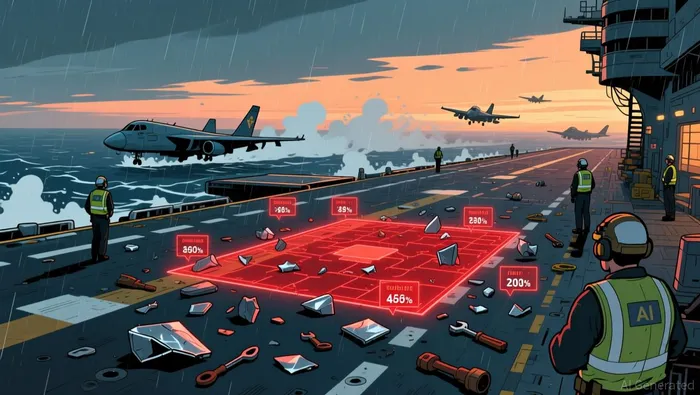
This level of precision directly addresses a significant and costly safety issue. Even small debris can lead to severe engine or tire damage, with the aviation industry spending billions each year on FOD-related incidents. Skylark’s technology aims to fill the gaps left by manual inspections, which are limited by human error and time constraints. Initial results from airbase trials indicate the system can cut FOD occurrences by up to 90%, significantly improving safety and operational readiness.
Within the broader market, Skylark targets a specialized segment. The global market for runway FOD detection is valued at $46.5 million and is expected to grow at a 7.1% annual rate through 2031. While the overall market is relatively small, the defense and naval aviation sectors demand high reliability and rapid response, making them especially valuable. Skylark’s edge-AI technology is positioned to deliver superior results in these mission-critical environments, with the recent carrier demonstration serving as the first real-world validation of its capabilities.
From Demonstration to Contract: What Comes Next
The immediate priority is converting the successful demonstration into a formal contract. The iDEX program provides the necessary structure, but Skylark must now prove its system can integrate seamlessly into naval operations and consistently deliver high performance under real-world conditions. Previous trials have confirmed the technology’s accuracy and speed, but the carrier deck presents an even more complex and dynamic challenge. The key test is whether the system can maintain its low-latency detection and adaptive learning in this demanding environment.
Securing the contract depends on successful operational integration. The iDEX initiative includes specific phases for embedding new technologies into existing workflows. Winning the deal would demonstrate that the Indian Navy views Skylark’s system as a reliable, deployable solution, not just a prototype. Such validation could open opportunities with other Indian defense programs and serve as a strong reference for entering the global military aviation market, where proven performance in challenging settings is highly valued.
At this stage, the company’s future hinges on the outcome of this transition. A contract award would confirm the viability of Skylark’s commercialization strategy and likely boost market confidence. Conversely, delays or setbacks would test investor patience for a technology that has yet to prove itself at scale. For now, all eyes are on Skylark’s ability to deliver on the promise demonstrated in its recent trial.
Disclaimer: The content of this article solely reflects the author's opinion and does not represent the platform in any capacity. This article is not intended to serve as a reference for making investment decisions.
You may also like
Gulf of Mexico Oil Spill Highlights Regulatory Challenges for U.S. Offshore Expansion Driver

MAA’s advanced valuation and sector rotation strategies introduce alpha risk as REITs begin to rebound

Fabrinet Drops 5.7% During Market Turbulence—Should Investors See This as a Chance to Buy or a Cautionary Sign?

Morgan Stanley Targets $160 Billion Demand with Bitcoin ETF Strategy
Trending news
MoreCrypto prices
More





