
Powell's Political Challenge: Can the Fed Remain Independent Amid Trump's Legal Push?

Powell vs. Volcker: A New Era for the Fed
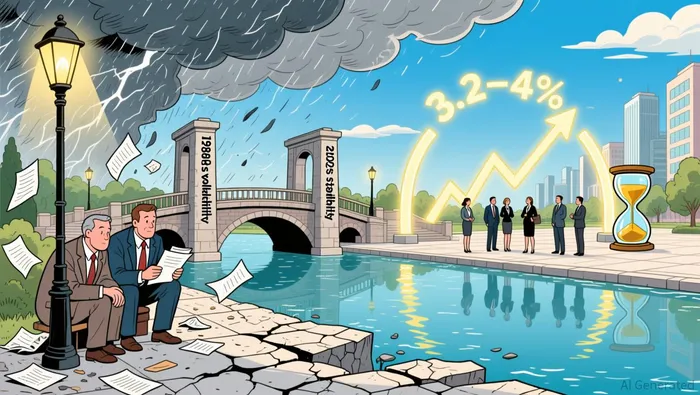
The challenge facing Jerome Powell today is fundamentally different from the one Paul Volcker confronted in the early 1980s. While both Federal Reserve chairs have grappled with the core mission of restoring price stability, the context and stakes have shifted. Volcker was forced to rein in an overheated economy, with inflation soaring above 10%—a crisis that demanded aggressive rate hikes and a recession by design. Powell, on the other hand, is navigating a landscape where the threat is not runaway inflation, but the preservation of the Fed’s autonomy amid mounting political pressure. Powell has praised Volcker’s resolve to withstand political interference—a quality he now must embody himself.
Shifts in market expectations around inflation highlight this transformation. In Volcker’s time, markets braced for the possibility of uncontrollable inflation. Today, expectations have moderated. Recent trading data shows a dramatic drop in bets on inflation exceeding 3.7% year-over-year; for instance, the likelihood of inflation above 3.8% has plunged from 35% to just 1%. Now, consensus centers around a more modest outcome—between 3.2% and 3.4% year-over-year for March 2026. While this is still above the Fed’s 2% target, it marks a clear departure from the extreme risks of the past.
This evolution underscores a shift in the Fed’s battleground. Volcker’s legacy was forged through the pain of recession, achieving price stability at a steep economic cost. Powell’s test is to protect the institution’s credibility and independence, all while avoiding a similar downturn. With ongoing Justice Department scrutiny and a stalled nomination process, Powell’s challenge is to maintain the Fed’s integrity in an era where moderate, predictable inflation is the new normal—and where the central bank’s independence is under the microscope.
The Core Economic Test: Is the Fight Worth Continuing?
Recent inflation data suggests the battle is far from over. The annual Consumer Price Index rose to 2.4% in February, a level not seen since May 2025. More importantly, the core inflation rate—which strips out volatile food and energy prices—remained steady at 2.5%. This persistent strength, even after a period of easing, indicates that underlying inflationary pressures are still above the Fed’s goal. The market’s recent shift away from extreme scenarios hasn’t changed the central bank’s cautious approach.
Strategy Spotlight: ATR Volatility Breakout (Long-Only)
- Entry: Buy when the 14-day Average True Range (ATR) exceeds its 60-day average and the closing price breaks above the 20-day high.
- Exit: Sell if the price falls below the 20-day low, after 20 trading days, or if a gain of 8% (take-profit) or a loss of 4% (stop-loss) is reached.
- Instrument: SPY (S&P 500 ETF)
- Risk Controls: Take-profit at 8%, stop-loss at 4%, maximum holding period of 20 days.
Backtest Results
- Strategy Return: 1.85%
- Annualized Return: 1.07%
- Maximum Drawdown: 5.5%
- Profit-Loss Ratio: 0.54
- Total Trades: 8
- Winning Trades: 5
- Losing Trades: 2
- Win Rate: 62.5%
- Average Holding Period: 17.12 days
- Max Consecutive Losses: 1
- Average Win: 1.38%
- Average Loss: 2.45%
- Best Single Trade: 2.88%
- Worst Single Trade: 3.3%
The Fed’s own forecasts reinforce this careful stance. In its latest Summary of Economic Projections for 2026, policymakers anticipate just one rate cut this year. This signals that, despite some improvement in headline inflation, officials remain wary of easing too soon. The decision to keep rates between 3.5% and 3.75% at the most recent meeting underscores their commitment to ensuring inflation is firmly under control before considering policy changes.
Geopolitical risks now pose the greatest immediate threat to this fragile progress. As Powell has acknowledged, the recent surge in oil prices—driven by conflict in the Middle East—has complicated the inflation outlook. A sustained energy shock could reignite inflation, forcing the Fed to choose between its price stability mandate and the risk of a deeper downturn. The central bank’s median forecast suggests it still sees value in staying the course, but the margin for error is slim.
The economic fundamentals are clear: inflation remains stubborn, and the Fed’s cautious approach is warranted. But the stakes now extend beyond economic data. The central bank is under direct political attack. Former President Trump has pursued Powell’s removal, and the administration has launched a Justice Department investigation into Powell’s comments about a building renovation—a move Powell has called a pretext for exerting political influence over the Fed.
This political maneuvering has real consequences. The investigation has stalled the nomination of Kevin Warsh as Powell’s successor. With a key Republican senator pledging to block any nominee until the probe concludes, the Senate Banking Committee is at a standstill. This delay is a strategic tool, potentially extending Powell’s influence beyond his official term, which ends May 15, and possibly keeping him on the Fed’s board until January 2028. The administration is effectively using legal tactics to freeze the Fed’s leadership, turning what could have been a routine transition into a prolonged standoff.
Markets are already shifting their focus from inflation risk to this new source of instability. The recent adjustment in inflation expectations to a 3.2%–3.4% range suggests a new baseline, but the real volatility may now come from political drama rather than economic surprises. When the Fed’s independence is in question, the credibility of its future decisions becomes the central concern for investors. This echoes past worries about the politicization of monetary policy, where the danger is not just bad data, but bad timing.
For investors, the takeaway is clear: in the near term, market movements may be driven more by political developments—subpoenas, Powell’s responses, committee votes—than by shifts in economic fundamentals. The Fed’s economic challenge is one of persistence; the political challenge is one of endurance. Powell’s current strategy is to hold firm, as he has for years. The market must now decide whether this resolve signals strength or simply a shift in the battleground.
Key Catalysts Ahead: What to Monitor
The next few weeks will reveal whether Powell’s stance can withstand mounting pressures. Three major catalysts will shape the outcome: a pivotal inflation report, a crucial political vote, and the risk of a geopolitical shock.
- April 10 CPI Release: The upcoming inflation data will be a critical test. It must confirm that inflation is continuing its gradual descent toward the 2% target. The market’s current expectation of a 3.2%–3.4% range for March sets the baseline, but any major deviation could force the Fed to reconsider its policy path. The central bank’s plan for just one rate cut this year depends on this progress.
- Senate Banking Committee and Warsh’s Nomination: The committee’s handling of Kevin Warsh’s nomination will reveal the staying power of political pressure. With Senator Thom Tillis vowing to block any nominee until the Justice Department investigation ends, the process is frozen. A vote to advance Warsh would indicate a break in the administration’s strategy; continued inaction would confirm its effectiveness.
- Oil Prices and Geopolitical Risks: Watch for further volatility in oil markets, especially given the recent surge tied to Middle East tensions. A prolonged energy shock could reignite inflation, forcing the Fed to choose between its inflation mandate and the risk of recession. Such an event could prompt a policy shift and test the Fed’s resolve.
In summary, Powell’s leadership is being tested on multiple fronts. The market will be watching closely for signs that the inflation fight is making progress, for shifts in the political landscape, and for any external shocks that could alter the central bank’s course.
Disclaimer: The content of this article solely reflects the author's opinion and does not represent the platform in any capacity. This article is not intended to serve as a reference for making investment decisions.
You may also like
ONE Gas: Analysts Believe There’s Potential for Gains as Profit Outlook Depends on May Forecast


CenterPoint’s High Valuation Depends on Perfectly Delivering Its $44 Billion Infrastructure Expansion

FFIN Surpasses Earnings Expectations and Offers 2.6% Yield Amid Market Turmoil Driven by Sector Anxiety

Trending news
MoreCrypto prices
More





