
Garret Jinn Issues Debt Alert: Markets Overlook $39 Trillion Fiscal Crisis Looming

Garret Jinn’s Strategic Bet: Anticipating the Unseen
On October 10, 2025, Garret Jinn executed a textbook move that capitalized on a disconnect between market expectations and looming reality. Just before a significant geopolitical event unfolded, this major crypto investor initiated a substantial short position on Bitcoin through Hyperliquid. Sensing a risk that the broader market had yet to recognize, he wagered on a threat that was only whispered about in select circles. Roughly an hour ahead of President Trump’s announcement of sweeping tariffs on China—a decision that sent shockwaves through financial markets—Jinn opened a $735 million BTC short. As Bitcoin’s value plummeted from over $120,000 to nearly $102,000, Jinn’s foresight was rewarded with more than $142 million in realized profits.
This was no mere stroke of luck. Market observers have traced a pattern in Jinn’s trades, linking him to other high-profile positions that anticipated White House decisions, such as a long bet on a Polymarket contract regarding a potential pardon for Binance’s CZ. The timing and nature of these trades suggest Jinn consistently positions himself ahead of major catalysts, exploiting the lag between emerging risks and the market’s response. In effect, he acts on rumors and exits before the news becomes widespread.
Now, Jinn is raising alarms about a much broader threat: the mounting U.S. national debt. He sees echoes of his previous strategies, identifying a systemic risk—soaring government borrowing—that the market seems to be downplaying as a distant concern. This creates a new expectation gap: while consensus remains calm, Jinn believes the market is underestimating the immediate dangers that ballooning debt could pose to interest rates, inflation, and overall financial stability. His track record suggests he’s prepared to make bold moves when he detects a disconnect between market complacency and underlying risk. His current attention to U.S. debt signals he believes another major mispricing is unfolding on a global scale.
America’s Debt Surge: A Looming Crisis
The U.S. national debt has soared past an unprecedented $39 trillion, a level not seen since the aftermath of World War II—and it’s accelerating at a startling rate. In just five months, the debt jumped from $38 trillion to $39 trillion. As Michael Peterson of the Peter G. Peterson Foundation remarked, borrowing trillions at this pace without a plan is fundamentally unsustainable.
The real issue isn’t just the current debt load, but where it’s headed. The Congressional Budget Office forecasts that annual deficits will swell from $1.9 trillion this year to $3.1 trillion within a decade. By 2036, the national debt could reach $63 trillion, with public debt equaling 120% of GDP. Economists warn that this trajectory will stifle economic growth, crowd out private investment, and drive up borrowing costs for everyone.
Despite these alarming numbers, markets remain largely unshaken. The prevailing attitude treats the debt as a manageable, long-term issue, not an immediate threat. This is the very expectation gap Jinn is targeting. While Wall Street analyst Ed Yardeni recently increased the odds of a U.S. stock market crash to 35%, this view remains in the minority. The warning signs are growing louder, but the market has yet to fully price in the risks posed by record debt levels.
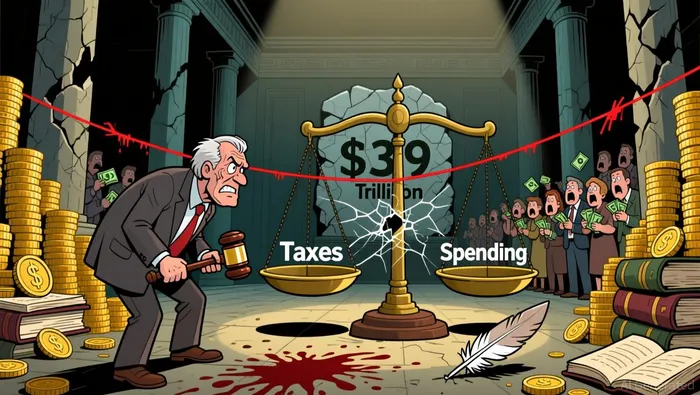
The Calm Before the Storm: Expectation Gap in Focus
Today’s market tranquility is perhaps the clearest indication that the dangers of America’s debt explosion are not yet reflected in asset prices. Even as the debt surpasses $39 trillion and the CBO projects deficits reaching $3.1 trillion annually within a decade, most investors remain confident that risks are under control. This sets the stage for a classic “sell the news” scenario that has yet to materialize. The consensus continues to treat fiscal challenges as a distant problem, not an imminent catalyst for market upheaval.
The greatest vulnerability lies in a sudden shift in guidance. Markets have not yet come to terms with the reality that this unsustainable path will eventually force policymakers to act. Whether it’s the Federal Reserve facing a tough choice between inflation and unemployment, or Congress being compelled to adopt austerity measures, the realization that debt will drive tighter monetary or fiscal policy could spark a widespread reassessment of risk. This is the very disconnect Jinn is wagering against—a gap between acknowledged fiscal dangers and the market’s current sense of stability.
Potential Catalysts for Market Turmoil
Sentiment could shift rapidly if a catalyst emerges. Ed Yardeni’s recent warning, raising the likelihood of a market crash to 35%, highlights the risk of geopolitical shocks—particularly escalating tensions in the Middle East, which could send oil prices soaring and put the Federal Reserve in a policy bind. This scenario closely mirrors Jinn’s previous strategy: just as a geopolitical event triggered the crypto crash in October 2025, a similar external shock could force markets to confront the debt crisis they’ve been ignoring. The current calm suggests investors are not prepared for such a destabilizing event.

Conclusion: When Calm Masks Crisis
In summary, markets are currently betting on continued fiscal stability, even as the pace of debt accumulation accelerates. Garret Jinn’s bold short on Bitcoin ahead of the October crash demonstrated how quickly fortunes can change when the expectation gap closes. His present focus on U.S. debt signals he sees a similar, even larger, mispricing at play. The prevailing calm is a warning in itself; when a catalyst finally emerges, the market’s outlook could be dramatically and abruptly reset.
Disclaimer: The content of this article solely reflects the author's opinion and does not represent the platform in any capacity. This article is not intended to serve as a reference for making investment decisions.
You may also like
Pennant’s Guidance Reset: Integration Concerns Reflected, Performance May Prompt Revaluation


Hawaiian Electric’s Wildfire Liability Approaches Settlement as Agreement Gains Approval

SCI’s Aggressive Acquisition Approach May Lead to a Valuation Shift If Debt Is Handled Wisely

Trending news
MoreCrypto prices
More





