
U.S. Electric Vehicle Shares Confront $65 Billion Profit Gap While International Leaders Rise

U.S. Electric Vehicle Market Faces Major Shakeup
The American electric vehicle (EV) sector is undergoing a dramatic transformation. Billions in investments are vanishing as profits remain elusive. The turning point? When the federal tax credit ended, consumer interest plummeted, causing sales to nosedive and forcing automakers to absorb enormous losses.
The statistics paint a grim picture. According to recent reports, EVs accounted for 12% of U.S. auto sales in September, but that figure dropped to just 6% by January. This isn’t a gradual decline—it’s a sharp downturn, with sales falling 20% in January alone. Experts now predict that 2026 will see no growth in the U.S. EV market.
The financial consequences are already being felt. Established automakers are bearing the brunt: Ford and General Motors have reported $19.5 billion and $6 billion in EV-related losses, respectively. These aren’t just accounting adjustments—they represent the closure of plants and the abandonment of new technologies and models once seen as the industry’s future. The message from Detroit is unmistakable: America’s EV ambitions are on pause.
In summary, while the U.S. retreats, global competitors are moving ahead. For businesses dependent on the American market, the road ahead has become much more challenging.
Global Momentum vs. U.S. Setback
While the U.S. EV industry falters, international markets are gaining speed. This isn’t just a divergence—it’s a clear split between risk and opportunity.
Domestically, automakers are shifting gears. The 2026 Detroit Auto Show highlighted this retreat, with electric vehicles taking a back seat to hybrids and gasoline models. This pivot is a direct response to the massive write-downs recently announced by Ford and GM.
Meanwhile, the global EV market is thriving. China, for example, exported 2.65 million EVs in 2025—double the previous year—making BYD the world’s top EV manufacturer. In countries like Vietnam and Indonesia, electric vehicles now represent a larger share of new car sales than in the U.S.
Industry-wide, losses and write-downs have reached at least $65 billion. Over $330 billion in planned investments for EVs and batteries from 2021 to 2024 are now being reversed. The U.S. is shouldering most of this burden, while other nations continue to invest and expand.
The takeaway? The financial crisis is largely confined to the U.S. For investors, this means a critical decision: steer clear of the shrinking American market or seek opportunities among global leaders. The risks are significant, but so are the potential rewards.
The Profit Blackhole: Tracing the Losses
The core issue is clear: billions aren’t just disappearing—they’re being funneled into a “profit blackhole” through massive write-downs and shuttered factories.
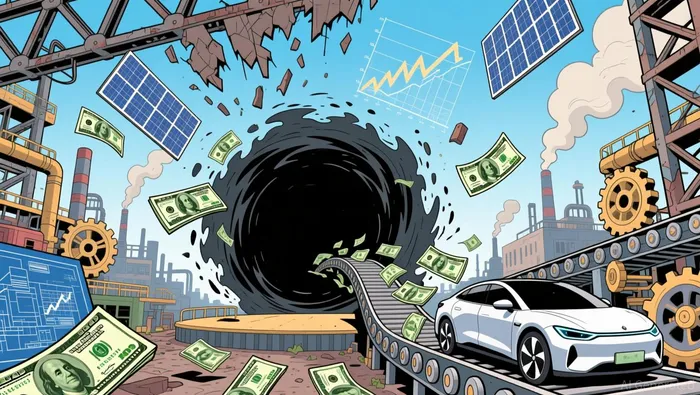
This blackhole is real, with at least $65 billion in industry losses as companies abandon multi-billion dollar projects. This is not a minor adjustment—it’s the unwinding of years of hype and investment. The collapse began when the federal tax credit ended, causing demand to evaporate almost instantly.
Companies most at risk are those heavily invested in the U.S. market. For instance, Rivian is making a substantial bet on its R2 model, but with U.S. demand down 20%, its $18.5 billion market cap is under threat. The stakes are enormous.
The battery sector is also shifting strategy. Factories originally built for EV production are now being repurposed for grid storage as expectations for EV demand are revised downward. This is a calculated move to recover sunk costs, but the transition is a race against time.


Ultimately, this blackhole is a uniquely American phenomenon. The losses are concentrated in write-downs, delayed production, and a difficult shift in strategy. For investors, the warning is clear: the greatest risks lie with companies deeply tied to the U.S. market and aggressive expansion plans. The real growth stories are emerging elsewhere.
Key Signals and What to Watch Next
While the profit blackhole is undeniable, there are still opportunities for those who pay attention to the right signals. The market has reset, and future trends will be shaped by policy changes, international exports, and a shift toward energy storage. Here’s what to keep an eye on:
-
Policy Shifts: The Immediate Wildcard
The U.S. EV market is struggling due to reduced government incentives. The expiration of the federal tax credit triggered the current crisis. Any new legislation to restore these incentives could quickly revive demand and boost related stocks. For now, policy remains the most influential factor.
-
China’s Export Surge: The Global Powerhouse
As the U.S. market stagnates, China’s EV exports are booming. In 2025, exports doubled, led by companies like BYD. The crucial question is whether Chinese manufacturers can sustain this momentum despite weaker U.S. demand. Any slowdown in Chinese exports would signal trouble for the global EV industry.
-
Battery Storage: The Contrarian Opportunity
The battery industry is rapidly pivoting from EVs to grid storage. This strategic shift could become a new growth driver. While it won’t immediately offset EV losses, it’s attracting significant investment. Companies that successfully transition to storage solutions before the market becomes saturated are likely to emerge as winners.
In conclusion: The landscape has changed. Monitor policy developments, track Chinese export trends, and watch the evolution of battery storage. Success will come to those who adapt to this new reality, rather than those holding onto outdated expectations for the U.S. EV market.
Disclaimer: The content of this article solely reflects the author's opinion and does not represent the platform in any capacity. This article is not intended to serve as a reference for making investment decisions.
You may also like
TotalEnergies’ Safety Buffer Diminishes as Market Trends Undermine Commodity Strength


What Will Become of Your Investments If the Stock Market Takes a Nosedive?

Solana Flashing Mixed Signals: $105 Breakout Or Double-Pair Collapse Ahead?

Trending news
MoreCrypto prices
More





