
Sun Communities (SUI): UK and RV Challenges Present Opportunity for Share Repurchases and Enhanced Margin of Safety

Sun Communities: A Durable Business Model with High Barriers to Entry
Sun Communities stands out as a company with resilient business fundamentals that appeal to value-focused investors. The firm manages an extensive and specialized portfolio, making it difficult for new entrants to compete. With ownership and operation of roughly 669 properties throughout North America and the UK, Sun is a dominant force among REITs specializing in manufactured housing and RV resorts. This impressive scale is more than just a statistic—it reflects a capital-heavy industry where acquiring land, developing communities, and building the infrastructure to oversee thousands of sites present significant challenges for potential competitors.
The company’s real strength lies in the consistency of its cash flows. Sun’s primary income is derived from site rentals and amenities, producing steady, recurring revenue. This reliability is reinforced by outstanding occupancy rates; by the close of 2025, North American blended occupancy surpassed 99%. Such consistently high occupancy is a hallmark of a business with a substantial competitive moat, reflecting robust demand and limited new supply. This dependable income stream allows for reinvestment and shareholder returns.
Sun’s leadership has recently enhanced its competitive edge by strategically refocusing its portfolio. In the second quarter of 2025, the company divested its Safe Harbor Marinas assets for $5.25 billion, signaling a renewed emphasis on its core manufactured housing and RV communities. By shedding non-core operations, Sun is doubling down on areas where it has the greatest expertise and competitive advantage. This sharpened focus is delivering results, as shown by the 8.9% same-property NOI growth in the manufactured housing segment for 2025. For long-term investors, Sun exemplifies the power of compounding: a wide moat, reliable earnings, and a management team committed to its strengths.
Financial Strength and Shareholder Returns
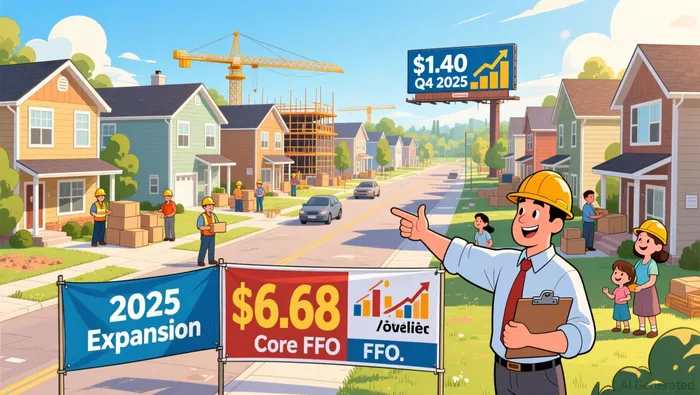
Sun’s robust business model is matched by the quality of its financial performance. The company consistently generates strong, predictable cash flows—an essential trait for value investors. In 2025, Sun reported core FFO per share of $6.68, surpassing its own guidance. The fourth quarter was particularly strong, with core FFO per share at $1.40, again exceeding expectations. This steady outperformance, including a 7.9% increase in North American same-property NOI in Q4, highlights Sun’s pricing power and operational efficiency. The company’s ability to adjust rents and manage costs in a market with limited new supply further underscores its competitive moat.
Shareholders have directly benefited from this financial strength. In 2025, Sun returned over $1.5 billion to investors through dividends and a substantial share repurchase program, buying back 4.3 million shares. This reduction in share count boosts earnings per share for remaining investors. Sun’s disciplined approach to capital allocation—returning capital when shares are undervalued and reinvesting when it adds value—demonstrates management’s commitment to shareholder value and confidence in the company’s prospects.
The company’s financial foundation is solid. Sun ended 2025 with a net debt to EBITDA ratio of 3.4x, a prudent level for a REIT of its size. With $636 million in cash on hand, Sun has ample liquidity to pursue acquisitions, fund capital expenditures, and continue share buybacks without depending on unpredictable capital markets. This combination of strong earnings, a history of returning capital, and a robust balance sheet provides a significant margin of safety for long-term investors, ensuring the company can withstand market cycles and continue to grow shareholder value.
Valuation: Assessing Intrinsic Value and Margin of Safety
Sun’s latest guidance offers a clear framework for estimating intrinsic value. Management projects 2026 core FFO per share between $6.83 and $7.03, with a midpoint of $6.93. For the core North American portfolio, same-property NOI growth is expected to moderate to about 4.5% at the midpoint, reflecting a natural slowdown as the business matures.
Valuing these future cash flows requires discipline. Applying a straightforward 15x multiple to the midpoint FFO estimate suggests a fair value near $104, but this likely undervalues Sun’s quality. A more appropriate range for a stable, high-quality REIT might be 18x to 20x. Using a 19x multiple, the fair value estimate rises to approximately $131.70. However, the market’s view is also important. Currently, Sun trades at $130.44, about 9.94% below the latest analyst target of $143.41. Some analysts see an even larger discount to intrinsic value, estimating a 39.09% gap to a $143 fair value. This difference suggests the market is both optimistic about Sun’s long-term prospects and cautious about near-term execution risks.

The main sources of risk stem from Sun’s international and diversified operations. While North America is expected to grow steadily at 4.5%, the UK segment’s same-property NOI is forecast to increase by only 2.2%. The RV segment, meanwhile, saw a 1.4% decline in 2025. These challenges are significant: the UK faces economic headwinds, and the RV market is more competitive and less stable. For value investors, the margin of safety depends on how much the current market price reflects these risks versus the strength of Sun’s core manufactured housing business.
In summary, Sun offers a compelling value opportunity with a clear margin of safety, but it demands patience. The stock trades below a fair value estimate that assumes a premium multiple, compensating investors for uncertainties in the UK and RV segments and slower North American growth. For disciplined investors, Sun’s wide moat and strong balance sheet provide a solid foundation. The margin of safety lies in the difference between the current price and a conservative intrinsic value estimate that considers all aspects of the business. Investors must weigh the quality of Sun’s core operations against the risks in its peripheral segments.
Key Catalysts, Risks, and What Investors Should Monitor
The next one to two years will be crucial for confirming Sun’s investment thesis. The company’s ability to achieve its 2026 targets while managing operational challenges will be closely watched. The main catalyst is the trajectory of North American same-property NOI growth, which is expected to average around 4.5%. This is a slowdown from the exceptional 7.9% growth in late 2025, reflecting the company’s larger base. Investors will be keen to see if Sun can maintain its pricing power and cost discipline during this transition; any significant shortfall could call the strength of its competitive moat into question.
The UK segment is another area to watch, as it faces ongoing economic pressures. Management has highlighted challenges such as rising minimum wages, which contributed to a decline in same-property NOI in the fourth quarter. With 2026 guidance for the UK at a modest 2.2% midpoint, investors should monitor whether operating costs, especially payroll, continue to outpace revenue growth. The broader UK housing market is also under pressure, with home sales down 4.9% from 2024 highs, adding further uncertainty to the outlook.
On the capital return side, two factors are particularly important. First, the pace of share repurchases: Sun returned over $1.5 billion to shareholders in 2025, supported by a strong balance sheet with $636 million in cash and an undrawn $2 billion credit facility. The sustainability of this buyback program depends on continued cash flow generation and management’s view of the stock’s value. Second, the dividend yield of 3.25% is a key attraction, with the next ex-dividend date on March 31, 2026. The Board’s recent 8% dividend increase signals confidence, but investors should watch for any signs of strain on this payout.
The main risks are concentrated in Sun’s non-core segments. Rising costs in the UK, particularly from wage increases, could widen the gap between guidance and actual results. The RV segment remains a weak spot, with a 1.4% NOI decline in 2025 and only 0.9% growth projected for 2026; further deterioration would impact overall performance. Broader interest rate changes could also introduce volatility, affecting both Sun and its residents. For value investors, the margin of safety is dynamic and will be tested by these operational and market factors in the coming year.
Disclaimer: The content of this article solely reflects the author's opinion and does not represent the platform in any capacity. This article is not intended to serve as a reference for making investment decisions.
You may also like
Bitcoin’s Support Level Compared to Pepeto’s Presale: A Comparison of Flow Patterns


FUEL fluctuated by 41.3% in 24 hours: trading volume surged by 61.42% with no clear catalyst
HOOK (HOOK) 24-hour volatility at 43.7%: Rebound follows panic sell-off triggered by Binance delisting announcement
Trending news
MoreCrypto prices
More





