
BellRing Brands (BRBR) Could Be Significantly Undervalued Due to Inventory Adjustments, Not a Compromised Competitive Advantage

Assessing BellRing Brands: Is the Core Value Intact?
For value investors, the essential question is whether BellRing Brands’ underlying worth has suffered lasting damage. Recent securities litigation highlights a severe inventory correction, but the real issue is whether the company’s competitive edge has been fundamentally compromised—or if this is simply a sharp, but temporary, supply chain misstep. The evidence suggests the market may have mistaken a supply-driven inventory surge for genuine consumer demand.
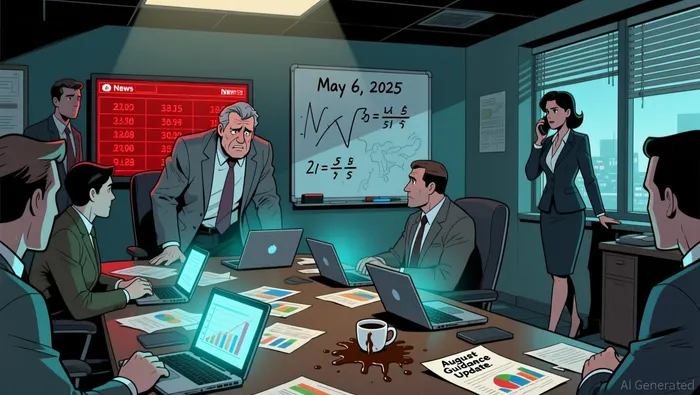
During the class period from November 2024 to August 2025, management attributed growth to “organic demand” and “distribution gains.” However, this narrative was undermined by a May 2025 disclosure revealing that retailers had been stockpiling inventory to avoid empty shelves, not responding to surging consumer interest. This inventory build-up was a defensive move, not a sign of robust end-user demand.
The market’s response was immediate and severe. Following the May 6 announcement, BellRing’s shares dropped 19%. The decline accelerated in August, with another 32.6% fall after the company confirmed the inventory correction and acknowledged rising competition. Over the past 120 days, shares have lost more than 53% of their value, and are down 74% over the past year, now trading near their lowest point in 52 weeks. This is not a typical correction—it’s a dramatic collapse of the company’s growth narrative.
From a value standpoint, the crucial issue is whether this inventory correction has permanently weakened BellRing’s competitive “moat.” The lawsuit claims management misrepresented the source of sales, and the stock’s steep decline suggests investors are now skeptical about the company’s long-term advantages. With the forward price-to-earnings ratio just above 9 and price-to-sales below 0.9, the market is deeply discounting future growth prospects. The investment case now depends on BellRing’s ability to navigate this inventory reset without losing market share, and whether its brands and product complexity can reignite consumer demand once retailer inventories normalize.
Business Fundamentals: Navigating the Destocking Cycle
The Q1 2026 results marked a sharp reversal from the previous year’s momentum, confirming investor concerns about the destocking process. Net sales for the quarter reached $537.3 million, up just 0.8% year-over-year, reflecting a business under pressure. More concerning was the steep drop in profitability: net income fell 43% to $43.7 million, and gross margin contracted from 37.5% to 29.9%. This margin squeeze was driven by rising input costs—including tariffs and unfavorable product mix—and the absence of $5 million in one-time cost benefits from the prior year. The company’s ability to pass on costs is clearly being tested in a more competitive environment.
Despite these challenges, BellRing demonstrated a key strength: it generated $97 million in operating cash flow during the quarter. This strong cash generation, even in a downturn, underscores the resilience of its business model. Management used this cash to repurchase about 2.5% of outstanding shares, a disciplined move that directly benefits shareholders. The company’s ability to maintain robust cash flow while managing through an inventory correction is a critical indicator of financial strength and management’s commitment to shareholder value.
Looking ahead, the company faces ongoing headwinds. Management has tightened its fiscal 2026 outlook, lowering both net sales and Adjusted EBITDA guidance. The new forecast calls for $2.41–$2.46 billion in net sales and $425–$440 million in Adjusted EBITDA, reflecting a tougher environment due to more frequent promotions and higher whey protein costs. This signals that the inventory correction will be a multi-quarter process, continuing to pressure both revenue and margins.
From a value lens, the main question is whether BellRing’s cash-generating capacity can withstand this cycle. The business is clearly challenged, but not broken. Management’s focus on brand investment and innovation—especially in high-growth lines like Dymatize and Premier RTD—suggests confidence that demand will recover as inventories normalize. The company’s ongoing share buybacks at depressed valuations are a positive sign for long-term investors, assuming the competitive moat remains intact.
Valuation: Is There a Margin of Safety?
For value investors, the margin of safety—the difference between intrinsic value and market price—is paramount. In BellRing’s case, this gap appears wide, but uncertainty clouds the outlook. Independent discounted cash flow analyses estimate intrinsic value between $42.82 and $82.59 per share, depending on growth and risk assumptions. With shares trading around $17.22, the discount is significant—about 60% below the low end of the valuation range.
This deep undervaluation suggests the market is pricing in a permanent setback, possibly conflating a temporary inventory cycle with a lasting erosion of competitive advantage. However, the margin of safety is not absolute—it depends on the risks an investor is willing to accept. The class action lawsuit raises doubts about the sustainability of BellRing’s growth, alleging that recent sales were driven by retailer stockpiling rather than true brand strength. If this is accurate, the company’s competitive position may be weaker than previously believed, and the path to normalized sales could be longer and more difficult.
Ultimately, the question for investors is whether the current price adequately compensates for these risks. The discount is substantial, but not limitless. Intrinsic value estimates assume a return to growth, which depends on BellRing’s ability to manage the inventory correction without losing market share. The company’s strong cash flow and ongoing buybacks are encouraging, but the real test will be whether the business can defend its moat and restore profitability.
In summary, while the margin of safety is considerable, uncertainty remains. The low share price offers a buffer against cyclical risks, but does not resolve questions about long-term durability. For patient investors, the opportunity is compelling, but the outcome hinges on how quickly the destocking cycle ends and whether the brands can regain momentum. The value is there—but it depends on your perspective.

Key Catalysts and Risks Ahead
The investment case now depends on several clear milestones. The most important catalyst for a recovery in valuation is the normalization of retailer inventories and a return to real consumer-driven sales growth. This will be evident if the company can deliver sequential sales increases, moving beyond the current stagnation. Management’s guidance for $2.41–$2.46 billion in net sales for the year assumes this process will unfold. If BellRing’s leading brands, such as Dymatize and Premier RTD, can regain shelf momentum as inventories stabilize, the market may begin to reassess the company’s competitive position.
However, a major risk is the ongoing securities class action, which alleges that BellRing misrepresented the drivers of its 2025 growth. The lead plaintiff motion is due by March 23, 2026. If the lawsuit is successful, the financial and reputational impact could be significant. More broadly, the allegations challenge the foundation of BellRing’s growth story, suggesting its competitive moat may have been overstated. This legal overhang adds another layer of risk that must be weighed against the stock’s deep discount.
For investors, the next few quarterly results are critical. Key metrics to monitor include stabilization in net sales and the company’s ability to maintain Adjusted EBITDA margins. The Q1 report showed a sharp drop in gross margin to 29.9%, partly due to rising input costs. BellRing’s ability to manage these pressures and protect profitability as it works through the destocking will be a crucial test of operational discipline. The updated Adjusted EBITDA target of $425–$440 million for fiscal 2026 provides a benchmark for performance.
In conclusion, BellRing’s future is at a crossroads. A successful inventory normalization and resolution of legal uncertainties could unlock significant value. Conversely, prolonged competitive pressures or a negative legal outcome could confirm fears about the company’s competitive position. Investors must closely track these catalysts and risks, as the coming quarters will reveal whether this is a temporary setback or a lasting impairment.
Disclaimer: The content of this article solely reflects the author's opinion and does not represent the platform in any capacity. This article is not intended to serve as a reference for making investment decisions.
You may also like
Why Shares of Arm Holdings Surged This Week

Gold and Silver Prices Drop: Inflation Surprise Outweighs Safe-Haven Appeal
Lufax Approaches April 30 Cutoff: Will It Escape Delisting in the Midst of Legal and Financial Turmoil?
Trending news
MoreCrypto prices
More





