
Uber Bets Everything on the Autonomy S-Curve — Can It Be the Self-Driving World’s Operating System?

The Uber-Rivian deal is a classic infrastructure play on the autonomy S-curve. It's a bet that the exponential growth of self-driving mobility will be captured not by the vehicle builders, but by the platforms that connect them to riders. UberUBER-- is making a decisive pivot, transforming from a company that operates vehicles to one that provides the foundational rails for the entire industry. Instead of building the "rocket," Uber is supplying the "fuel and launchpad," as it monetizes its decade of operational expertise.
This shift is strategic. By launching its Uber Autonomous Solutions division, the company is offering a turnkey platform for third-party autonomous vehicles. Partners get access to Uber's demand generation, rider experience, and fleet management-everything except the self-driving software itself. The RivianRIVN-- deal is a major commitment to this model, with Uber pledging to deploy up to 50,000 fully autonomous R2 vehicles on its platform by 2031. That's a massive scale-up from current pilots and a direct bet on the commercial deployment phase that is just beginning in 2026.
For Rivian, the partnership provides a crucial, large-scale commercial path for its integrated vehicle and software stack. The deal gives the EV maker a dedicated fleet for its robotaxi ambitions, backed by a well-capitalized partner. In return, Uber secures a steady supply of vehicles while cementing its role as the distribution layer for autonomous rides. As one analyst noted, Uber is positioning itself as a piece of modern technological infrastructure, agnostic to which autonomy stack wins. Whichever technology matures first, passengers will likely hail it through Uber's network.
Uber Autonomous Solutions is a significant move.
The setup is clear. Both companies are betting on the adoption rate of autonomous mobility accelerating from a niche test phase to widespread commercial use. Uber is building the platform to capture that growth, while Rivian provides the vehicle hardware and software stack. The real question now is execution: can they deliver on the 2028 launch timeline and navigate the regulatory and technological hurdles ahead? The deal commits them to a long-term build-out, aligning their fortunes with the steep part of the autonomy S-curve.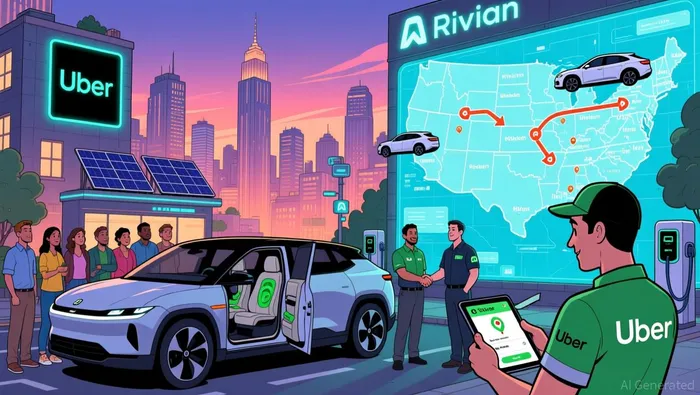
Financial Reality Check: Unprofitability vs. Exponential Bet
The partnership is a bold bet on the future, but the present financial reality is stark. Both companies are operating at a loss, and the market is pricing in significant risk. Rivian expects a massive adjusted EBITDA loss of $1.8 to $2.1 billion in 2026, a figure that underscores the immense cost of building autonomous technology. This isn't a surprise; the company has been unprofitable, with its first annual gross profit last year driven largely by software services while its core automotive business lost hundreds of millions. The Uber deal itself is a capital-intensive commitment, with the company pledging $1.25 billion to secure its future fleet.
Uber's stock performance reflects the market's skepticism. The stock is down roughly 9% this year and has fallen sharply since its last earnings report. This underperformance highlights the tension between its long-term platform vision and near-term profitability concerns. For all that, Uber's underlying business still generates substantial cash. The company produced $2.8 billion in free cash flow last quarter, a buffer that provides the financial flexibility to fund its $1.25 billion commitment to Rivian without jeopardizing its core operations.
| Total Trade | 15 |
| Winning Trades | 8 |
| Losing Trades | 7 |
| Win Rate | 53.33% |
| Average Hold Days | 9.6 |
| Max Consecutive Losses | 2 |
| Profit Loss Ratio | 1.06 |
| Avg Win Return | 4.85% |
| Avg Loss Return | 4.21% |
| Max Single Return | 9.58% |
| Max Single Loss Return | 7.19% |
The Adoption Curve: Catalysts, Risks, and What to Watch
The Uber-Rivian bet hinges on a single, critical question: when does the adoption curve for autonomous mobility finally steepen? The partnership has laid out a clear timeline, but the path from pilot to profit is fraught with technological and regulatory friction. The first deployments in San Francisco and Miami are slated for 2028, with a target to expand to 25 cities by 2031. This is the commercial ramp-up phase, where the paradigm shift from experimental testing to mainstream deployment is supposed to accelerate. The sector is indeed moving into that zone, with analysts noting the autonomous electric vehicle sector is poised to shift from experimental testing to mainstream commercial deployment this year.
The key catalyst here is a technological leap: the adoption of Vision-Language-Action (VLA) AI models. These systems are redefining autonomy by replacing costly, rule-based software with camera-and-video perception that can make real-time decisions. The impact is already visible, as recent improvements have shortened expected timelines for city launches across many fleets. For Uber and Rivian, embracing VLA could be the difference between a slow, capital-intensive build-out and a faster, more economical scaling. It could compress the path to profitability by reducing reliance on expensive hardware like LiDAR.


Yet, the timeline remains uncertain. Industry experts note that adoption timelines for autonomous vehicles have slipped by one to two years on average in recent surveys. Validation costs are high, and regulatory approval is a major hurdle in each new city. Waymo's lead is a stark reminder of the competition; the company has already scaled to 10 U.S. cities and aims for 27 by the end of 2026. Uber's strategy of being a distribution layer is smart, but it must execute faster than its rivals to capture market share before the curve flattens.
The bottom line is a race against time and cost. Watch for two things: first, the successful integration and deployment of VLA technology in the Rivian stack, which will determine if the 2028 launch is truly a commercial reality or another pilot. Second, monitor the pace of regulatory approvals in the target cities. If the partnership can leverage new AI to accelerate city launches while navigating the regulatory maze, it will be on track to capture the exponential growth of the autonomy S-curve. If not, the massive capital commitments and unprofitability may simply extend the build-out phase indefinitely.
Disclaimer: The content of this article solely reflects the author's opinion and does not represent the platform in any capacity. This article is not intended to serve as a reference for making investment decisions.
You may also like

BTC and gold divergence reflects split between retail and central banks: Analyst
Bitcoin’s Market Share Nears Key Support As CME Gap Unsettles Short-Term Outlook
March U.S. Manufacturing PMI Balances at 51.2: One Point Shift May Spark Dollar Turnaround or Treasury Rally
Trending news
MoreCrypto prices
More





