
White Cliff Minerals' Danvers drilling outcomes indicate significant copper prospects—however, the timeline continues to be a key uncertainty

Breakthrough Drilling Results at Danvers Expand Copper Resource
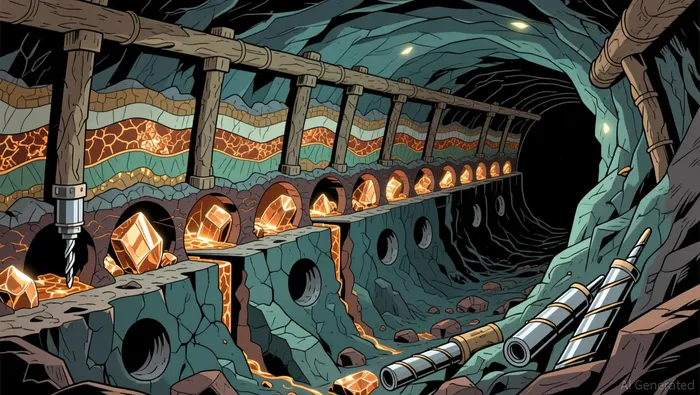
White Cliff Minerals has achieved a significant milestone at its Danvers site, with deep drilling efforts substantially increasing the known extent of the copper deposit. The latest drilling campaign has verified copper mineralisation extending over 60 metres beneath the previous deepest drill holes. Notably, one drill hole reached a depth of 188 metres and remains open, underscoring the effectiveness of the company's approach to exploring below historical boundaries.
The most impressive outcome comes from drillhole DAN25008, which intersected 175 metres at 2.5% copper and 8.66g/t silver from 7.6 metres, including a high-grade section of 14 metres at 7.55% copper and 25.8g/t silver from 138 metres. The drill hole ended in mineralisation, with the final 1.5 metres yielding 4.46% copper and 11.58g/t silver, indicating further potential at depth. This discovery also connects the Danvers area to the larger Stark target, following a basin-scale conductor stretching over 15 kilometres, highlighting the broader regional opportunity.
These technical achievements mark a turning point for Danvers, transforming it from a previously defined deposit into a system with clear potential for both vertical and lateral expansion. While this development greatly enhances the project's resource outlook, it will take years before it can influence the global copper market. The discovery demonstrates strong potential, but moving from exploration to production will require extensive resource modeling, feasibility assessments, regulatory approvals, and significant investment. For now, the results reinforce the project's long-term promise rather than offering an immediate boost to copper supply.
Global Copper Market: Challenges and Opportunities
While the Danvers find is a notable technical accomplishment, it is just one part of a much larger project and must be viewed within the context of a shifting global copper landscape. The Rae Copper Silver Project, which includes Danvers, covers around 2,000 square kilometres in a proven copper-producing region. Danvers is currently the most advanced discovery within this extensive landholding, but it remains at an early exploration stage. White Cliff Minerals plans to build on this momentum with a 2026 drilling program targeting an 8-kilometre strike length, a significant expansion from the 950 metres already outlined at Danvers. This ambitious campaign aims to systematically evaluate the district-scale potential revealed by recent deep drilling.
Absolute Momentum Long-only Strategy: Backtest Summary
- Entry Criteria: Enter when the 252-day rate of change is positive and the closing price is above the 200-day simple moving average (SMA).
- Exit Criteria: Exit when the closing price falls below the 200-day SMA, after 20 trading days, or if a take-profit of +8% or stop-loss of −4% is reached.
- Instrument: WCM
- Risk Controls: Take-profit at 8%, stop-loss at 4%, maximum holding period of 20 days.
- Total Return: 36.63%
- Annualized Return: 17.71%
- Maximum Drawdown: 13.73%
- Profit-Loss Ratio: 2.13
- Total Trades: 18
- Winning Trades: 8
- Losing Trades: 10
- Win Rate: 44.44%
- Average Hold Days: 9
- Max Consecutive Losses: 3
- Average Win Return: 9.36%
- Average Loss Return: 3.89%
- Max Single Return: 18.43%
- Max Single Loss Return: 6.21%
Strategic Location and Market Implications
One of the project's logistical strengths is its proximity to the deep-water port of Kugluktuk, located about 75 kilometres away. This advantageous location could help reduce both capital and operational expenses for any future mining operation, though it does not accelerate the overall development timeline.
In the broader context of the copper market, the Danvers discovery represents a long-term opportunity. The global copper industry is facing restricted supply growth, with new projects often delayed by regulatory, financial, and social challenges. Meanwhile, demand is being propelled by the ongoing transition to renewable energy, electric vehicles, and modernized power grids—all of which require substantial copper inputs. This dynamic is expected to maintain a supply-demand gap for years to come. While Danvers adds to a project with a 1,228 square kilometre land position, turning this potential into actual supply will require navigating a complex and lengthy development process. At present, the discovery strengthens the project's long-term outlook rather than serving as an immediate supply solution.
From Discovery to Production: Steps and Challenges Ahead
Although the technical progress at Danvers is a crucial first achievement, a series of important milestones must be reached before the discovery can impact global copper supply. The next immediate step is the release of the maiden JORC-compliant mineral resource estimate, which will provide an industry-standard assessment of the deposit's size and grade. White Cliff Minerals has indicated that new drilling results will be incorporated into this initial resource estimate, with the 2026 drilling campaign playing a pivotal role in this process.
The upcoming drilling program, targeting an 8-kilometre strike length, represents a major step forward from the currently defined area. Investors should monitor follow-up drilling at the Kiimala and Kopsa prospects, as well as the newly identified Danvers 2 zone, to determine whether the high-grade mineralisation seen so far continues over larger distances. Recent drilling has already shown consistent high-grade copper over more than 500 metres of strike, but the 2026 campaign will test the broader district potential.
Securing adequate funding remains a key operational challenge. As of the end of December 2025, the company reported a cash balance of approximately $5.85 million, after spending $3.26 million on exploration during the quarter. Advancing through further exploration, feasibility studies, and eventual mine development will require substantial additional capital. The company's ability to attract investment will depend on the strength of the upcoming resource estimate and the success of the 2026 drilling program. Without sufficient funding, the project's long-term progress could be at risk.
Overall, the development pathway involves a deliberate progression: from initial discovery and resource definition, through detailed feasibility work, to permitting and eventual construction. Each phase is essential and time-intensive. The Danvers discovery marks an exciting new phase for the Rae Project, but the transition from promising drill results to a producing mine will take years. For now, the focus remains on executing the technical and financial steps necessary to move from exploration success to a potential future contributor to global copper supply.
Disclaimer: The content of this article solely reflects the author's opinion and does not represent the platform in any capacity. This article is not intended to serve as a reference for making investment decisions.
You may also like
Smart Money Wagers Iran Tensions Are a Short-Lived Disruption, Not a Fundamental Shift in Oil Prices


Banque Syz loses founder’s son and crypto chief over Bitcoin strategy dispute
Trending news
MoreCrypto prices
More





