
Singular Health Insider Purchases $100K During Cash Drain and Widespread Sell-Offs—Savvy Investors Question Whether This Signals a Turnaround or a Final Exit

Insider Activity: A Lone Buy Amidst a Sea of Selling
Recently, a director made a $100,000 share purchase in July 2025. While this might seem noteworthy, it’s overshadowed by a history of insider selling and ongoing financial struggles at the company.
To understand the significance of this transaction, consider the broader context. In July 2023, the same director, Denning Chong, sold shares worth $100,000. Looking further back, 2008 saw major shareholders offload millions in stock. Although that was years ago, it established a pattern: insiders tend to cash out when the opportunity arises. Against this backdrop, the recent $100,000 buy is barely a blip compared to the long-standing trend of insider exits.
Financially, Singular Health is under significant pressure. The company is rapidly depleting its cash reserves. For the half-year ending December 2025, it posted a net loss of $2,970,106, with revenue only amounting to a few hundred thousand dollars. According to company disclosures, there is less than a year’s worth of cash left. In this context, a single director’s purchase does little to counteract the prevailing pattern of insider selling or to address the urgent need for capital.
In short, those with the most insight into the company’s prospects are not buying in. Instead, they appear to be waiting on the sidelines for clearer signs of a turnaround.
Financial Health: Equity Dependence and Market Skepticism
Singular Health’s financial statements reveal a company struggling to convert its growth ambitions into meaningful revenue, while heavily relying on equity to fund operations. This approach leaves insiders with limited personal financial exposure, and the market remains deeply cautious.
Revenue remains modest. For the half-year ending December 2025, total revenue was just $479,000, with $450,743 coming from the U.S.—a market the company views as a major opportunity. However, this income is negligible compared to the company’s losses, which approached $3 million for the same period.
To sustain its operations, Singular Health has leaned heavily on share-based compensation, recording $1,009,578 in such expenses in the last half-year alone. This substantial use of equity to pay staff dilutes existing shareholders and underscores the company’s dependence on stock rather than cash to attract and retain talent. While this aligns with a growth-focused narrative, it does little to create a stable, profitable business.
These financial realities are reflected in the share price, which trades at $0.2100—more than 50% below its 52-week high of $0.4200. This steep decline signals the market’s doubts about the company’s ability to move from minimal revenue to profitability. The stock’s volatility further highlights the perceived risks and uncertainty.
Ultimately, the company is burning through cash, compensating with equity, and generating revenue that falls far short of its losses. The director’s $100,000 purchase is largely symbolic and does not change the underlying financial picture. The market’s skepticism is clearly reflected in the share price.
Growth Prospects: Regulatory Progress and Market Potential
Singular Health’s growth ambitions rest on two main factors: regulatory approval and commercial expansion. The FDA’s 510(k) clearance for the 3DICOM platform, granted in January 2026, was a critical milestone for entering the U.S. market. However, regulatory approval alone does not guarantee sales—it is simply a necessary step.
The company’s first move toward commercialization is a partnership with a managed service organization network (PNS), which serves as the initial channel for scaling its platform. The first U.S. contract, valued at $1.3 million, is modest when compared to the estimated $16.5 billion total addressable market. While this contract marks progress, it is a small start from a very low revenue base.
This creates a familiar challenge: investors want to see whether these early milestones will translate into substantial revenue growth. So far, the company continues to burn cash, with a net loss of nearly $3 million for the half-year ending December 2025. The $1.3 million contract does little to bridge the gap or extend the company’s cash runway.
In summary, while regulatory and partnership milestones have been achieved, the financial impact remains limited. Insider sentiment, as reflected by a single director’s purchase amid ongoing selling and cash burn, suggests little confidence in near-term financial improvement. The market is factoring in the likelihood of a long, expensive journey to meaningful commercial scale, rather than expecting quick results.
Key Catalysts and Risks Ahead

The current situation is straightforward: the company has cleared regulatory hurdles and secured its first commercial contract, but it is rapidly consuming cash and has a limited runway. Investors are closely monitoring two things: whether the company can turn its growth story into real revenue, and whether insiders continue to sell shares.
The most immediate catalyst is execution. FDA approval and the $1.3 million PNS contract are only the beginning. The real test will be whether Singular Health can turn these initial steps into sustained, large-scale revenue. The company is aiming to expand across Puerto Rico, Florida, and Texas. Investors will be watching for additional contracts, signs of platform adoption, and accelerating revenue. Until then, the stock is priced for a slow and costly climb to commercial viability.
At the same time, insider transactions remain a crucial signal. While there was a single $100,000 director purchase in July 2025, this stands out as an exception in a broader pattern of selling. The company’s reliance on equity compensation continues to dilute shareholders. If insiders resume selling, especially among directors or executives, it would signal a lack of confidence from those closest to the company’s finances.
The most pressing risk is the company’s cash burn. With less than a year of cash remaining and a net loss nearing $3 million for the recent half-year, the $1.3 million contract is insufficient to close the gap. Additional funding will be required soon, likely through another equity raise—which would further dilute shareholders—or a strategic partnership. The market’s current valuation reflects the seriousness and immediacy of this risk.
In conclusion, investors are waiting for tangible evidence of revenue growth and watching insider activity for signs of confidence or retreat. Until there is clear progress, the outlook remains one of high risk and limited visibility.
Disclaimer: The content of this article solely reflects the author's opinion and does not represent the platform in any capacity. This article is not intended to serve as a reference for making investment decisions.
You may also like
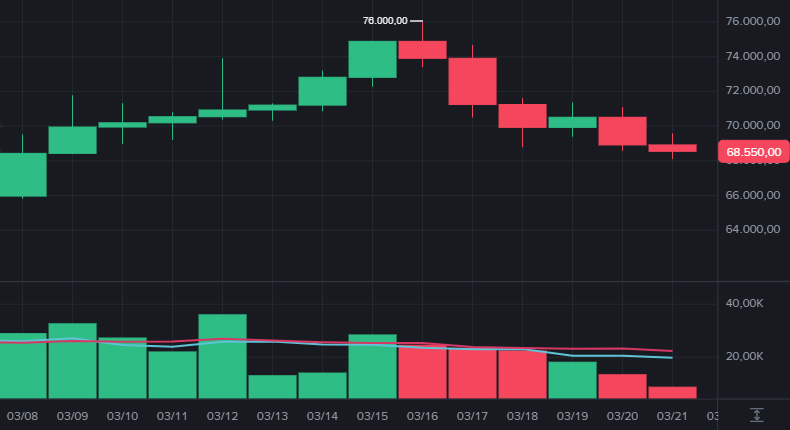
Bitcoin falls to $68 today amid tensions in the Middle East, putting pressure on altcoins.
Mt. Gox moves Bitcoin and reignites attention on payments.
Trending news
MoreCrypto prices
More





