
Nvidia’s limited A16 supply could delay the Feynman release until 2028—GTC 2026 will determine the outcome

Nvidia Faces Supply Chain Challenges Amid Feynman Chip Rumors
Investor attention is currently riveted on speculation surrounding Nvidia's upcoming Feynman chips, which are scheduled for release in 2028. Reports suggest that Nvidia is reworking the design due to insufficient access to TSMC's state-of-the-art A16 (1.6 nanometer) manufacturing process. As a workaround, the company plans to utilize the older N3P node for less critical components. This adjustment highlights a significant bottleneck in advanced chip production, raising questions about Nvidia's supply chain strength and its future product strategy.
These developments come at a time when Nvidia's stock (NVDA) has already been experiencing downward pressure, dropping 6% over the past four trading sessions amid broader market turbulence. The timing of the rumor is crucial, as it has sparked increased online searches and shifted investor sentiment. The real turning point is imminent: Nvidia's GPU Technology Conference (GTC) 2026 is set to begin soon, and CEO Jensen Huang's keynote is expected to address the Feynman redesign, the A16 supply issue, and provide clarity on the company's roadmap.
Search trends reveal heightened interest in "Nvidia Feynman A16 capacity," reflecting how the rumor has become a focal point for investors. The recent decline in Nvidia's share price has made the market more receptive to such news, creating a classic scenario where a pre-existing downtrend intersects with credible speculation about a future product. The Feynman chip redesign has become the centerpiece of today's market narrative.
Market Reaction and the GTC Conference
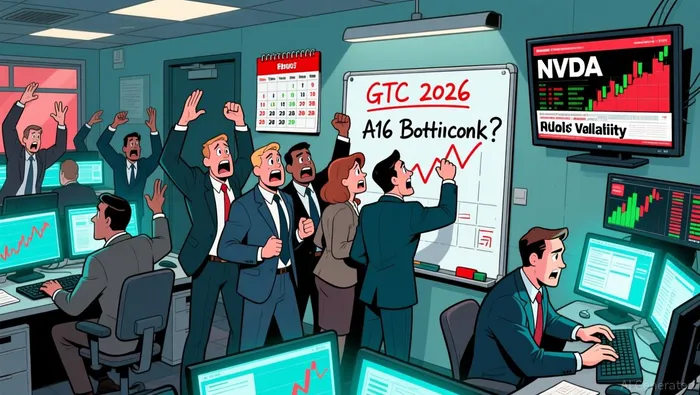
The rumor about the A16 bottleneck underscores Nvidia's vulnerability to competitive threats. Just last week, the stock plummeted 17% after DeepSeek, a Chinese startup, demonstrated it could train advanced AI models using fewer Nvidia chips. This event wiped out approximately $600 billion in market value, illustrating how quickly investor confidence can be shaken if Nvidia's perceived monopoly is challenged. Now, the A16 supply issue stands alongside competitive risks as a major concern, potentially leading to delays or performance compromises in the Feynman chip. This dual threat—competition and supply chain hiccups—poses a significant challenge for Nvidia's stock.
With GTC 2026 approaching, analysts and investors are eagerly awaiting updates that could either confirm or dispel concerns about the A16 crunch. Key topics include the roadmap for the next-generation Feynman system, details about an inference chip developed in partnership with Groq, and Nvidia's strategy for entering the CPU market. The conference will be the platform for Nvidia to address these issues and outline its vision for the future.
Nvidia's rapid pace of innovation serves as its main defense. The company has committed to launching a new GPU architecture annually, with LPU and CPU updates following a similar schedule. Even if the Feynman chip faces delays or relies on older technology, it remains part of a broader roadmap extending through 2028. The Vera Rubin platform is expected this year, Rubin Ultra in 2027, and Feynman in 2028. This steady cadence helps cushion the impact of any single setback, allowing investors to look forward to upcoming advancements. The critical question at GTC is whether Nvidia can reassure the market that its pipeline remains robust and that the A16 issue will not derail its long-term plans.

Key Announcements and What Investors Should Monitor
Nvidia is at the center of the current market drama, with the A16 supply rumor threatening its 2028 roadmap and competitive position. The recent stock decline highlights how sensitive the company is to any perceived weakness in its supply chain or product timeline. The most definitive answers will come after the GPU Technology Conference, when Nvidia's official statements either validate or dispel capacity concerns.
At GTC, investors should pay close attention to technical updates on 3D die-stacking and custom HBM memory solutions for the Feynman chips. Nvidia has already indicated these innovations are part of its strategy to maintain performance, even if some components use older manufacturing nodes. If the company can convincingly show that these advanced packaging techniques will offset any drawbacks from the node shift, it may ease investor worries. However, a lack of detail or signs of delay would likely exacerbate concerns.
The stock's movement following the conference will serve as the ultimate indicator. A positive reaction would suggest the market views the A16 issue as a manageable supply chain challenge, while continued volatility or declines would signal deeper worries. If Nvidia delivers a strong technical narrative, the rumor-driven anxiety may quickly dissipate. Conversely, a lackluster response could indicate that investor fears are more substantial than just a passing headline.
Disclaimer: The content of this article solely reflects the author's opinion and does not represent the platform in any capacity. This article is not intended to serve as a reference for making investment decisions.
You may also like
IMI Share Buybacks Signal Undervaluation as 20% Margin Engine Fuels Capital Return Play

TURB Surges 10% in Pre-Market with No Clear Catalyst


Bitcoin’s round-the-clock liquidity pool compared to the equity market’s selloff driven by geopolitical events

Trending news
MoreCrypto prices
More





