
Daikoku Denki's Digital Coupon Move: A Retention Play in a Priced-In Decline

Daikoku Denki has unveiled a new shareholder benefit program, offering digital gift coupons to long-term holders. The core mechanics are straightforward: shareholders who have held their shares for over a year receive additional coupons, which can be used as payment at any physical K's Denki store. The program is designed to be a low-cost engagement tool, with coupons usable only for merchandise and not for services or cash, and they cannot be exchanged for money or transferred.
This move fits squarely within a broader trend reshaping Japan's shareholder perk landscape. As the Tokyo Stock Exchange pushes for higher valuations and capital efficiency, companies are shifting from simple cash gifts to retention-focused digital perks. The goal is to build a more stable, long-term investor base while minimizing the cost of shareholder engagement. This evolution is a direct response to pressure from foreign institutional investors, who view traditional physical gifts as an inefficient use of capital.
For Daikoku Denki, the program is a classic example of a low-cost, high-visibility signal. The digital coupons are a minimal financial outlay for the company, but they provide a tangible benefit that can strengthen the relationship with its existing shareholders.  The key constraint-coupons are usable only at physical stores and not for services or cash-further limits the program's cost and scope. This is not a fundamental business transformation; it is a targeted communication tool.
The market's negative expectations for the core business remain firmly priced in. In this context, the new program does not materially alter the investment thesis. It is a retention tactic, not a catalyst. The real question for investors is whether this kind of engagement can help stabilize the stock's price in the face of broader headwinds, or if it is simply a cosmetic layer over deeper challenges.
Expectations vs. Reality: The Core Business Context
The market's expectations for Daikoku Denki are set by a harsh reality: the company operates in a niche, regulated industry facing long-term structural headwinds. Its core business is the development and sale of computer systems and machines for pachinko and pachislot parlors, a sector widely viewed as in secular decline. The catalyst for this pressure is Japan's planned legalization of integrated resorts, which is expected to draw customers and revenue away from traditional pachinko halls starting around 2029-2030. As one analyst notes, the "current opportunity" in pachinko lies not in stabilization, but in managing a likely continued decline.
This bleak outlook is fully priced into the stock. Daikoku Denki trades at a P/E ratio of 5.49 and offers a forward dividend yield of 4.14%. These metrics signal a market that assigns minimal growth expectations to the business. The stock is also trading near its 52-week low of 2,072 JPY, with the current price of 2,377 JPY still well below its recent highs. This price action confirms that investor focus remains squarely on the core business's challenges, not on shareholder perks.
| Total Trade | 13 |
| Winning Trades | 6 |
| Losing Trades | 7 |
| Win Rate | 46.15% |
| Average Hold Days | 8.54 |
| Max Consecutive Losses | 5 |
| Profit Loss Ratio | 1.42 |
| Avg Win Return | 2.7% |
| Avg Loss Return | 1.82% |
| Max Single Return | 5.34% |
| Max Single Loss Return | 3.65% |
Valuation and Catalysts: What to Watch
The digital gift program is a minor cost in a priced-in environment. The real investment thesis hinges on the company's ability to navigate its industry's structural shift and maintain profitability. For now, the program is a distraction from the core business, not a catalyst.
The next earnings report, scheduled for May 20, 2026, is the key catalyst to watch. It will be the first major data point to assess if the core business is meeting expectations amid the long-term decline. The market's consensus is already low, with the stock trading near its 52-week low. Any deviation from that low bar-whether a beat or a miss-will move the needle more than a new perk program.
Financially, the company shows signs of resilience. It reported net income of 2.04 billion JPY for the last quarter, and maintains a strong EBITDA margin of 24.31%. This suggests the business can generate solid cash flow even as the industry contracts. The primary risk is that the program distracts management and investor focus from the more pressing need to manage this decline profitably. The opportunity, however, is that in a low-growth, low-expectation environment, even a marginal improvement in shareholder retention could provide a slight support to the stock's price floor.
Viewed through the broader trend of shareholder perk evolution, Daikoku Denki's move is a logical adaptation. As the Tokyo Stock Exchange pushes for capital efficiency, companies are replacing costly physical gifts with digital, retention-focused tools. This shift is a response to pressure from foreign institutional investors who see traditional perks as inefficient. For Daikoku Denki, the program fits this new model: a low-cost signal that aligns with the broader industry's move toward digital transformation and continuous holding requirements.
The bottom line is that the digital gift is a signal, not a solution. The real drivers for the stock are the company's financial health and its execution in a niche, declining industry. Investors should watch the May earnings report for confirmation that the core business is holding up, not for signs of a new growth story.
Disclaimer: The content of this article solely reflects the author's opinion and does not represent the platform in any capacity. This article is not intended to serve as a reference for making investment decisions.
You may also like
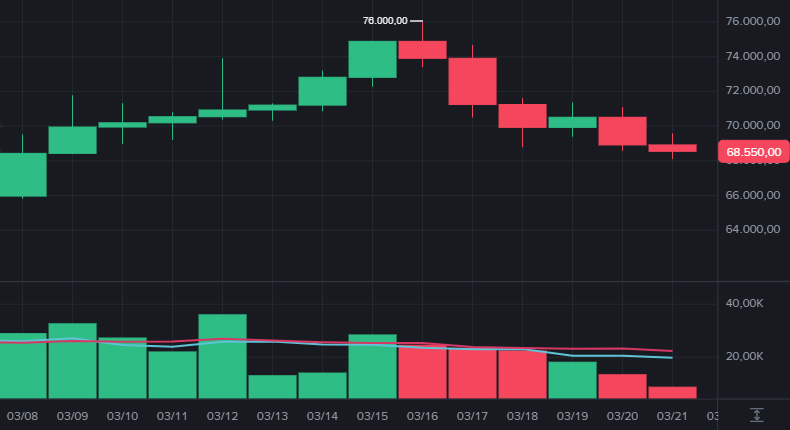
Bitcoin falls to $68 today amid tensions in the Middle East, putting pressure on altcoins.
Mt. Gox moves Bitcoin and reignites attention on payments.
Trending news
MoreCrypto prices
More





