
MicroStrategy Purchases $1.28 Billion in Bitcoin: An Examination of Fund Movement

MicroStrategy’s Bold Bitcoin Accumulation Plan
MicroStrategy recently secured $1.28 billion through a combination of STRC perpetual preferred shares and common stock sales, using these funds to purchase 17,994 BTC. This marks their second-largest acquisition this year, with an average purchase price close to $71,000 per Bitcoin. The move is part of a larger, ongoing strategy to amass a total of 1 million BTC by the end of 2026. Achieving this goal would require raising an additional $22 billion, translating to a steady weekly acquisition rate of about 6,158 BTC.
Stock Performance Diverges from Ambitious Strategy
Despite these aggressive Bitcoin purchases, MSTR shares have experienced significant downward pressure. Over the past 120 days, the stock has dropped by 56.11%, and it remains 10.72% lower year-to-date. This has resulted in a notable valuation gap, with the stock trading at approximately a 74% discount to some intrinsic value estimates that place fair value near $663 per share, based on the company’s treasury expansion plan.
The company’s approach involves channeling capital into Bitcoin, while the equity used to finance these purchases is being heavily discounted. MicroStrategy’s strategy depends on its stock trading at a premium to its net asset value, enabling cost-effective equity issuance to fund further Bitcoin buys. However, as the stock price falls, this premium diminishes, making it more expensive to raise capital and complicating the path to their accumulation target.
Stock and Treasury: Price Dynamics
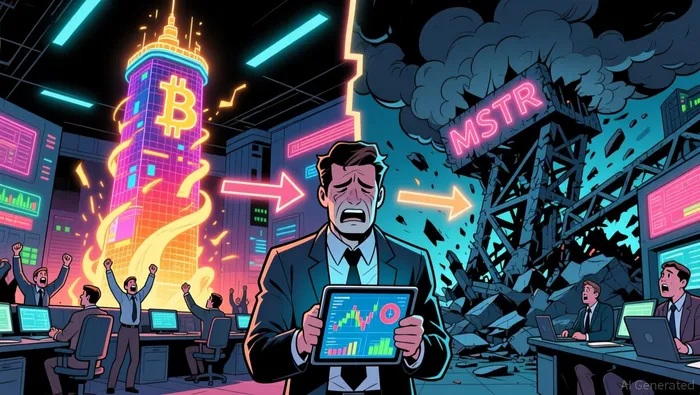
MicroStrategy’s share price now moves in lockstep with Bitcoin’s volatility, exhibiting 4.14% daily price swings and a 9.1% turnover rate. This tight connection means that declines in the value of the company’s Bitcoin holdings directly impact its equity. For example, a $12.4 billion net loss in Q4 2025 was directly tied to Bitcoin’s price drop, with unrealized losses on the treasury currently around $5.5 billion.
This dynamic creates a challenging cycle: as the company continues to buy more Bitcoin, its stock price suffers due to the paper losses on its holdings. The market penalizes the stock for these unrealized losses, even as the company’s strategy is to accumulate more BTC. This situation is a reversal of the typical “buy the rumor, sell the news” pattern, with the market reacting negatively to the very accumulation that is meant to drive future value.
Ultimately, the stock’s steep discount to estimated intrinsic value persists, even as Bitcoin holdings increase. This discount raises the cost of future capital raises, as the equity premium that funds these purchases erodes. The market appears to be treating the treasury’s losses as permanent, rather than temporary fluctuations.
Key Drivers: Funding and Bitcoin’s Trajectory
The success of MicroStrategy’s plan depends on two interconnected factors. First, the company must consistently secure $523 million in new capital each week to maintain its targeted pace of 6,158 BTC purchases. This is an ongoing requirement, not a one-time event. The recent $1.28 billion acquisition was financed through a mix of $900 million in common stock and $377 million in STRC preferred shares, highlighting the reliance on equity issuance. Any disruption in this funding—whether due to a deeper stock discount or waning investor interest—would immediately slow the accumulation process.
The second critical factor is Bitcoin’s price movement. The company’s unrealized losses, currently around $5.5 billion, fluctuate with the market and remain a significant concern. For these losses to diminish and for the treasury’s value to approach its average acquisition cost of roughly $76,000 per BTC, Bitcoin’s price must recover and sustain levels above that threshold. A strong price recovery would not only improve the company’s balance sheet but also help restore the MSTR share premium, making future capital raises less costly and the overall strategy more viable.
Investors should watch for signs of funding pressure. Any change in Michael Saylor’s steadfast “buy forever” approach would be a significant warning. More immediately, monitoring the volume and pricing of STRC share issuances—the company’s main fundraising tool—is crucial. The recent record daily issuance of 2.4 million STRC shares indicates the funding engine is still running, but any slowdown or the need for larger discounts to attract buyers would signal increasing challenges in the capital markets. In essence, MicroStrategy is racing both to accumulate the remaining 371,100 BTC and to maintain investor confidence to keep the funding pipeline open.
Disclaimer: The content of this article solely reflects the author's opinion and does not represent the platform in any capacity. This article is not intended to serve as a reference for making investment decisions.
You may also like
FUEL (FuelNetwork) fluctuated 40.9% in 24 hours: Low liquidity and amplified trading effects are the main drivers
ELIZAOS fluctuates 55.2% in 24 hours: CoinDCX listing and rebranding drive price rebound
ARIA (Aria.AI) sees 67.3% volatility in 24 hours: Surge in trading volume triggers sharp price fluctuations
Trending news
MoreCrypto prices
More





