
Orbán's Fidesz Encounters Geopolitical Pressure as Kremlin Influence Poses Risks to Election Fairness

Hungary's Election: Geopolitics Take Center Stage
Hungary is heading into a pivotal election, with international influences playing a significant role in shaping the campaign. For investors, the key issue is whether Hungary’s close ties with Russia will be accepted by the market or prompt a wave of risk aversion.
The controversy began with serious allegations of intelligence leaks. An investigation by the Washington Post claims that Foreign Minister Péter Szijjártó has, for years, shared confidential EU Council information with his Russian counterpart. Poland’s Prime Minister Donald Tusk responded that these revelations were unsurprising and now makes him more cautious in EU discussions. This alleged backchannel points to a sustained and deep connection between Budapest and Moscow.
Tensions have escalated further. The Washington Post also reported that Russia’s Foreign Intelligence Service (SVR) had suggested orchestrating an “assassination attempt” on Prime Minister Viktor Orbán. This operation, code-named “gamechanger,” aimed to shift the election debate from economic issues to national security, dramatically altering the campaign’s tone. Although no attack took place, the plan highlights the Kremlin’s vested interest in Orbán’s political future.
Adding to the turmoil, opposition leader Péter Magyar has accused Russia of bankrolling a disinformation campaign. He claims the Kremlin is behind 14 AI-generated attack videos targeting his Tisza party’s candidates, aiming to force them out of the April 12 race. This represents a modern, scalable form of election meddling, designed to create confusion and undermine opponents before voters head to the polls.
These developments reveal a clear pattern: Moscow is leveraging intelligence leaks, threats, and digital manipulation to influence the outcome in Orbán’s favor. As the election approaches, the market’s willingness to tolerate this alignment will be put to the test.
Economic Strength Versus Geopolitical Uncertainty
Investors are caught between two competing narratives. On one hand, economic indicators suggest Hungary’s recovery is gaining traction. On the other, the political backdrop is becoming increasingly unstable. The interplay between these forces will shape market sentiment in the weeks ahead.
Recent economic data provides some reassurance. In January, retail sales rose by 3.5% compared to the previous year, reflecting solid consumer demand. Industrial output also returned to growth, up 0.3% year-on-year after a period of contraction—potentially signaling a turnaround for manufacturing. Hungary’s fiscal position remains relatively robust, with government debt at 76.2% of GDP, lower than many EU countries and providing some policy flexibility.
Sample Trading Strategy: Long-Only Bollinger Bands
- Enter a long position on the BUX index when the price closes above the 20-day upper Bollinger Band.
- Exit the position if the price closes below the 20-day lower Bollinger Band, after 15 trading days, or if a 10% profit or 5% loss is reached.
Backtest Highlights
- Strategy Return: 0.33%
- Annualized Return: 0.38%
- Maximum Drawdown: 11.15%
- Profit-Loss Ratio: 1.28
- Total Trades: 9
- Winning Trades: 4
- Losing Trades: 5
- Win Rate: 44.44%
- Average Hold Days: 13.56
- Max Consecutive Losses: 2
- Average Win Return: 3.79%
- Average Loss Return: 2.84%
- Largest Single Gain: 6.43%
- Largest Single Loss: 5.74%
Despite these positive fundamentals, market behavior tells a different story. Hungary’s main stock index, the BUX, reached a record high of 133,631 in February, but has since dropped 3.9% over the past month. This pullback suggests that investors are increasingly concerned about political risks, which are beginning to overshadow economic resilience. The swift change in sentiment highlights how quickly markets can react when the political climate deteriorates.
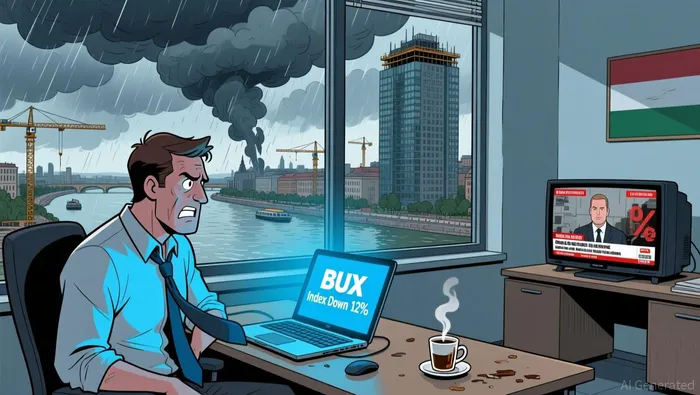
This dynamic creates a delicate balance. While Hungary’s economic fundamentals act as a buffer against a severe financial crisis, the real threats are political and strategic. If the government’s fate appears tied to foreign interests, market patience may run out. The recent decline in the BUX indicates that investors are starting to factor in these risks, even as the economy remains stable. In short, economic strength may delay market fallout, but it cannot prevent it if political uncertainty persists.
Possible Market Outcomes: Win, Loss, or Deadlock
The direction of Hungarian assets will depend on the outcome of the April 12 election, which remains highly competitive. Current polls show the opposition Tisza Party leading with 48% support, compared to 39% for Viktor Orbán’s Fidesz party. This narrow margin sets the stage for heightened volatility, as investors gauge the market’s appetite for ongoing geopolitical risk.
If Fidesz prevails, the market is likely to interpret this as a continuation of the current pro-Russia stance. The established pattern of intelligence cooperation and alignment would probably persist, providing a degree of predictability. Investors would focus on domestic policy and economic management, with geopolitical risks seen as manageable and already priced in.
A victory for the Tisza Party, however, would mark a dramatic shift in Hungary’s relationship with the EU. Péter Magyar’s party has promised to restore frozen EU funds and improve public services, signaling a break from Orbán’s confrontational approach. This could prompt a reassessment of Hungary’s strategic position within the EU. Markets would need to weigh the prospects for renewed fiscal support against the uncertainty of a new government. The likely result would be a period of adjustment, as investors recalibrate Hungary’s risk profile and future access to EU resources.
However, the election process itself introduces significant unpredictability. Reports of Russian sabotage plans—including the alleged assassination plot and disinformation campaign—threaten to undermine the legitimacy of the vote, regardless of the outcome. If these actions are confirmed, they would demonstrate a determination by the Kremlin to keep Orbán in power at any cost. This could destabilize the political environment, making it difficult for markets to find clarity. The central question becomes not just who wins, but whether the electoral process can deliver a trustworthy result.
Key Events and Signals to Watch
Several upcoming events will shape market expectations. The most important is the April 12 election itself. While the official results will be decisive, exit polls released immediately after voting ends will offer the first clues about the outcome. Given the close race, even a slight lead for the Tisza Party could prompt a rapid reassessment of Hungary’s geopolitical risk.
The BUX index’s response on election day will be a crucial indicator. The index has already retreated 3.9% from its February peak amid rising political tensions. A Fidesz win would likely spark a relief rally, signaling continuity. In contrast, a Tisza victory would probably lead to increased volatility, as investors digest the prospect of policy changes and greater uncertainty. Statements from Brussels or Moscow in the aftermath could further influence market reactions.
Beyond the election, attention will turn to official responses to the Washington Post’s allegations. The claims of intelligence leaks and disinformation are serious, but not yet proven. The key question is whether the European Commission or Hungarian authorities launch credible investigations. If the allegations are substantiated, confidence in Hungary’s political process and strategic reliability could be further eroded. A dismissive response from Budapest might calm markets temporarily, but would not resolve underlying concerns about foreign interference. Ultimately, the market’s tolerance for geopolitical risk is limited, and official reactions will determine whether these issues become a passing controversy or a lasting challenge to Hungary’s credibility.
Disclaimer: The content of this article solely reflects the author's opinion and does not represent the platform in any capacity. This article is not intended to serve as a reference for making investment decisions.
You may also like
BC-Soybean Futures
BC-Sugar Futures
BC-Merc Table
Trending news
MoreCrypto prices
More





